Mexican Peso plummets more than 4% in the aftermath of Morena’s victory

Most recent article: Mexican Peso falls over 4% after landslide victory for left
- Mexican Peso falls sharply after Dr. Claudia Sheinbaum’s victory and Morena’s majority in Congress.
- Concerns rise over potential constitutional changes and market stability, impacting investor sentiment toward the Peso.
- Sheinbaum pledges to maintain financial discipline and Bank of Mexico autonomy, but market remains wary.
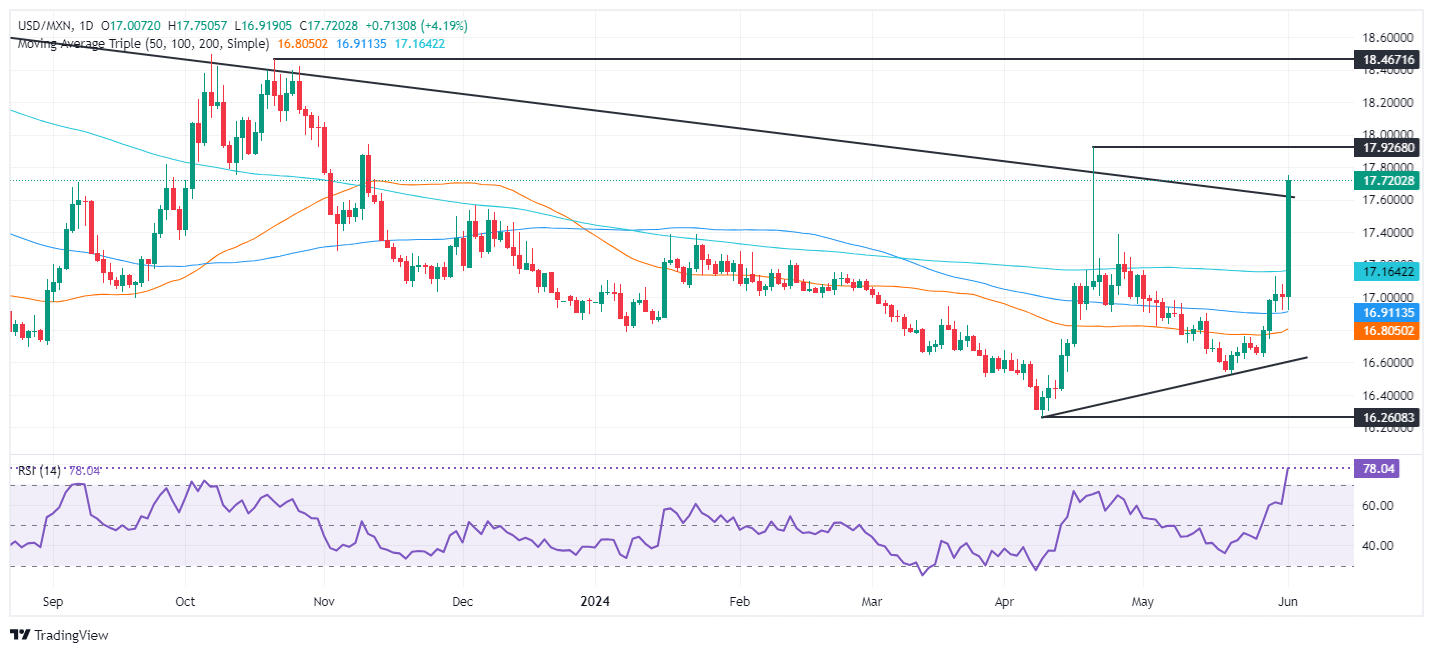
The Mexican Peso plunges against the US Dollar during the North American session following Dr. Claudia Sheinbaum’s overwhelming victory in Mexico’s presidential election. Additionally, her party, Morena, won the majority of the Mexican Congress, opening the door to change the Mexican Constitution, which was seen by investors as a threat to the status quo. The USD/MXN trades at 17.70, with more than 4.20% losses.
The Mexican Peso began its landslide after the Instituto Nacional Electoral (INE) revealed Sheinbaum’s party, Morena, would have the majority in both houses of the legislature. This opens the door to making structural changes that involve reforming the judicial system, which could be greatly influenced by the president.
Following the INE announcement, Sheinbaum compromised to continue the current plant from President Andres Manuel Lopez Obrador’s (AMLO) government. She pledged to maintain financial discipline and emphasized the autonomy of the Bank of Mexico.
Sheinbaum added, “There wouldn’t be real increases to fuels or electricity,” populist promises previously made by AMLO.
Analysts via Reuters commented that a Morena-led congress could be reluctant to “approve the necessary reforms to adopt the measures required to attract investment,” which could leverage the nearshoring opportunity, said Alberto Ramos of Goldman Sachs.
Most analysts were expecting Sheinbaum’s victory but not the overwhelming result in the Mexican Congress.
Andres Abadia of Pantheon Macroeconomics added, “The potentially qualified majority could open the door for (her party) Morena to increase the concentration of power and pose a threat to institutional checks and balances.”
Lastly, Chris Turner of ING added, "The question is whether the Morena party has done so well that it could command a super-majority and try to pursue market non-friendly policies of constitutional reform.”
Daily digest market movers: Mexican Peso remains offered on investors' fears
- Monday’s economic docket in Mexico featured Business Confidence and Foreign Reserves.
- Mexico’s Business Confidence in May worsened compared to April’s, drifting from 54.1 to 53.7.
- Mexico’s Foreign Reserves increased from $220 billion to $221 billion in April, revealed Banxico.
- September would be the crucial month for the Mexican Congress. Morena’s majority could push bills blocked by the opposition, including the reduction of lawmakers and plans for direct election of the Supreme Court members.
- Morgan Stanley noted that if Mexico’s upcoming government and Congress adopted an unorthodox agenda, it would undermine Mexican institutions and be bearish for the Mexican Peso, which could weaken to 19.20.
- That and speculation of another Banxico rate cut in June could pave the way for further upside in the USD/MXN.
- US manufacturing PMIs in May were mixed, as revealed by the Institute for Supply Management (ISM) and S&P Global.
- The US ISM Manufacturing PMI was worse than expected in May, coming at 48.7, down from 49.2 and below estimates of 49.6. Contrarily, the S&P Global Manufacturing PMI expanded by 51.3, up from 50 and exceeding estimates of 50.9.
- The futures markets suggest the Federal Reserve might cut rates by 31 basis points in 2024, according to December’s 2024 fed funds future rate contract.
Technical analysis: Mexican Peso depreciates as USD/MXN rallies above 17.50
The USD/MXN downtrend begins to be threatened due to political uncertainty. That has lifted the exchange rate above the 200-day Simple Moving Average (SMA) of 17.15, opening the door to push the spot prices toward a one-month high of 17.73.
Momentum has shifted strongly in favor of buyers as communicated by the Relative Strength Index (RSI), which has skyrocketed and crushed the 70 overbought level.
That said, if the USD/MXN clears the psychological 18.00 figure, up next would be the year-to-date (YTD) high of 18.15. Further gains are seen above the latter, on October 6, 2023, at a high of 18.48, before the exotic pair trends up toward the 19.00 figure.
On the downside, if sellers push the exchange rate below the 17.00 figure, that could pave the way to test the year-to-date (YTD) low of 16.25.
Mexican Peso FAQs
The Mexican Peso (MXN) is the most traded currency among its Latin American peers. Its value is broadly determined by the performance of the Mexican economy, the country’s central bank’s policy, the amount of foreign investment in the country and even the levels of remittances sent by Mexicans who live abroad, particularly in the United States. Geopolitical trends can also move MXN: for example, the process of nearshoring – or the decision by some firms to relocate manufacturing capacity and supply chains closer to their home countries – is also seen as a catalyst for the Mexican currency as the country is considered a key manufacturing hub in the American continent. Another catalyst for MXN is Oil prices as Mexico is a key exporter of the commodity.
The main objective of Mexico’s central bank, also known as Banxico, is to maintain inflation at low and stable levels (at or close to its target of 3%, the midpoint in a tolerance band of between 2% and 4%). To this end, the bank sets an appropriate level of interest rates. When inflation is too high, Banxico will attempt to tame it by raising interest rates, making it more expensive for households and businesses to borrow money, thus cooling demand and the overall economy. Higher interest rates are generally positive for the Mexican Peso (MXN) as they lead to higher yields, making the country a more attractive place for investors. On the contrary, lower interest rates tend to weaken MXN.
Macroeconomic data releases are key to assess the state of the economy and can have an impact on the Mexican Peso (MXN) valuation. A strong Mexican economy, based on high economic growth, low unemployment and high confidence is good for MXN. Not only does it attract more foreign investment but it may encourage the Bank of Mexico (Banxico) to increase interest rates, particularly if this strength comes together with elevated inflation. However, if economic data is weak, MXN is likely to depreciate.
As an emerging-market currency, the Mexican Peso (MXN) tends to strive during risk-on periods, or when investors perceive that broader market risks are low and thus are eager to engage with investments that carry a higher risk. Conversely, MXN tends to weaken at times of market turbulence or economic uncertainty as investors tend to sell higher-risk assets and flee to the more-stable safe havens.
Author

Christian Borjon Valencia
FXStreet
Markets analyst, news editor, and trading instructor with over 14 years of experience across FX, commodities, US equity indices, and global macro markets.

















