Mexican Peso hits a ceiling on global trade concerns

Most recent article: Mexican Peso falls further against US Dollar amid diverging central bank stances
- The Mexican Peso pulls back after its recent run of gains on the back of fears of global trade becoming fragmented.
- US Dollar recovers against the Peso after data shows the Fed is likely to kick the can of lowering interest rates further down the road.
- USD/MXN stalls in its short-term downtrend, but more downside is still foreseen.
The Mexican Peso (MXN) meets resistance in its upwards climb on Tuesday possibly due to growing concerns about the fragmentation of international trade that could especially hit export-based emerging-market economies like Mexico.
Against the US Dollar (USD) MXN seasaws between tepid gains and losses after US data showed heightened US inflation expectations, which are likely to keep interest rates in the US elevated for some time, increasing capital inflows to the Dollar.
USD/MXN is exchanging hands at 16.77, EUR/MXN at 18.11 and GBP/MXN at 21.05, at the time of publication.
Mexican Peso loses upside momentum on geopolitical concerns
The Mexican Peso hit a ceiling on Monday after the International Monetary Fund (IMF) warned global economic growth might lose momentum due to a fragmentation of international trade along geopolitical lines.
In a speech at Stanford Institute for Economic Policy Research, IMF First Deputy Managing Director Gita Gopinath, said: “Countries are reevaluating their trading partners based on economic and national security concerns,” adding that if the trend continued, “we could see a broad retreat from global rules of engagement and, with it, a significant reversal of the gains from economic integration.”
The news comes after the US plans to impose further protectionist policies by quadrupling tariffs on Chinese electric vehicles and BRICS countries continued to erode the hegemony of the US Dollar.
At the start of May, India and Nigeria, for example, agreed to settle all their trade using their domestic currencies rather than the US Dollar. This follows similar agreements between other nations, especially China, Russia and Iran, designed to circumvent Western sanctions.
USD/MXN recovers on elevated US inflation expectations
The US Dollar gained in most pairs, including versus the Mexican Peso, after data from the Reserve Bank of New York showed a rise in inflation expectations which reinforced the inflationary outlook presented in Friday’s Michigan sentiment survey.
The NY Survey of Consumer Expectations showed consumer inflation expectations for one year ahead increased to 3.3% in April, from 3.0% in March – and the three previous months. It was the highest level since November and stands well above the Federal Reserve’s 2.0% target.
The data further reduces the chance of the Fed moving to cut interest rates in the near future, which is positive for the USD since an expectation of higher interest rates increases foreign capital inflows.
Technical Analysis: USD/MXN pulls back in a downtrend
USD/MXN – the value of one US Dollar in Mexican Pesos – has pulled back after decisively breaking below the bottom of a short-term range last week.
The breakout of the range was a decisive technical development that suggests a protracted move lower. However, after falling to a new low of 16.72 on Friday, USD/MXN reversed and started recovering.
USD/MXN 4-hour Chart
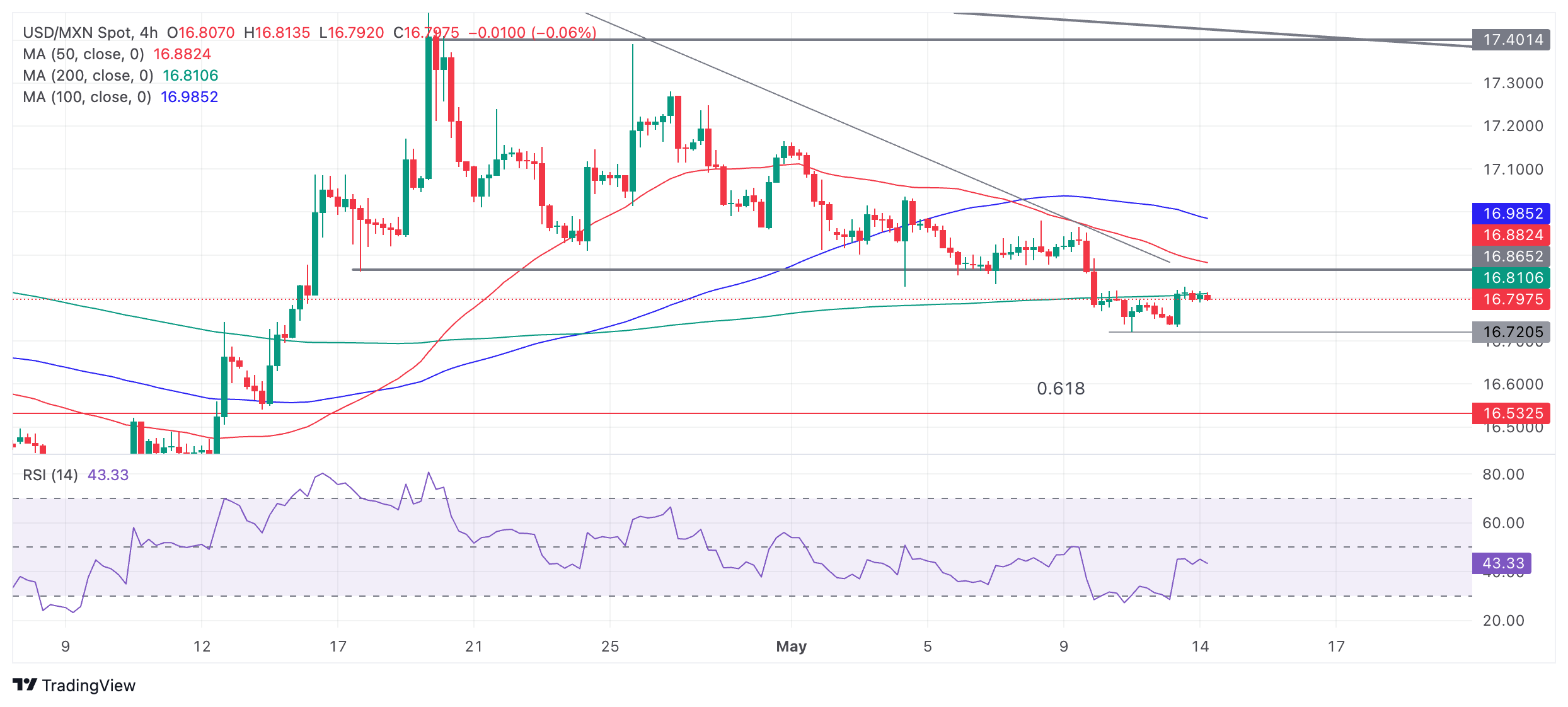
The recovery is not yet strong enough to negate the bearish implications of the breakdown from the range. The short-term trend is still probably bearish, which, given the old adage that the “trend is your friend”, suggests the odds continue favoring more downside.
The pair is still probably likely to resume its downtrend and hit the conservative target for the breakout at 16.54. This is the 0.681 Fibonacci ratio of the height of the range extrapolated lower. Further bearishness after that could reach 16.34, the full height of the range extrapolated lower.
A break below 16.72 would confirm a continuation south.
Given the medium and long-term trends are bearish, the odds further favor more downside for the pair in line with those trends.
Mexican Peso FAQs
The Mexican Peso (MXN) is the most traded currency among its Latin American peers. Its value is broadly determined by the performance of the Mexican economy, the country’s central bank’s policy, the amount of foreign investment in the country and even the levels of remittances sent by Mexicans who live abroad, particularly in the United States. Geopolitical trends can also move MXN: for example, the process of nearshoring – or the decision by some firms to relocate manufacturing capacity and supply chains closer to their home countries – is also seen as a catalyst for the Mexican currency as the country is considered a key manufacturing hub in the American continent. Another catalyst for MXN is Oil prices as Mexico is a key exporter of the commodity.
The main objective of Mexico’s central bank, also known as Banxico, is to maintain inflation at low and stable levels (at or close to its target of 3%, the midpoint in a tolerance band of between 2% and 4%). To this end, the bank sets an appropriate level of interest rates. When inflation is too high, Banxico will attempt to tame it by raising interest rates, making it more expensive for households and businesses to borrow money, thus cooling demand and the overall economy. Higher interest rates are generally positive for the Mexican Peso (MXN) as they lead to higher yields, making the country a more attractive place for investors. On the contrary, lower interest rates tend to weaken MXN.
Macroeconomic data releases are key to assess the state of the economy and can have an impact on the Mexican Peso (MXN) valuation. A strong Mexican economy, based on high economic growth, low unemployment and high confidence is good for MXN. Not only does it attract more foreign investment but it may encourage the Bank of Mexico (Banxico) to increase interest rates, particularly if this strength comes together with elevated inflation. However, if economic data is weak, MXN is likely to depreciate.
As an emerging-market currency, the Mexican Peso (MXN) tends to strive during risk-on periods, or when investors perceive that broader market risks are low and thus are eager to engage with investments that carry a higher risk. Conversely, MXN tends to weaken at times of market turbulence or economic uncertainty as investors tend to sell higher-risk assets and flee to the more-stable safe havens.
Author

Joaquin Monfort
FXStreet
Joaquin Monfort is a financial writer and analyst with over 10 years experience writing about financial markets and alt data. He holds a degree in Anthropology from London University and a Diploma in Technical analysis.