Mexican Peso extends losses for third day in a row amid tariff fears
- The Mexican Peso depreciates amid uncertainty over the future of trade with the US and the likely imposition of tariffs.
- The threat of mass deportation of Mexican immigrants could further hit remittance flows and demand for MXN.
- USD/MXN rebounds from the bottom of a rising channel, and looks poised to resume its established uptrend.

The Mexican Peso (MXN) depreciates in its main pairs as it continues its run of weakness into the third day on Tuesday. Investor fears about the impact of President-elect Donald Trump’s policy agenda on the Mexican economy are a major factor in the Peso’s depreciation, as are expectations that the Bank of Mexico (Banxico) will forge ahead with a quarter percent interest rate cut at its meeting on Thursday and, more generally, a stronger US Dollar (USD).
Mexican Peso declines on uncertainty regarding Trump policies towards Mexico
The Mexican Peso weakens as markets digest the implications of Trump’s proposed policy agenda on the Mexican economy, including the outlook for trade relations between the two nations, issues surrounding migration, the war on drugs and the radical constitutional changes to the judiciary pushed through by Mexico’s Morena-led governing coalition.
The two countries (and Canada) have an existing free trade deal, the United States-Mexico-Canada Trade Agreement (USMCA) which is in place until 2026. However, Mexico’s recent changes to its constitution, such as the controversial reform to the judiciary that will make judges elected by popular vote rather than appointed, contravene the agreement. This could give Trump the opportunity to press for an immediate renegotiation, according to El Financiero.
On Friday, the Peso weakened almost 2.0% in a day after the Financial Times reported that Donald Trump had offered Washington lawyer Robert Lighthizer the job of US trade chief. Although the rumors were later contradicted by Reuters, who quoted a source in the White House as saying they were “untrue,” the possibility the known protectionist hawk could get the job was another risk for MXN.
The Mexican Peso is likely to further weaken as it looks as if Trump is going ahead with his pledge to deport millions of illegal migrants, many of whom are likely Mexican. Trump has already picked immigration hardliner Tom Homan as “Border Tzar” to spearhead the mass deportations.
Such a policy could affect the many Mexican workers who illegally work in the US black economy and send substantial remittances back home to their families in Mexico. This, in turn, would reduce aggregate demand for the Peso. In addition, the influx of illegal immigrants sent back to Mexico could create a supply shock, which could lead the Banxico to cut Mexican interest rates more aggressively, reducing foreign capital inflows and causing the Peso to weaken further.
The increasing likelihood that the Republican party will win a majority in the US Congress, allowing them free reign to implement Trump’s radical policies, might also impact MXN. The final seats are still being called, but as things stand the Republican party has won 214 to the Democratic party’s 205 seats, with only 16 outstanding, according to the Associated Press. The threshold for a majority is 218.
According to forecasts by El Financiero, a Republican majority in Congress with Trump as President could lead the Peso to weaken even further against the USD. They estimate a band of between 21.14 and 22.26 for USD/MXN in such a scenario.
If the Republicans fail to win a majority in Congress, however, the pair is likely to end up in a range between 19.70 and 21.14, says El Financiero.
The Peso could see volatility later in the week when the Bank of Mexico (Banxico) meets on Thursday for its November policy meeting. Although recent headline inflation data came out higher than expected, core inflation fell to 3.80% YoY in October, from 3.91% previously, bringing it closer to Banxico’s 3.0% target. Experts see a good chance of Banxico cutting the bank rate by 0.25% to 10.25% on Thursday. Such a move would be negative for the Peso since lower interest rates attract lower foreign capital inflows.
Technical Analysis: USD/MXN rebounds from base of channel
USD/MXN recovers from the bottom of its rising channel and starts to extend higher in line with the broader uptrend.
USD/MXN 4-hour Chart
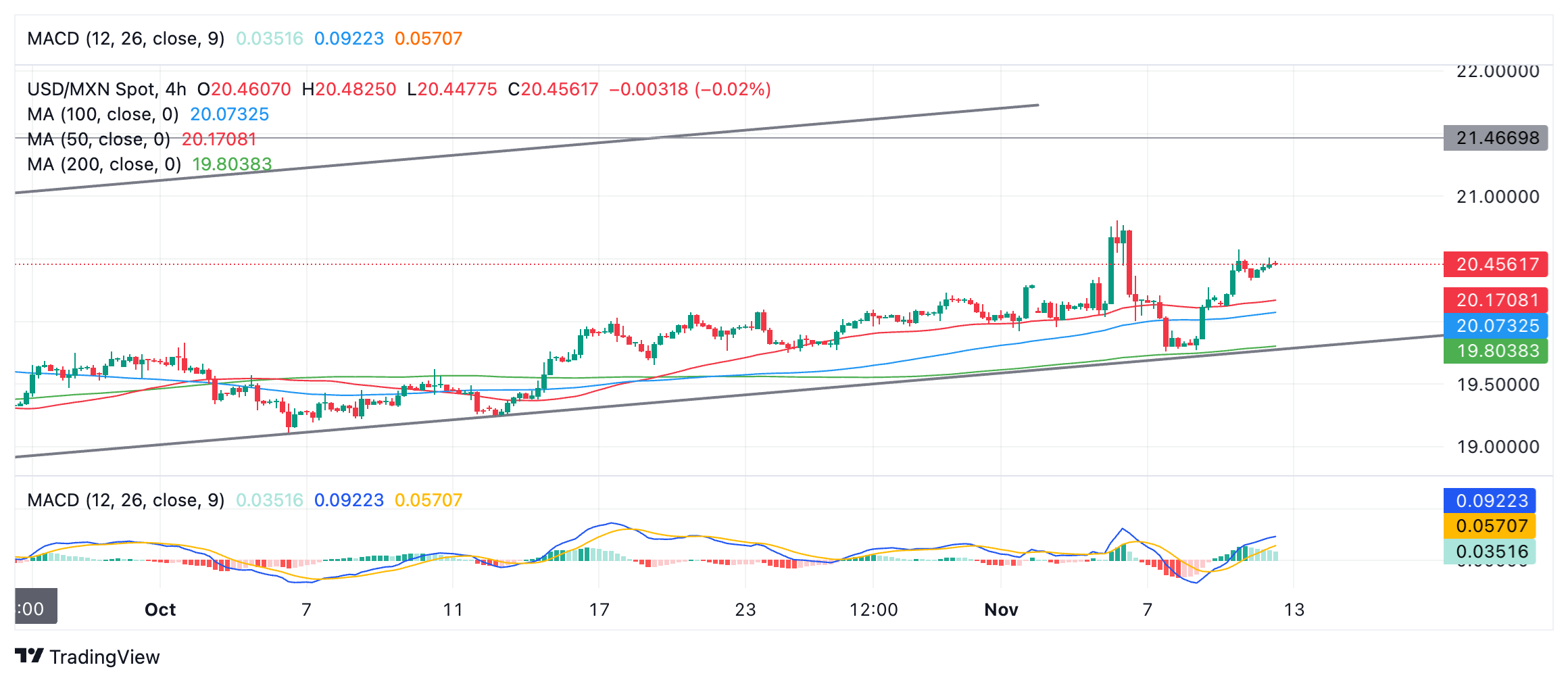
The pair is in a short, medium and long-term uptrend. As the old technical analysis saying goes “the trend is your friend”, suggesting the odds favor more upside to come.
A break above 20.58 (November 11 high) would add weight of evidence to the bullish short-term thesis.
For more confidence that the uptrend has resumed, traders should wait for a break above the 20.80 high of November 6. Such a move would probably confirm more gains ahead, with 21.00 as the next key target and resistance level (round number, psychological support).
Banxico FAQs
The Bank of Mexico, also known as Banxico, is the country’s central bank. Its mission is to preserve the value of Mexico’s currency, the Mexican Peso (MXN), and to set the monetary policy. To this end, its main objective is to maintain low and stable inflation within target levels – at or close to its target of 3%, the midpoint in a tolerance band of between 2% and 4%.
The main tool of the Banxico to guide monetary policy is by setting interest rates. When inflation is above target, the bank will attempt to tame it by raising rates, making it more expensive for households and businesses to borrow money and thus cooling the economy. Higher interest rates are generally positive for the Mexican Peso (MXN) as they lead to higher yields, making the country a more attractive place for investors. On the contrary, lower interest rates tend to weaken MXN. The rate differential with the USD, or how the Banxico is expected to set interest rates compared with the US Federal Reserve (Fed), is a key factor.
Banxico meets eight times a year, and its monetary policy is greatly influenced by decisions of the US Federal Reserve (Fed). Therefore, the central bank’s decision-making committee usually gathers a week after the Fed. In doing so, Banxico reacts and sometimes anticipates monetary policy measures set by the Federal Reserve. For example, after the Covid-19 pandemic, before the Fed raised rates, Banxico did it first in an attempt to diminish the chances of a substantial depreciation of the Mexican Peso (MXN) and to prevent capital outflows that could destabilize the country.
Author

Joaquin Monfort
FXStreet
Joaquin Monfort is a financial writer and analyst with over 10 years experience writing about financial markets and alt data. He holds a degree in Anthropology from London University and a Diploma in Technical analysis.