Mexican Peso closes lower, pressured by strong US Dollar
Most recent article: Mexican Peso pressured on economic weakness and trade fears
- Mexican Peso drops 0.46%, reaching a six-day high of 20.26 following INEGI reports of weak Aggregate Demand and plummeting Private Spending.
- The Fed maintains steady rates; Powell highlights rising economic uncertainty and inflation risks from tariffs.
- US data shows mixed signals; jobless claims increase, Philadelphia Fed Manufacturing Index indicates economic slowdown.
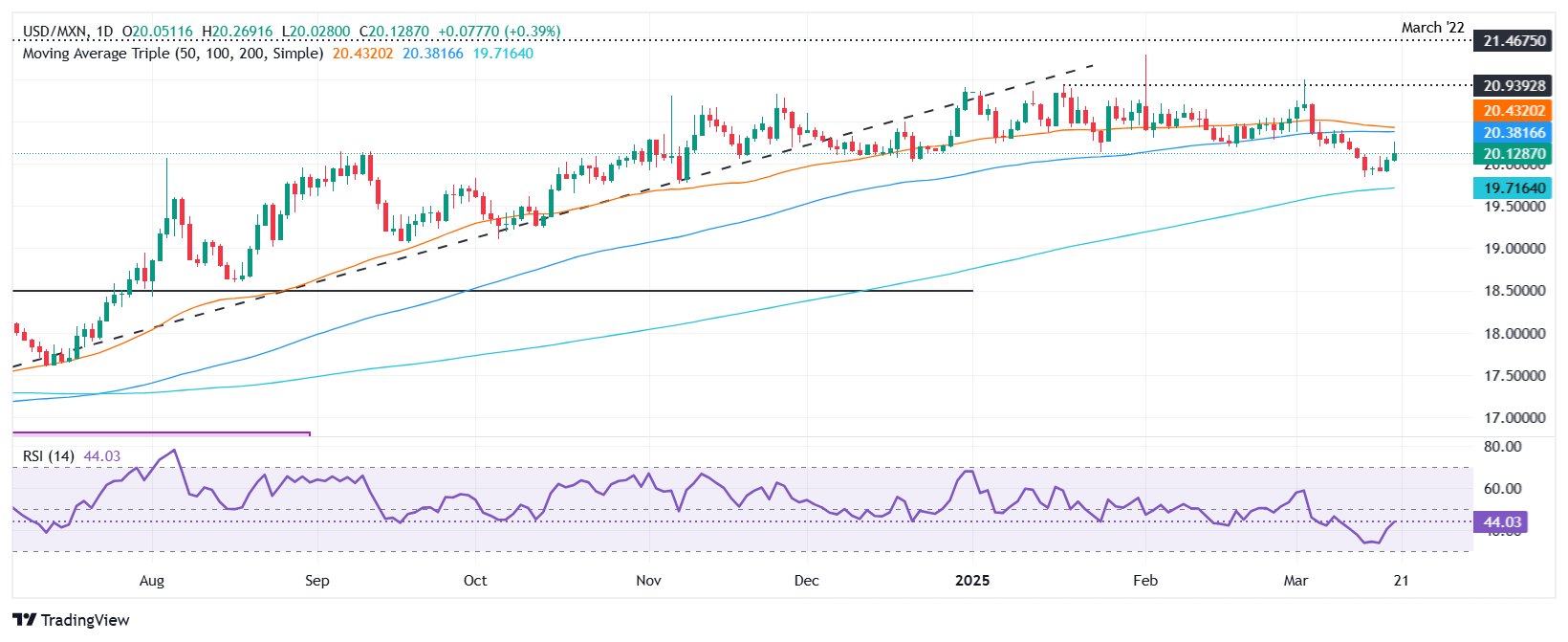
The Mexican Peso (MXN) is extending its losses versus the US Dollar (USD) on Thursday, as Mexico’s economic data paints a gloomy outlook. At the same time, traders continued to assess the latest Federal Reserve (Fed) monetary policy decision. USD/MXN ended Thursday's session trading at 20.13, up 0.46%.
The Peso weakened sharply early as USD/MXN rose to a six-day high of 20.26 as the Instituto Nacional de Estadistica Geografia e Informatica (INEGI) revealed several economic data. First, INEGI revealed that Aggregate Demand on a quarterly and yearly basis dipped but continued to expand.
On the other hand, Private Spending plunged in the fourth quarter of 2024. At the same time, the statistics agency revealed the preliminary reading of the Global Indicator of Economic Activity for February, which suggests Mexico’s economy slowed down on yearly figures despite improving monthly.
On Wednesday, the Fed kept rates unchanged and announced it would slow the pace of the balance sheet reduction. Officials acknowledged that the labor market is solid but recognized that inflation is “somewhat” elevated.
After releasing the monetary policy statement, Fed Chair Jerome Powell stated that economic uncertainty has increased, noting that some tariff-driven inflation has been passed on to consumers. Powell said, "Our current policy stance is well positioned to deal with the risk and uncertainties we face,” adding that the central bank is in no rush to cut rates.”
Aside from this, US economic data was mixed. The number of Americans filing for unemployment claims rose, but it was mostly below estimates, while the Philadelphia Fed Manufacturing Index showed signs of cooling down.
Daily digest market movers: Mexican Peso tumbles as data shows economy slowed in February
- Mexico’s Aggregate Demand in Q4 2024 was 0% down from 1.2% QoQ. On an annual basis, demand dipped from 2.3% to 1.9%, aligned with the consensus.
- Private Spending for Q4 plunged by 1.4%, down from 1.1% growth. In the twelve months for the same period, it barely grew 0.4%, beneath Q3’s 3% increase.
- Mexico’s Global Indicator of Economic Activity fell 0.7% YoY in February from the previous month a year earlier, revealed INEGI. Compared to January, the economy most likely grew 0.2% MoM.
- The Organization for Economic Cooperation and Development (OECD) revealed earlier this week that US tariffs on Mexican products could spur a recession in Mexico. If duties remain unchanged, the OECD projects that Mexico’s economy will shrink 1.3% in 2025 and 0.6% in 2026.
- Via the Summary of Economic Projections (SEP), Fed officials expect two rate cuts in 2025, with rates reaching 3.9%, unchanged from December’s projections. The Fed’s favorite inflation gauge, the Personal Consumption Expenditures (PCE) Price Index, and the Unemployment Rate were revised higher. At the same time, GDP growth is now expected to dip below 2%, reflecting a slowdown spurred by US President Donald Trump’s trade policies.
- Initial Jobless Claims for the week ending March 15 ticked up from 221K to 223K, but was below forecasts of 224K. Meanwhile, the Philadelphia Fed Manufacturing Index dipped from 18.1 to 12.5 in February.
- Traders had priced the Fed to ease policy by 68 basis points (bps) throughout the year, as revealed by data from the Chicago Board of Trade (CBOT).
USD/MXN technical outlook: Mexican Peso retreats as USD/MXN climbs above 20.10
USD/MXN bounced off yearly lows reached on March 14 at 19.84, though it faces stiff resistance at the 100-day Simple Moving Average (SMA) at 20.35.
Momentum seems constructive for buyers, as depicted by the Relative Strength Index (RSI), which cleared the latest through despite remaining below its neutral line. This means that bulls are gathering steam.
Therefore, if USD/MXN closes on a daily basis above 20.00, look for some upside, with key resistance at 20.35, the 50-day SMA at 20.41, and the psychological 20.50 barrier. On the flipside, the first key support is the YTD low of 19.84, ahead of the 200-day SMA at 19.68.
Mexican Peso FAQs
The Mexican Peso (MXN) is the most traded currency among its Latin American peers. Its value is broadly determined by the performance of the Mexican economy, the country’s central bank’s policy, the amount of foreign investment in the country and even the levels of remittances sent by Mexicans who live abroad, particularly in the United States. Geopolitical trends can also move MXN: for example, the process of nearshoring – or the decision by some firms to relocate manufacturing capacity and supply chains closer to their home countries – is also seen as a catalyst for the Mexican currency as the country is considered a key manufacturing hub in the American continent. Another catalyst for MXN is Oil prices as Mexico is a key exporter of the commodity.
The main objective of Mexico’s central bank, also known as Banxico, is to maintain inflation at low and stable levels (at or close to its target of 3%, the midpoint in a tolerance band of between 2% and 4%). To this end, the bank sets an appropriate level of interest rates. When inflation is too high, Banxico will attempt to tame it by raising interest rates, making it more expensive for households and businesses to borrow money, thus cooling demand and the overall economy. Higher interest rates are generally positive for the Mexican Peso (MXN) as they lead to higher yields, making the country a more attractive place for investors. On the contrary, lower interest rates tend to weaken MXN.
Macroeconomic data releases are key to assess the state of the economy and can have an impact on the Mexican Peso (MXN) valuation. A strong Mexican economy, based on high economic growth, low unemployment and high confidence is good for MXN. Not only does it attract more foreign investment but it may encourage the Bank of Mexico (Banxico) to increase interest rates, particularly if this strength comes together with elevated inflation. However, if economic data is weak, MXN is likely to depreciate.
As an emerging-market currency, the Mexican Peso (MXN) tends to strive during risk-on periods, or when investors perceive that broader market risks are low and thus are eager to engage with investments that carry a higher risk. Conversely, MXN tends to weaken at times of market turbulence or economic uncertainty as investors tend to sell higher-risk assets and flee to the more-stable safe havens.
Author

Christian Borjon Valencia
FXStreet
Markets analyst, news editor, and trading instructor with over 14 years of experience across FX, commodities, US equity indices, and global macro markets.