Mexican Peso extends gains as US-China trade talks boost sentiment
- The Mexican Peso extends its advance against the US Dollar, marking a fourth consecutive day of gains.
- US-China trade talks commence in London, lifting demand for emerging market currencies.
- USD/MXN suffers its fourth day of losses as prices move toward 19.00.

The Mexican Peso (MXN) is strengthening against the US Dollar (USD) for a fourth straight session on Monday as broader market sentiment improves. The latest boost in risk appetite can be attributed to encouraging developments in US-China trade negotiations, which have helped ease global uncertainty.
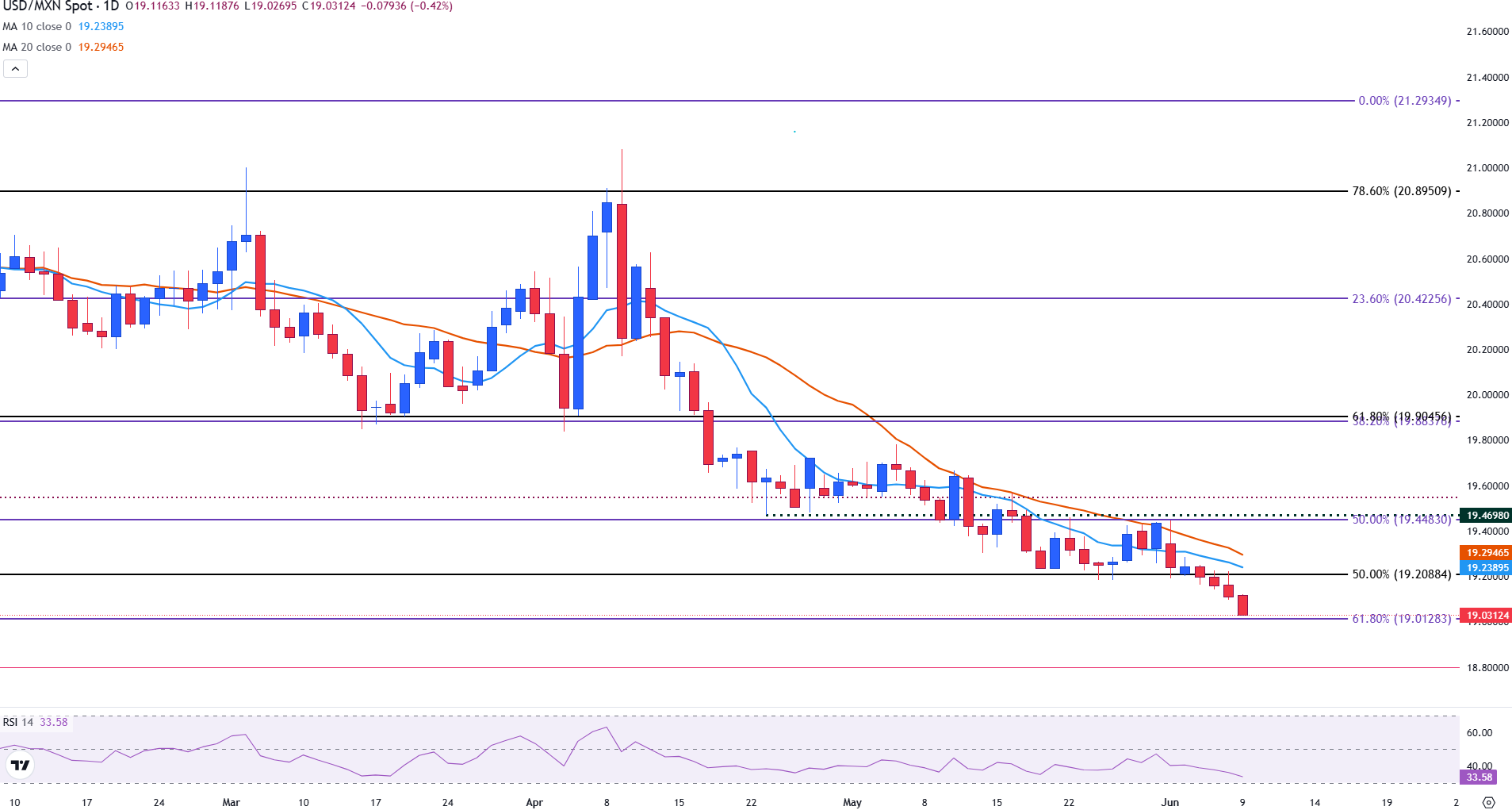
At the time of writing, USD/MXN is trading at 19.03, its lowest level since August last year, with price action heading toward the psychological support level of 19.00.
Mexican Peso daily digest: US-China trade talks support emerging market currency pairs
- US and Chinese officials are meeting in London for two days of high-level trade talks aimed at easing tensions and restoring dialogue between the world’s two largest economies.
- The main focus is on China's rare earth mineral exports and potential concessions on tech-related export controls for the US.
- Positive outcomes could lift risk sentiment and support the Peso, while failed talks may drive safe-haven flows into the US Dollar.
- Friday’s US Nonfarm Payrolls (NFP) report surprised to the upside, with the May labour market data showing 139,000 new jobs added, outperforming analyst expectations of a 130,000 increase.
- This stronger-than-expected print reinforced the resilience of the US economy and helped lift the US Dollar. However, easing tensions between the US and China continued to support risk assets, adding to USD/MXN weakness.
Mexican Peso technical analysis: USD/MXN heads toward 19.00
After four straight days of losses, the USD/MXN exchange rate remains under pressure, stuck below the 20-day Simple Moving Average (SMA) around 19.30.
This level is acting as dynamic resistance, capping any short-term recovery attempts. It's also a psychologically important price point, as round numbers like 19.30 tend to attract heavy order flow and institutional attention.
With momentum still tilted to the downside, the inability to reclaim this level keeps the near-term outlook cautious.
That said, the pair is hovering near 19.01, a key level that could make or break the next directional move. This support marks the 61.8% Fibonacci retracement of the rally, which occurred from the July low to the February high.
If USD/MXN can hold this level, it might attract buyers looking for a bounce, especially as the Relative Strength Index (RSI) sits at 34, nearing oversold territory.
USD/MXN daily chart
Mexican Peso FAQs
The Mexican Peso (MXN) is the most traded currency among its Latin American peers. Its value is broadly determined by the performance of the Mexican economy, the country’s central bank’s policy, the amount of foreign investment in the country and even the levels of remittances sent by Mexicans who live abroad, particularly in the United States. Geopolitical trends can also move MXN: for example, the process of nearshoring – or the decision by some firms to relocate manufacturing capacity and supply chains closer to their home countries – is also seen as a catalyst for the Mexican currency as the country is considered a key manufacturing hub in the American continent. Another catalyst for MXN is Oil prices as Mexico is a key exporter of the commodity.
The main objective of Mexico’s central bank, also known as Banxico, is to maintain inflation at low and stable levels (at or close to its target of 3%, the midpoint in a tolerance band of between 2% and 4%). To this end, the bank sets an appropriate level of interest rates. When inflation is too high, Banxico will attempt to tame it by raising interest rates, making it more expensive for households and businesses to borrow money, thus cooling demand and the overall economy. Higher interest rates are generally positive for the Mexican Peso (MXN) as they lead to higher yields, making the country a more attractive place for investors. On the contrary, lower interest rates tend to weaken MXN.
Macroeconomic data releases are key to assess the state of the economy and can have an impact on the Mexican Peso (MXN) valuation. A strong Mexican economy, based on high economic growth, low unemployment and high confidence is good for MXN. Not only does it attract more foreign investment but it may encourage the Bank of Mexico (Banxico) to increase interest rates, particularly if this strength comes together with elevated inflation. However, if economic data is weak, MXN is likely to depreciate.
As an emerging-market currency, the Mexican Peso (MXN) tends to strive during risk-on periods, or when investors perceive that broader market risks are low and thus are eager to engage with investments that carry a higher risk. Conversely, MXN tends to weaken at times of market turbulence or economic uncertainty as investors tend to sell higher-risk assets and flee to the more-stable safe havens.
Author

Tammy Da Costa, CFTe®
FXStreet
Tammy is an economist and market analyst with a deep passion for financial markets, particularly commodities and geopolitics.