Mexican Peso edges lower as bulls take a breather following 2.5% rally
- The Mexican Peso trades flat as traders opt to cover their longs following the recent rally.
- An easing in market risk has helped the Peso recover, as does stubbornly high inflation expectations in Mexico.
- The Pound Sterling is rising the most against the Peso on Friday after strong UK data.

The Mexican Peso (MXN) slides in its key pairs on Friday as bulls take a breather following recent run of gains. This comes after the Peso gained almost 2.5% in the past few days following a turnaround in risk sentiment which has aided emerging market FX.
Lower interest rates are normally negative for a currency as they attract less foreign capital inflows. Although the Banco de Mexico (Banxico) is expected to continue cutting interest rates, the MXN has held its value relatively well due to both the high starting level of its interest rates (over 10%) and the view that stubbornly high inflation could make future cuts more gradual than expected.
At the time of writing, one US Dollar (USD) buys 18.70 Mexican Pesos, EUR/MXN trades at 20.57, and GBP/MXN at 24.12.
Mexican Peso eases after recent rally
The Mexican Peso is trading lower in its most-traded pairs at the end of the trading week.
Better-than-expected US Retail Sales and Initial Jobless Claims data on Thursday helped scotch concerns the US might be on the verge of entering a recession, leading to a general rebound in morale. Although this helped support the US Dollar (USD), it also appreciated the risk-sensitive Mexican Peso.
The VIX volatility index, a common gauge of investor nervousness, has fallen to below the levels it was at prior to the weak July Nonfarm Payrolls triggered the panic sell-off, according to Jim Reid, Research Strategist at Deutsche Bank. This suggests the market has fully recovered from its bruising start to the month – a further plus for emerging market FX.
The Pound Sterling (GBP) is the major currency that is rising most against MXN on Friday. This comes after a slew of data was released out of the UK – including Retail Sales, Industrial Production, Manufacturing Production and GDP – which either beat or came out in line with estimates.
More broadly, a background factor that is supporting the Peso may be the perception that inflation could remain elevated for longer than expected, forcing the Banxico to cut interest rates at a more gradual pace than expected.
Headline inflation in Mexico remains elevated at 5.57% and this could be further supported by stubbornly high dwelling inflation, according to research by Capital Economics. That said, core inflation has fallen for 18 consecutive months to 4.05% and was the prime reason leading Banxico to go for the unexpected 0.25% interest rate cut at its August meeting.
The rate cut brought Banxico’s policy rate down to 10.75%. Relatively speaking, this remains high and continues to attract carry trade flows. The carry trade is an operation by which traders borrow in a currency with low interest rates, like the Japanese Yen (JPY) or the Swiss Franc (CHF), and use the money to buy higher-interest paying assets or currencies such as the Peso.
Technical Analysis: USD/MXN resumes down leg within channel
USD/MXN resumes its down move within a rising channel after the short-lived pullback petered out. This leg lower within the channel is expected to continue, possibly to either the 50-day Simple Moving Average at 18.40 or the lower channel line in the 18.30s.
USD/MXN Daily Chart
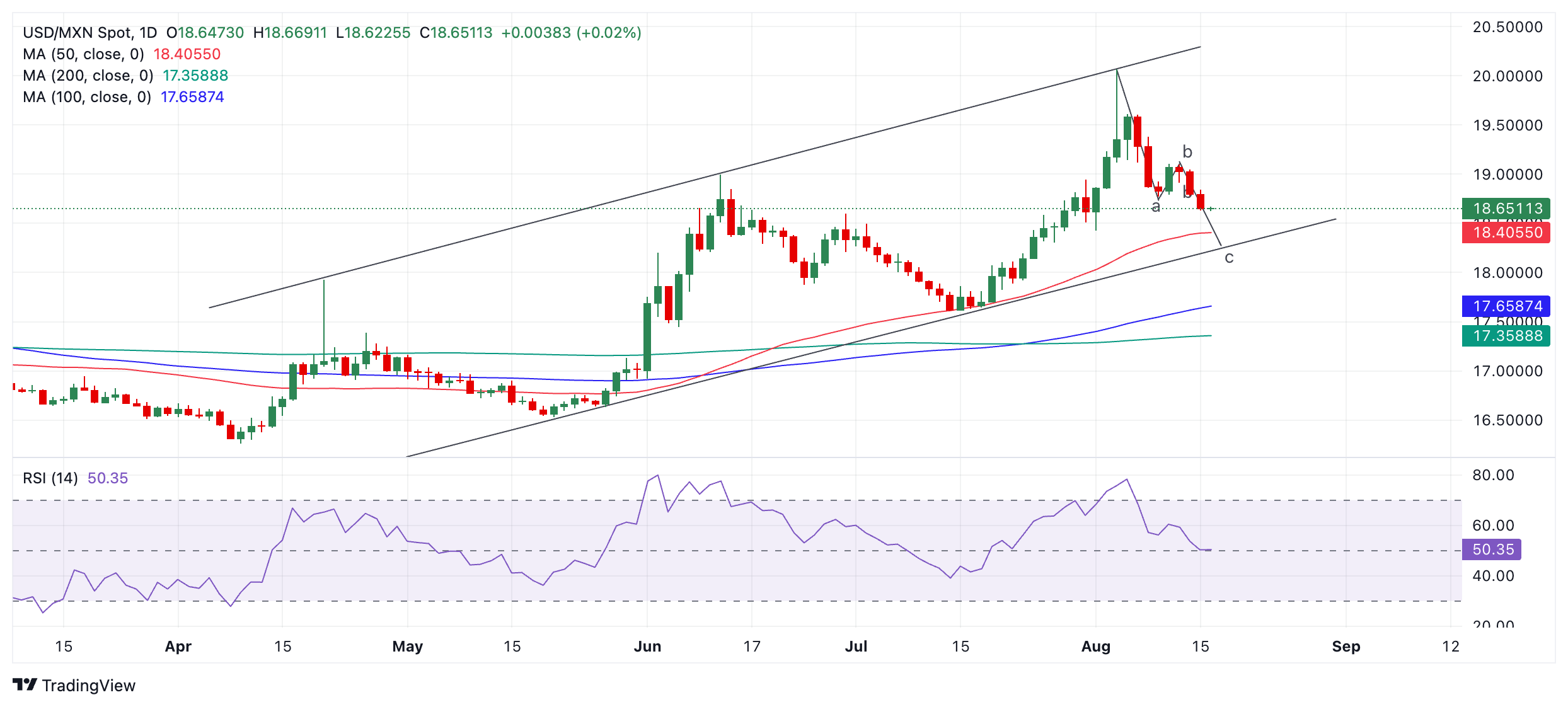
USD/MXN could be unfolding in a bearish abc correction within its rising channel. If so, it looks as if waves “a” and “b” have finished and wave “c” is currently evolving. Usually wave c is a similar length to wave a or a Fibonacci ratio thereof, so the move lower still probably has further to go. It will likely reach the 50-day SMA or even the lower channel line.
Economic Indicator
Retail Sales (MoM)
The Retail Sales data, released by the Office for National Statistics on a monthly basis, measures the volume of sales of goods by retailers in Great Britain directly to end customers. Changes in Retail Sales are widely followed as an indicator of consumer spending. Percent changes reflect the rate of changes in such sales, with the MoM reading comparing sales volumes in the reference month with the previous month. Generally, a high reading is seen as bullish for the Pound Sterling (GBP), while a low reading is seen as bearish.
Read more.Last release: Fri Aug 16, 2024 06:00
Frequency: Monthly
Actual: 0.5%
Consensus: 0.5%
Previous: -1.2%
Source: Office for National Statistics
Author

Joaquin Monfort
FXStreet
Joaquin Monfort is a financial writer and analyst with over 10 years experience writing about financial markets and alt data. He holds a degree in Anthropology from London University and a Diploma in Technical analysis.