Mexican Peso hits six-day low against US Dollar as US yields climb following robust data

Most recent article: Mexican Peso weakens against US Dollar following weak GDP, Banxico rate cut speculations
- Mexican Peso drops 0.5% following Mexico's cooler inflation and stronger economic growth indicators.
- Banxico's January minutes would be scrutinized by traders on speculation of an imminent policy easing.
- Fed's cautious stance on rate cuts contrasts with Mexico's potential monetary easing, favoring USD/MXN upside.
The Mexican Peso trips down and falls against the US Dollar in early trading during the North American session on Thursday. Mexico’s economic docket featured an inflation report, the Gross Domestic Product (GDP), and the release of the January meeting minutes of the Bank of Mexico (Banxico). The USD/MXN exchanges hands at 17.12, up 0.5%.
Mexico’s National Statistics Agency (INEGI) revealed that inflation cooled down in the first half of February as the Consumer Price Index (CPI) plunged in monthly figures, which exacerbated a slowdown in yearly numbers. The same report depicted that Core inflation increased less than estimates, while other data revealed the economy grew a tick higher than expected, portraying a solid economic outlook.
The surprise on inflation sponsored the USD/MXN leg up as Banxico’s rate cut bets increased. Some officials expressed that Mexico’s Central Bank could begin to ease policy toward the March meeting. Recently, Banxico revealed its monetary policy minutes, which would be greatly scrutinized by traders.
Across the border, the Minutes of the US Federal Reserve (Fed) meeting showed that policymakers remain hesitant to cut rates amidst fears of a second round of inflation. Recently, the US Bureau of Labor Statistics (BLS) revealed that unemployment claims rose below estimates, while business activity, despite moderating, expanded.
Daily digest market movers: Mexican Peso collapses to six-day lows as inflation cools down
- Mexico’s CPI came at -0.10% MoM, below the previous reading and estimates of 0.15%, while annual-based inflation dipped to 4.45% from 4.9%. The Core CPI was 0.24%, below the previous reading and forecasts of 0.28%, while annually-based cooled down from 4.78% to 4.63%, beneath the consensus.
- The economy in Mexico grew above forecasts but is losing its pace as the Gross Domestic Product (GDP) expanded in the fourth quarter by 0.1% QoQ, but lower than Q3’s 1.1% expansion. Annually based, GDP exceeded estimates of 2.4% to hit 2.5% from the previous 3.3%.
- Mexico’s Retail Sales dropped -0.9% MoM, below estimates of 0.2%. Yearly figures plummeted -0.2% vs. a 2.5% forecast.
- The Mexican currency could depreciate further if the Mexican government fails to resolve the steel and aluminum dispute with the United States. US Trade Representative Katherine Tai warned the US could reimpose tariffs on the commodities.
- The Conference Board (CB) revealed that its Leading Economic Index (LEI), no longer signals an upcoming recession in the US, reported on Tuesday.
- Recently, Richmond Fed President Thomas Barkin said the latest inflation reports were “less good,” adding the US has “a ways to go” to achieve a soft landing.
- US Initial Jobless Claims for the week ending February 17 decreased by 12K to 201K, below estimates of 218K.
- According to the S&P Global report, business activity in the United States moderated in February. The Services and Manufacturing Purchasing Managers Indices (PMI) both stayed in expansionary territory, indicating growth. Consequently, the Composite Index experienced a slight decline, moving from 52 to 51.4.
- US economic data related to price pressures should greatly influence Federal Reserve officials. Although opening the door to easing policy, Fed officials have expressed numerous times that they will not rush rate cuts.
- Federal Reserve Governor Phil Jefferson commented that he sees progress on inflation, adding that rate cuts are tied to a broad set of data.
- Market players are expecting the first rate cut by the Federal Reserve at the June monetary policy meeting as they have trimmed odds for March and May.
Technical analysis: Mexican Peso struggles to keep the rally, dives to new weekly low
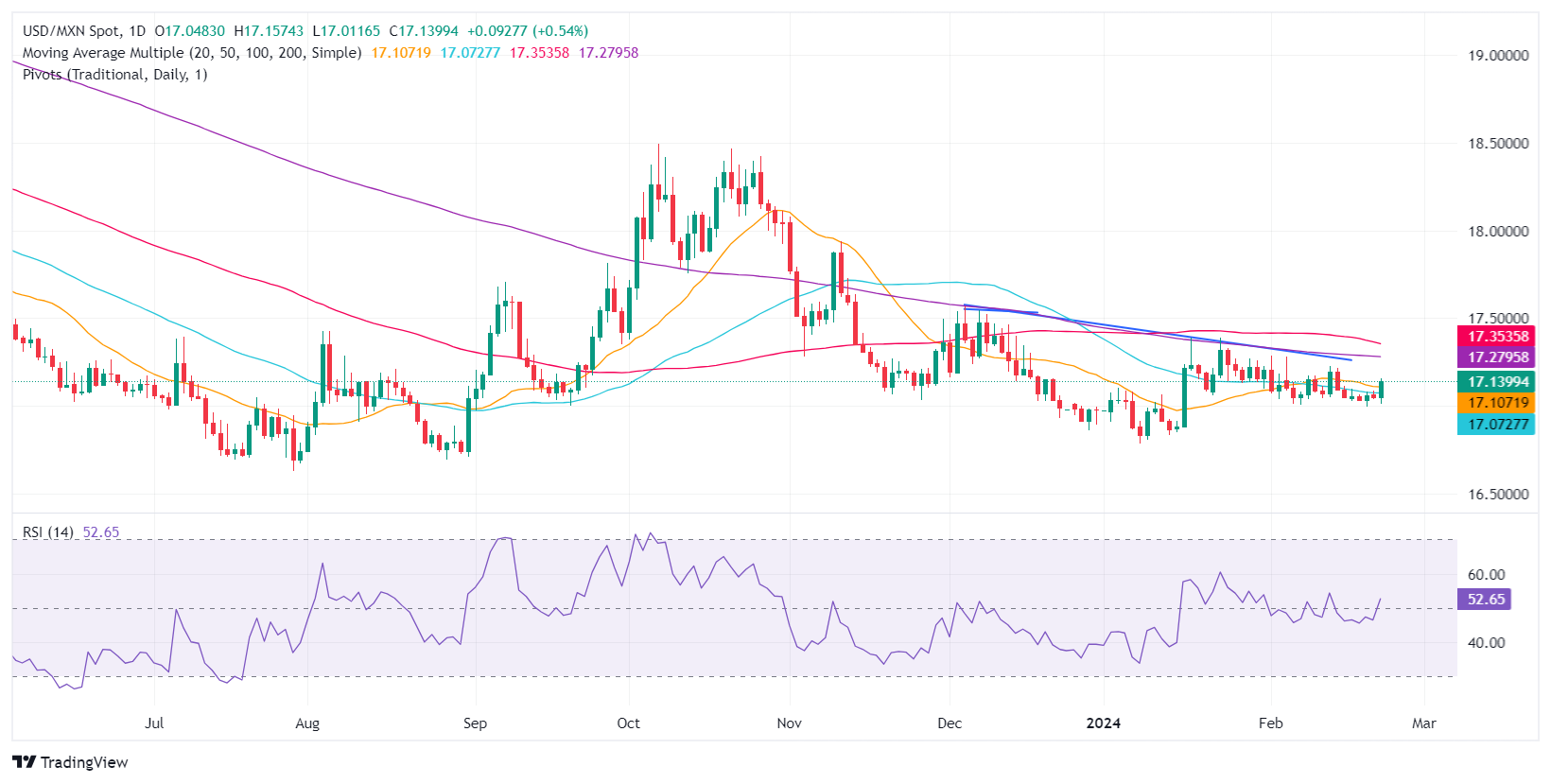
On Wednesday, I wrote, “The USD/MXN remains in consolidation, at around 17.05, awaiting a fresh catalyst.” Today’s data finally triggered a break of the top of the 17.05-17.10 range as buyers regained the 50-day Simple Moving Average (SMA) at 17.07, which opened the door to reclaim 17.10. If the pair manages to rally past the psychological 17.20 figure, the 200-day SMA would be up for grabs at 17.27. Once cleared, the next stop would be the confluence of the 100-day SMA and the January 17 high near 17.36-17.38.
On the other hand, if sellers step in and cap USD/MXN’s upside, they need to push prices below the 17.00 figure. Once cleared, the next support would be the current year-to-date (YTD) low of 16.78, followed by the 2023 low of 16.62.
USD/MXN Price Action – Daily Chart
Mexican Peso FAQs
What key factors drive the Mexican Peso?
The Mexican Peso (MXN) is the most traded currency among its Latin American peers. Its value is broadly determined by the performance of the Mexican economy, the country’s central bank’s policy, the amount of foreign investment in the country and even the levels of remittances sent by Mexicans who live abroad, particularly in the United States. Geopolitical trends can also move MXN: for example, the process of nearshoring – or the decision by some firms to relocate manufacturing capacity and supply chains closer to their home countries – is also seen as a catalyst for the Mexican currency as the country is considered a key manufacturing hub in the American continent. Another catalyst for MXN is Oil prices as Mexico is a key exporter of the commodity.
How do decisions of the Banxico impact the Mexican Peso?
The main objective of Mexico’s central bank, also known as Banxico, is to maintain inflation at low and stable levels (at or close to its target of 3%, the midpoint in a tolerance band of between 2% and 4%). To this end, the bank sets an appropriate level of interest rates. When inflation is too high, Banxico will attempt to tame it by raising interest rates, making it more expensive for households and businesses to borrow money, thus cooling demand and the overall economy. Higher interest rates are generally positive for the Mexican Peso (MXN) as they lead to higher yields, making the country a more attractive place for investors. On the contrary, lower interest rates tend to weaken MXN.
How does economic data influence the value of the Mexican Peso?
Macroeconomic data releases are key to assess the state of the economy and can have an impact on the Mexican Peso (MXN) valuation. A strong Mexican economy, based on high economic growth, low unemployment and high confidence is good for MXN. Not only does it attract more foreign investment but it may encourage the Bank of Mexico (Banxico) to increase interest rates, particularly if this strength comes together with elevated inflation. However, if economic data is weak, MXN is likely to depreciate.
How does broader risk sentiment impact the Mexican Peso?
As an emerging-market currency, the Mexican Peso (MXN) tends to strive during risk-on periods, or when investors perceive that broader market risks are low and thus are eager to engage with investments that carry a higher risk. Conversely, MXN tends to weaken at times of market turbulence or economic uncertainty as investors tend to sell higher-risk assets and flee to the more-stable safe havens.
Author

Christian Borjon Valencia
FXStreet
Markets analyst, news editor, and trading instructor with over 14 years of experience across FX, commodities, US equity indices, and global macro markets.