Mexican Peso hoovers within previous ranges awaiting the Fed's decision
- The Mexican Peso treads water near the 20.00 area as the US Dollar steadies ahead of the Fed decision on interest rates.
- Strong US economic data has boosted speculation that the Fed could scale back rate cut projections for 2025.
- Technically, the USD/MXN pair remains bearish but needs an extra boost to breach the 20.00 level.
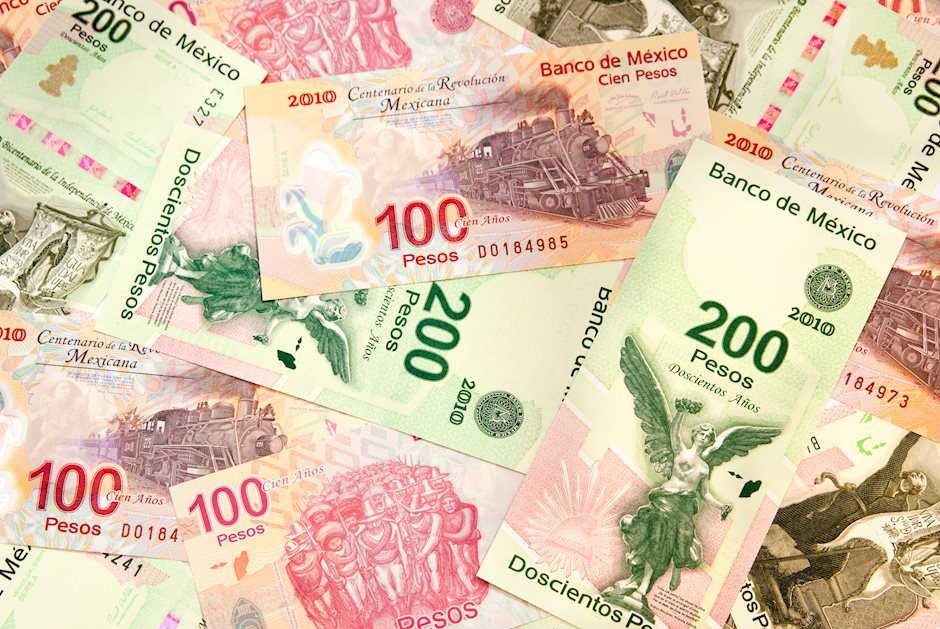

The Mexican Peso (MXN) is practically flat on Wednesday, with US Dollar Index (DXY) steady near recent highs as investors bid their time ahead of the US Federal Reserve’s (Fed) monetary policy decision.
Investors are nearly fully pricing a 25 basis points (bps) interest-rate cut later on Wednesday. Nevertheless, the strong US economy and the higher inflationary pressures might prompt policymakers to raise their interest rate projections for 2025.
This sentiment has been boosting US yields and the US Dollar (USD) higher since last week, capping the near-term rally of the Mexican Peso below the 20.00 round level.
Beyond that, Mexican macroeconomic data have failed to cheer MXN buyers. Inflation eased beyond expectations in November, industrial output deteriorated and retail consumption dropped against expectations in October. These figures pave the path for a further rate cut by the Bank of Mexico (Banxico) on Thursday.
Fears of a hawkish Fed underpin the US Dollar
- The US Dollar Index (DXY) trades with moderate gains for the second consecutive day on Wednesday as investors brace for a “hawkish cut” by the Fed later today.
- US Treasury yields remain steady at one-month highs above 4.40%, buoyed by market expectations of fewer rate cuts in 2025.
- Construction activity data from the US released on Wednesday has been mixed. Housing starts declined unexpertedly while building permits increased beyond expectations in November.
- On Tuesday, US retail consumption increased by 0.7%, beyond expectations of a 0.5% increment, boosted by increasing vehicle and online sales
- These figures come after an unexpected improvement in US services sectors’ activity. The US preliminary Services Purchasing Managers Index (PMI) recorded its best performance in more than three years, with the PMI increasing to 58.5 from 56.1 in November and against expectations of a moderate slowdown to 55.7.
- Despite the recent upbeat US data, investors remain fully confident that the Fed will cut rates on Wednesday. The CME FedWatch tool shows a 95% chance of a 25 bps interest cut later today, with more than a 70% chance of less than three cuts during 2025.
- In Mexico, Retail Sales dropped unexpectedly by 0.3% in October, against expectations of a 0.2% increase. Retail Consumption moderated its yearly decline to 1.2% from 1.5% in the previous month against expectations of a 1.6% fall.
- A survey from Banxico published this week reveals that economic experts see prices growing at a 4.37% pace in 2024, down from the 4.42% inflation rate seen in November, while the expectations for 2025 remain steady at 3.80%.
- The country’s GDP is expected to grow by 1.60% in 2024, up from the previous 1.53%. However, expectations for 2025 have been downwardly revised to 1.12% from previous estimations of 1.20%, due to mainly the impact of tariffs from the US.
US Dollar PRICE This week
The table below shows the percentage change of US Dollar (USD) against listed major currencies this week. US Dollar was the strongest against the Australian Dollar.
| USD | EUR | GBP | JPY | CAD | AUD | NZD | CHF | |
|---|---|---|---|---|---|---|---|---|
| USD | 0.03% | -0.79% | -0.05% | 0.62% | 0.73% | 0.62% | 0.05% | |
| EUR | -0.03% | -0.76% | 0.02% | 0.66% | 0.88% | 0.66% | 0.08% | |
| GBP | 0.79% | 0.76% | 0.66% | 1.43% | 1.66% | 1.42% | 0.83% | |
| JPY | 0.05% | -0.02% | -0.66% | 0.65% | 0.78% | 0.68% | 0.15% | |
| CAD | -0.62% | -0.66% | -1.43% | -0.65% | 0.17% | -0.01% | -0.60% | |
| AUD | -0.73% | -0.88% | -1.66% | -0.78% | -0.17% | -0.21% | -0.82% | |
| NZD | -0.62% | -0.66% | -1.42% | -0.68% | 0.00% | 0.21% | -0.60% | |
| CHF | -0.05% | -0.08% | -0.83% | -0.15% | 0.60% | 0.82% | 0.60% |
The heat map shows percentage changes of major currencies against each other. The base currency is picked from the left column, while the quote currency is picked from the top row. For example, if you pick the US Dollar from the left column and move along the horizontal line to the Japanese Yen, the percentage change displayed in the box will represent USD (base)/JPY (quote).
Mexican Peso technical outlook: USD/MXN hovers above the 20.00 support area
USD/MXN is trading lower from its late November highs near 20.80, but the pair is struggling to find acceptance below the 20.00 psychological level.
Price action remains contained between the mentioned 20.00 level and 20.30 on the upside, awaiting the Fed later on Wednesday and Banxico’s decision on Thursday.
On the upside, above 20.30, the next target would be the December 2 high at 20.60 and November’s peak at around 20.80. Below 20.00, bears would be focusing on the October 24 and 25 lows and the November 8 low at 19.75.
USD/MXN 4-Hour Chart

Fed FAQs
Monetary policy in the US is shaped by the Federal Reserve (Fed). The Fed has two mandates: to achieve price stability and foster full employment. Its primary tool to achieve these goals is by adjusting interest rates. When prices are rising too quickly and inflation is above the Fed’s 2% target, it raises interest rates, increasing borrowing costs throughout the economy. This results in a stronger US Dollar (USD) as it makes the US a more attractive place for international investors to park their money. When inflation falls below 2% or the Unemployment Rate is too high, the Fed may lower interest rates to encourage borrowing, which weighs on the Greenback.
The Federal Reserve (Fed) holds eight policy meetings a year, where the Federal Open Market Committee (FOMC) assesses economic conditions and makes monetary policy decisions. The FOMC is attended by twelve Fed officials – the seven members of the Board of Governors, the president of the Federal Reserve Bank of New York, and four of the remaining eleven regional Reserve Bank presidents, who serve one-year terms on a rotating basis.
In extreme situations, the Federal Reserve may resort to a policy named Quantitative Easing (QE). QE is the process by which the Fed substantially increases the flow of credit in a stuck financial system. It is a non-standard policy measure used during crises or when inflation is extremely low. It was the Fed’s weapon of choice during the Great Financial Crisis in 2008. It involves the Fed printing more Dollars and using them to buy high grade bonds from financial institutions. QE usually weakens the US Dollar.
Quantitative tightening (QT) is the reverse process of QE, whereby the Federal Reserve stops buying bonds from financial institutions and does not reinvest the principal from the bonds it holds maturing, to purchase new bonds. It is usually positive for the value of the US Dollar.
Author
Guillermo Alcala
FXStreet
Graduated in Communication Sciences at the Universidad del Pais Vasco and Universiteit van Amsterdam, Guillermo has been working as financial news editor and copywriter in diverse Forex-related firms, like FXStreet and Kantox.