Mexican Peso recovery falters after traders shrug off Banxico’s intervention warning
- The Mexican Peso briefly recovered on Thursday after the President of the Banxico warned she will prop up the Peso if volatility persists.
- The recovery falters on Friday, however, as traders continue beating MXN lower following the outcome of the June elections.
- USD/MXN appears to end its correction and resume its bullish trend.

The Mexican Peso (MXN) trades between half a percent and over one percent lower in its most traded pairs on Friday as markets continue to fret about the proposed policies of Mexico’s newly elected left-wing government. The Peso is additionally pressured by a squeeze on overweight long positions that have built up after a multi-year period of appreciation for the Mexican currency.
At the time of writing, a single US Dollar (USD) buys 18.62 Mexican Pesos, EUR/MXN is trading at 19.92 and GBP/MXN at 23.67.
Mexican Peso temporarily recovers after intervention, then sinks
The Mexican Peso backs and fills on Friday after the previous day’s steep rally, which came on the back of verbal intervention by the President of the Banco de Mexico (Banxico), Victoria Rodriguez Ceja, who said Banxico would step in to prop up the Peso if volatility became too “extreme”.
On Friday, however, traders continue to apply pressure in line with the downturn since the results of the Mexican elections on June 2. These led to a victory for President-elect Claudia Sheinbaum and her left-wing coalition Sigamos Haciendo Historia (SHH). SHH won a supermajority in the Mexican house of deputies and came two seats away in the senate. This will make it easier for incumbent President Andres Manuel Lopez Obrador (AMLO) to push through radical amendments to the constitution that have set markets on edge.
The raft of 20 proposed amendments and reforms range from rights to higher minimum wages and an increase in state-sector pensions, to the abolition of independent regulators and reforms to the judiciary – particularly the controversial idea of replacing the current system of appointing judges with one that would see them elected by popular vote.
“The main concerns around these amendments is that (i) there will be an erosion of checks and balances and (ii) they would start to take Mexico down the path of wage indexation, which would clearly undermine Banxico’s efforts to get inflation under control,” Jason Tuvey, Deputy Chief Emerging Markets Economist at Capital Economics told FXStreet.
On Wednesday during his daily broadcast to the masses, AMLO hit back at critics of his reforms, saying the current depreciation of the Peso, which has lost 10% of its value since the election, has been driven by “speculators” not “investors” and is part of a conspiracy of the right to “blackmail” the government into ditching the proposed reforms.
He further argued that the current system of appointing judges was too open to corruption by elites, politicians and organized crime, resulting in a judiciary that was compromised. In comparison his reforms “would make the appointment of judges more democratic, improving the rule of law and actually attracting more not less foreign investment,” he said. AMLO also pointed to the fact that under his administration the Peso had appreciated whereas under all five previous Presidents it had depreciated, sometimes considerably. Critics of AMLO say he is punishing the Supreme court for obstructing some of his reforms.
The large decline in the Mexican Peso since the June 2 elections could be seen as an overdue correction from overvalued extremes. The Peso has been in a long-term uptrend since April 2020, partly due to the extraordinarily high interest rates set by the Bank of Mexico (Banxico), which have made the currency attractive to carry traders. Carry traders borrow in currencies with low interest rates like the Japanese Yen (Apr circa 0.0% -0.1%) and invest in currencies like the Mexican Peso that offer higher returns (Apr circa 11.00%), pocketing the difference.
It seems unlikely that the prospect of judicial reforms are primarily to blame for the sudden steep correction in MXN. Rather the elections may have acted as a kind of tinder stick to a bonfire of long positions that had built up in the Peso.
“Before the election, we’d been arguing for some time that the Peso appeared increasingly overvalued and was vulnerable to a sharp fall – the declines over the past couple of weeks have taken it within touching distance of our long-standing year-end forecast of 19.00 (USD/MXN),” said Tuvey.
Technical Analysis: USD/MXN probably resumes short-term uptrend
USD/MXN rebounds after its recent correction on Friday, resuming its short and intermediate term uptrend.
USD/MXN Daily Chart
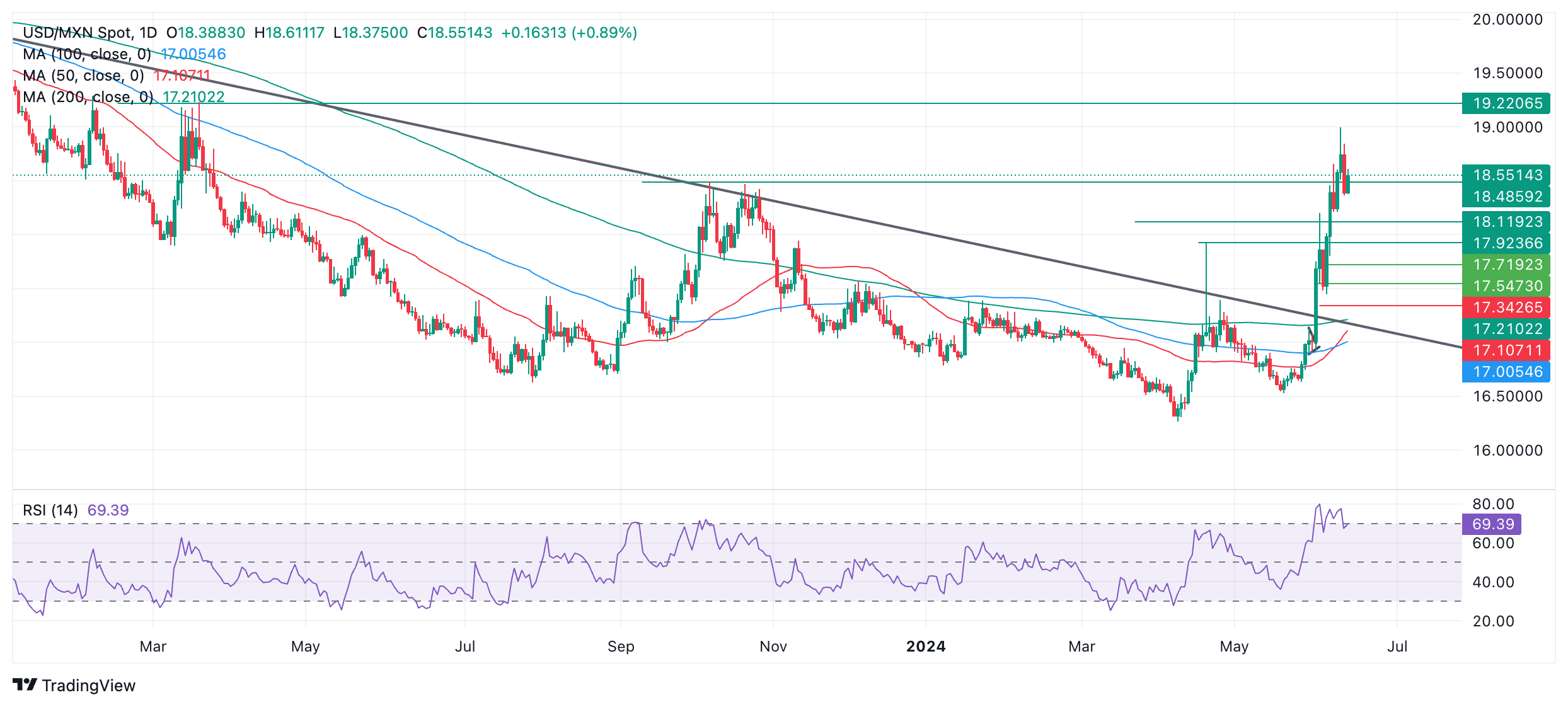
Given “the trend is your friend,” the odds favor a continuation of the uptrend, with the next target potentially situated at 19.22 (March 2023 high).
The Relative Strength Index (RSI) has just exited the overbought zone. However, the correction could still go deeper – although the established uptrend is likely to eventually resume.
The direction of the long-term trend is in doubt after the break above the October 2023 high. Previous to that, it was down.
Banxico FAQs
The Bank of Mexico, also known as Banxico, is the country’s central bank. Its mission is to preserve the value of Mexico’s currency, the Mexican Peso (MXN), and to set the monetary policy. To this end, its main objective is to maintain low and stable inflation within target levels – at or close to its target of 3%, the midpoint in a tolerance band of between 2% and 4%.
The main tool of the Banxico to guide monetary policy is by setting interest rates. When inflation is above target, the bank will attempt to tame it by raising rates, making it more expensive for households and businesses to borrow money and thus cooling the economy. Higher interest rates are generally positive for the Mexican Peso (MXN) as they lead to higher yields, making the country a more attractive place for investors. On the contrary, lower interest rates tend to weaken MXN. The rate differential with the USD, or how the Banxico is expected to set interest rates compared with the US Federal Reserve (Fed), is a key factor.
Banxico meets eight times a year, and its monetary policy is greatly influenced by decisions of the US Federal Reserve (Fed). Therefore, the central bank’s decision-making committee usually gathers a week after the Fed. In doing so, Banxico reacts and sometimes anticipates monetary policy measures set by the Federal Reserve. For example, after the Covid-19 pandemic, before the Fed raised rates, Banxico did it first in an attempt to diminish the chances of a substantial depreciation of the Mexican Peso (MXN) and to prevent capital outflows that could destabilize the country.
Author

Joaquin Monfort
FXStreet
Joaquin Monfort is a financial writer and analyst with over 10 years experience writing about financial markets and alt data. He holds a degree in Anthropology from London University and a Diploma in Technical analysis.