Mexican Peso stabilizes ahead of Banxico rate decision
- The Mexican Peso gears up for a busy calendar week.
- The Bank of Mexico holds its policy meeting Thursday and major inflation data is out on Tuesday.
- USD/MXN gains momentum as it rises back up within its ascending channel.

The Mexican Peso (MXN) seesaws between gains and losses in its major pairs on Monday, ahead of a week in which a raft of key economic data will be released and the Bank of Mexico (Banxico) will hold its September policy meeting on Thursday – all factors that could influence the Peso.
On Monday, Mexican Retail Sales data shows a 0.6% decline in July against the 3.1% (revised down from 3.9%) fall YoY in June. The result was below expectations of a 0.5% decline.
Monthly Retail Sales, meanwhile, rose 0.7% MoM in July after a 0.5% decline in June, according to data from INEGI.
Mexican Peso to feel impact of data releases, Banxico meeting
The Mexican Peso could be moved by domestic data releases and the Banxico policy meeting during the week ahead.
On Tuesday, 1st half-month inflation and core inflation for September will hit the wires at 12:00 GMT. The previous data showed a 0.03% decline in inflation and 0.1% rise in core inflation. If the new figures are higher, they could influence the Banxico decision on Thursday. Higher inflation will increase the probability that the central bank will keep interest rates high and vice versa for lower inflation.
On Thursday, Banxico will hold its policy meeting and could decide to adjust its key interest rate, currently at 10.75%. Most economists think the bank will cut by 0.25%, bringing it down to 10.50%. The expectation of lower interest rates is generally negative for a currency since it lessens foreign capital inflows.
At the August meeting, Banxico decided to cut interest rates by 0.25% (25 bps), bringing its official rate from 11.00% to 10.75%. The decision was a close call, with only three members voting for the cut versus two who wanted to keep rates where they were.
“Some members felt that the slowdown in activity was greater than expected and that risks are biased to the downside. All said that disinflation was expected to continue, but most felt that the balance of risks to inflation were biased to the upside and that the inflationary environment remains complex. Since that meeting, inflation readings have fallen further. Next Banxico meeting is September 26 and if disinflation continues, another 25 bp cut to 10.50% seems likely. The swaps market is pricing in 175 bp of easing over the next 12 months,” says Dr. Win Thin, Global Head of Markets Strategy at Brown Brothers Harriman (BBH).
Finally, Friday sees the release of Balance of Trade data. This registered a $0.072 billion deficit and a $1.168 billion surplus on a seasonally adjusted basis, in August. Generally consistent surpluses are positive for a currency and vice versa for deficits.
Technical Analysis: USD/MXN establishes short-term uptrend
USD/MXN continues its rise into the fourth day after finding technical support at the base of a long-term rising channel.
Although the pair declined sharply last week, it found key support from the base of a long-term rising channel and the 50-day Simple Moving Average at just above 19.00, which has so far prevented a deeper slide.
USD/MXN Daily Chart
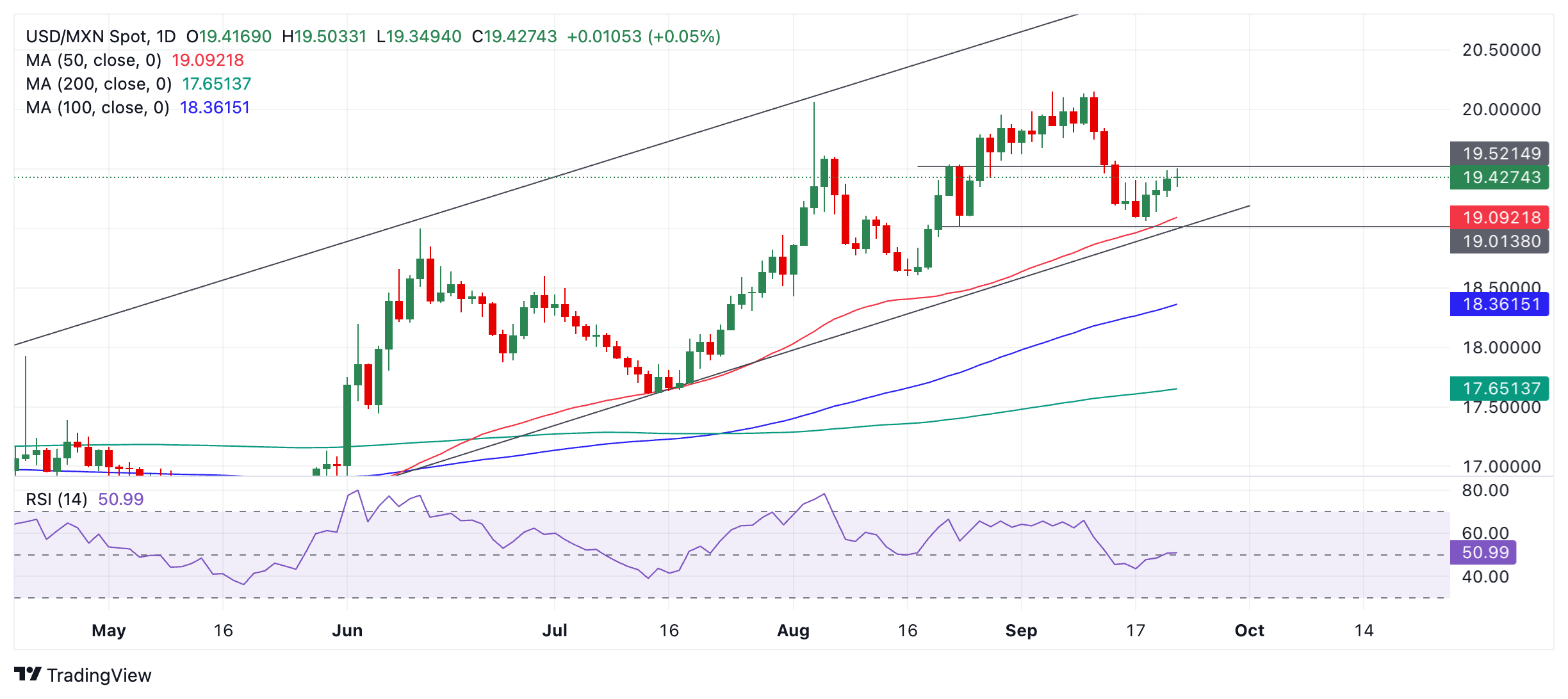
There is a possibility USD/MXN has found stability at these support levels and begun a short-term uptrend within the channel. It is already in a medium and long-term uptrend so the direction of the “current” is north.
A close above 19.53 (August 23 swing high), however, would further confirm the pair was in a bullish short-term uptrend.
Mexican Peso FAQs
The Mexican Peso (MXN) is the most traded currency among its Latin American peers. Its value is broadly determined by the performance of the Mexican economy, the country’s central bank’s policy, the amount of foreign investment in the country and even the levels of remittances sent by Mexicans who live abroad, particularly in the United States. Geopolitical trends can also move MXN: for example, the process of nearshoring – or the decision by some firms to relocate manufacturing capacity and supply chains closer to their home countries – is also seen as a catalyst for the Mexican currency as the country is considered a key manufacturing hub in the American continent. Another catalyst for MXN is Oil prices as Mexico is a key exporter of the commodity.
The main objective of Mexico’s central bank, also known as Banxico, is to maintain inflation at low and stable levels (at or close to its target of 3%, the midpoint in a tolerance band of between 2% and 4%). To this end, the bank sets an appropriate level of interest rates. When inflation is too high, Banxico will attempt to tame it by raising interest rates, making it more expensive for households and businesses to borrow money, thus cooling demand and the overall economy. Higher interest rates are generally positive for the Mexican Peso (MXN) as they lead to higher yields, making the country a more attractive place for investors. On the contrary, lower interest rates tend to weaken MXN.
Macroeconomic data releases are key to assess the state of the economy and can have an impact on the Mexican Peso (MXN) valuation. A strong Mexican economy, based on high economic growth, low unemployment and high confidence is good for MXN. Not only does it attract more foreign investment but it may encourage the Bank of Mexico (Banxico) to increase interest rates, particularly if this strength comes together with elevated inflation. However, if economic data is weak, MXN is likely to depreciate.
As an emerging-market currency, the Mexican Peso (MXN) tends to strive during risk-on periods, or when investors perceive that broader market risks are low and thus are eager to engage with investments that carry a higher risk. Conversely, MXN tends to weaken at times of market turbulence or economic uncertainty as investors tend to sell higher-risk assets and flee to the more-stable safe havens.
Author

Joaquin Monfort
FXStreet
Joaquin Monfort is a financial writer and analyst with over 10 years experience writing about financial markets and alt data. He holds a degree in Anthropology from London University and a Diploma in Technical analysis.