Major growth stocks falter as week comes to an end, PCE shows falling monthly core inflation
- Core PCE data from the US shows monthly inflation arriving below expectations.
- Downwardly revised consumer spending data and Q1 GDP growth earlier in the week worry traders.
- UiPath and Salesforce plunge on reduced growth.
- Dell, MongoDB, CrowdStrike suffer from pessimism regarding guidance.

A number of premier tech stocks have cascaded lower late this week, providing the NASDAQ index with reason to power down.
Three tech stalwarts capsized on Thursday: CrowdStrike (CRWD), UiPath (PATH) and Salesforce (CRM).
Then on Friday, Dell (DELL) and MongoDB (MDB) plunged in the premarket following unloved earnings releases.
The overall market has been dealing with a Q1 GDP figure that was revised lower for the US economy on top of reduced data regarding consumer spending. This data would seem to align itself with ushering in Federal Reserve (Fed) interest rate cuts already, but then on Friday core Personal Consumption Expenditures (PCE) data showed core inflation drifting down to 0.2% MoM, below consensus.
The NASDAQ fell 1.08% on Thursday but gained somewhat due to the PCE release in Friday's premarket.
Stock market news: CRWD, PATH, CRM, DELL, MDB
CrowdStrike ducked 9.6% on Thursday but is rebounding somewhat in Friday’s premarket. The company announced a partnership with Cloudflare for zero-trust technology. Bulls are looking ahead to quarterly results on June 4.
UiPath beat Wall Street’s earnings and revenue consensus on Thursday but collapsed 34% after announcing an abrupt change in the CEO position. Keybanc and Bank of America both downgraded the automation software company on slower growth. Management provided guidance for revenue to rise 7.6% in 2025 rather than the 19.1% given earlier.
Salesforce (CRM) dropped 19.7% on Thursday after the purveyor of the leading customer relationship management software missed its earnings and sales consensus. Jefferies, Mizuho and Morgan Stanley all cut their price targets on the stock but gave rather optimistic outlooks for the future, chalking up the current malaise to a temporary situation. CRM’s Thursday performance was its worst in 16 years.
Dell’s sell-off was surprising. DELL shares lost more than 5% on Thursday and fell another 17% in Friday’s premarket. It missed the quarterly earnings consensus by 1% but surpassed the consensus for revenue, reaching $22.2 billion. One culprit is that the AI server backlog fell $1 billion below expectations but still sits at $3.8 billion. Another is that gross margin is expected to dip by 150 basis points in the coming quarters.
MongoDB lost more than 7% on Thursday and is down 24% in Friday’s premarket. Despite besting Wall Street consensus, MongoDB shed weight due to its Q2 outlook. Management said revenue should arrive at $462 million, below consensus of $471 million. Earnings per share is also expected to fall below consensus of $0.57, arriving between $0.46 and $0.49.
Nasdaq FAQs
The Nasdaq is a stock exchange based in the US that started out life as an electronic stock quotation machine. At first, the Nasdaq only provided quotations for over-the-counter (OTC) stocks but later it became an exchange too. By 1991, the Nasdaq had grown to account for 46% of the entire US securities’ market. In 1998, it became the first stock exchange in the US to provide online trading. The Nasdaq also produces several indices, the most comprehensive of which is the Nasdaq Composite representing all 2,500-plus stocks on the Nasdaq, and the Nasdaq 100.
The Nasdaq 100 is a large-cap index made up of 100 non-financial companies from the Nasdaq stock exchange. Although it only includes a fraction of the thousands of stocks in the Nasdaq, it accounts for over 90% of the movement. The influence of each company on the index is market-cap weighted. The Nasdaq 100 includes companies with a significant focus on technology although it also encompasses companies from other industries and from outside the US. The average annual return of the Nasdaq 100 has been 17.23% since 1986.
There are a number of ways to trade the Nasdaq 100. Most retail brokers and spread betting platforms offer bets using Contracts for Difference (CFD). For longer-term investors, Exchange-Traded Funds (ETFs) trade like shares that mimic the movement of the index without the investor needing to buy all 100 constituent companies. An example ETF is the Invesco QQQ Trust (QQQ). Nasdaq 100 futures contracts allow traders to speculate on the future direction of the index. Options provide the right, but not the obligation, to buy or sell the Nasdaq 100 at a specific price (strike price) in the future.
Many different factors drive the Nasdaq 100 but mainly it is the aggregate performance of the component companies revealed in their quarterly and annual company earnings reports. US and global macroeconomic data also contributes as it impacts on investor sentiment, which if positive drives gains. The level of interest rates, set by the Federal Reserve (Fed), also influences the Nasdaq 100 as it affects the cost of credit, on which many corporations are heavily reliant. As such the level of inflation can be a major driver too as well as other metrics which impact on the decisions of the Fed.
NASDAQ forecast
The NASDAQ tracked below the 9-day Exponential Moving Average (EMA) on Thursday, its first time since May 1. This could signify a pullback in the works, although the inflation news on Friday might lead to a rebound.
The Moving Average Convergence Divergence (MACD) indicator showcases a likely crossover that would foreshadow a downtrend as well. If a downtrend does arrive over the next week, expect the NASDAQ to find its footing between 16,000 and 16,250. This is an area where the index has spent considerable time.
A pullback would be unsurprising since the NASDAQ just reached 17,000 for the first time ever earlier this week. In other words, consolidation seems to be arriving right in line with expectations.
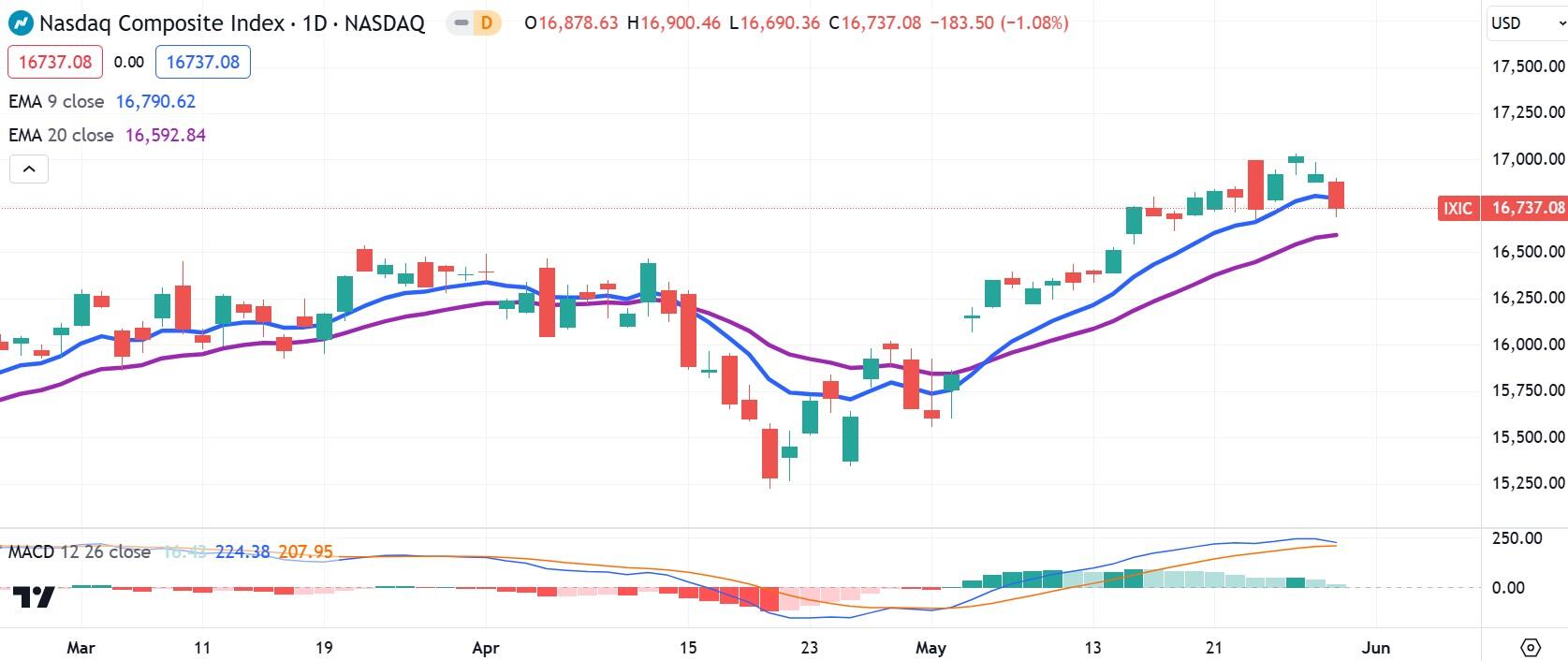
NASDAQ daily chart
Author

Clay Webster
FXStreet
Clay Webster grew up in the US outside Buffalo, New York and Lancaster, Pennsylvania. He began investing after college following the 2008 financial crisis.