|

Lithium ETF (LIT) should see more downside to reach a blue box

The Global X Lithium & Battery Tech ETF (LIT) invests in the full lithium cycle, from mining and refining the metal, through battery production. The Global X Lithium & Battery Tech ETF (LIT) seeks to provide investment results that correspond generally to the price and yield performance, before fees and expenses, of the Solactive Global Lithium Index.

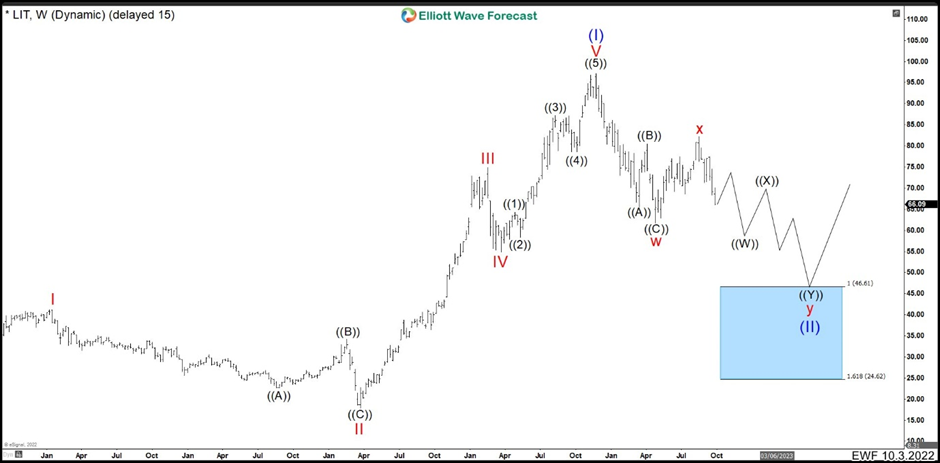
LIT weekly chart October 2022 
Chart

Lithium ETF (LIT) ended a bullish cycle in November 2021, and we call it wave (I). Wave I ended at 41.19 and we had a 3 waves correction to end wave II at 17.82. Then in March 2020, we saw a strong bounce toward 74.95 to complete wave III and a pullback as wave IV ending at 55.00. The latest rally made new 5 waves to finish at 97.26 and complete wave V and wave (I).

From this point the downward movement started, and it seems that it should complete a double correction before continuing with a rally. We can clearly see 3 swings down to complete wave w at 61.50. Then the x-connector ended at 82.15 and continue lower. Finishing the wave x, we called LIT could build a double correction structure as we can see in the chart. It should reach the 46.61 – 24.62 area and continue a rally. (If you want to learn more about Elliott Wave Principle, follow these links: Elliott Wave Education and Elliott Wave Theory).

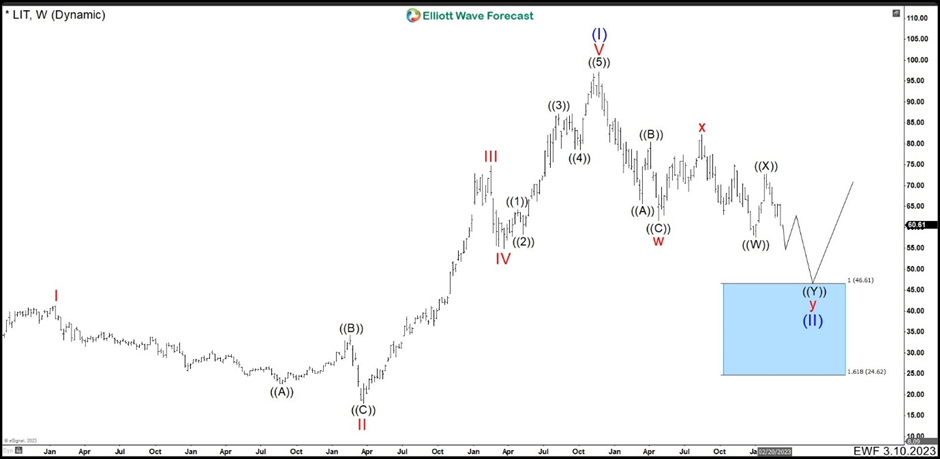
LIT weekly chart March 2023 
Chart

After 5 months, we can see LIT made 3 swings lower ending wave ((W)) at 57.56. This drop confirmed a bearish sequences breaking 61.50  low. The bounce completed wave ((X)) at 72.77 and continued with the downtrend.  To finish the short term double correction structure ((W)), ((X)) and ((Y)), the ETF needs 3 swings lower to reach 46.61 – 24.62 area. Also this should end red wxy  correction and wave (II) where it should rally to start a new uptrend.

Author

Elliott Wave Forecast Team

Elliott Wave Forecast Team

ElliottWave-Forecast.com

More from Elliott Wave Forecast Team
Share:

Editor's Picks

AUD/USD sticks to positive bias above 0.7100; lacks bullish conviction

AUD/USD trades with a positive bias for the second straight day, holding above 0.7100 in the Asian session on Friday as softer US bond yields keep US Dollar bulls on the back foot. Furthermore, hawkish RBA Governor Bullock's comments boost rate hike bets and support the Aussie. However, the Fed's hawkish outlook, along with geopolitical uncertainties, limits USD losses and caps the pair.

USD/JPY retreats below 157.00 as Ueda speaks on outlook

USD/JPY reverses the uptick to two-week highs near 157.30 in the European session on Friday as the Japanese Yen finds some respite from BoJ Governor Ueda's comments at the post-monetary policy meeting press conference. Earlier in the day, the central bank hiked the interest rate to 1.25%, with a surprise 7-2 vote.

Gold advances to fresh weekly top; eyes $$4,400 as softer US bond yields cap USD gains

Gold attracts some follow-through buying for the second straight day, and touches a fresh weekly high heading into the European session. US bond yields retreat further from multi-year highs as the recent pullback in crude oil prices helped alleviate immediate fears of runaway inflation. This caps gains for the US Dollar and supports the bullion.

Bitcoin extends recovery, Ethereum eyes $2,500, XRP holds $1.30
Bitcoin (BTC), Ethereum (ETH) and Ripple (XRP) extend their recovery, trading above $76,700, $2,400 and $1.300, respectively, on Friday. These top three cryptocurrencies now face key technical levels that could determine whether their recoveries extend further or pull back.
Cardano extends gains on bullish derivatives
Cardano (ADA) extends its recovery, trading above $0.210 at the time of writing on Friday, after finding support around a key zone earlier this week. Improving derivatives positioning and supporting technical indicators indicate growing bullish sentiment among ADA traders. Derivatives data shows a bullish tilt among Cardano traders.
How Japan became the World's Banker and why that era may be ending

Japan's ultra-low interest rates helped finance trillions of dollars in global investments for more than a decade, making the Japanese Yen one of the world’s cheapest sources of funding. With the Bank of Japan expected to tighten policy again this week, that advantage may be entering a new phase. While most major economies raised interest rates, Japan remained the world's outlier.