Lagarde Speech: ECB press conference to give clues on future policy after 25 bps rate hike
- Christine Lagarde to hold key press conference on Thursday.
- European Central Bank raises interest rates by 25 basis points as expected.
- Q&A section of speech will be important to determine ECB hawkish or dovish tone.
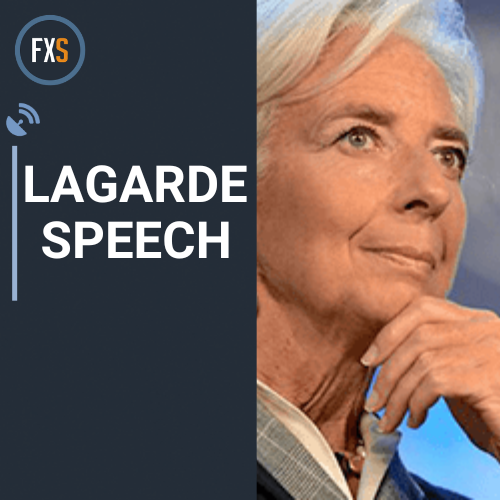
Christine Lagarde, President of the European Central Bank (ECB), will hold a press conference on Thursday, May 4 at 12:45 GMT, 30 minutes after the publication of the ECB monetary policy decision statement. The ECB raised interest rates by 25 basis points as expected.
You can follow the ECB press conference, with Christine Lagarde’s speech, in the following video:
ECB Press Conference: Lagarde speech live stream
Not making any commitment to cut rates at any point in time
"Saving a little bit of optionality on APP reinvestment."
"The ultimate goal is to reduce APP bond holdings to zero."
"Rate hiking is a journey, we are not there yet."
"Data dependency is not forward guidance."
"We had lengthy debates about core inflation."
"We are particularly concerned about food inflation."
"We are not Fed-dependent in rate decisions, we can tighten if the Fed pauses."
"We are not making any commitment to cut rates at any point in time."
Some governors thought 50 bps hike was appropriate
"Some ECB governors thought 50 bps hike was appropriate."
"Nobody advocated unchanged rates."
"There was a very strong consensus."
"I don't have a numerical estimate for sufficiently restrictive."
"We are not yet seeing the complete impact desired to get to target."
Not pausing, we have more ground to cover
"Mood in the meeting was determined."
"We were attentive to Bank Lending Survey."
"There were a variety of views expressed, everybody agreed that raising rates was needed."
"Not pausing, we have more ground to cover."
There are still significant upside risks to inflation
"Resilince of labour market could lead to higher growth."
"There are still significant upside risks to inflation."
"Recent wage deals added to upside risks."
"The Euro area banking sector has proved resilient."
"Higher pay growth or profit margins could increase inflation."
"According to a recent survey, bank lending may continue to decline."
Wage pressures have strengthened further
"Domestic demand, consumption, remained weak."
"We see divergence among sectors of the economy."
"Manufacturing prospects are worsening."
Government should roll back energy support measures."
"Price pressure remain strong."
"Services prices pushed up also by pent up demand."
"Wage pressures have strengthened further."
"Some firms also increased profit margins."
"Longer term inflation expectations warrant monitoring."
The Q&A session by Christine Lagarde will be key to shaping the market reaction. The 25 basis point rate hike could be accompanied by hawkish remarks from the ECB president.
The ECB has been raising interest rates in the past months, since the summer of 2022, lifting the main operations rate from 0% to the current 3.75%. In the previous press conference in March, Lagarde notoriously wore an owl pin on her jacket, a metaphor as a way to distance herself from both the hawkish or dovish camps.
How Lagarde operates this time around will be crucial to the market reaction, particularly for the Euro, which has retraced from year-to-date highs close to 1.1100 to just above 1.1000 after the ECB rate decision release.
About Christine Lagarde
Christine Lagarde was born in 1956 in Paris, France. Graduated from Paris West University Nanterre La Défense and became President of the European Central Bank in November 1st 2019. Prior to that, she served as Chairman and Managing Director of the International Monetary Fund between 2011 and 2019. Lagarde previously held various senior ministerial posts in the Government of France: she was Minister of the Economy, Finance and Industry (2007–2011), Minister of Agriculture and Fishing (2007) and Minister of Commerce (2005–2007).
Author

FXStreet Team
FXStreet
Composed of a group of economic journalists and FX experts, the FXStreet content team produces and oversees all content published on FXStreet. It provides a purely journalistic approach to the Forex market.