King of the memes: How Robinhood stocks soared after a slow IPO
Robinhood is a company that rarely sits still, so it’s perhaps unsurprising that its IPO is undergoing the same rollercoaster ride during its early days of life on the stock market. The investing app, indicated by its HOOD Nasdaq ticker symbol, has roared into life following a difficult start to life on its market debut. So why is the ever-popular platform surging after a slow start? It appears as though the app that’s birthed numerous meme-based short-squeezes is getting its own r/WallStreetBets treatment.
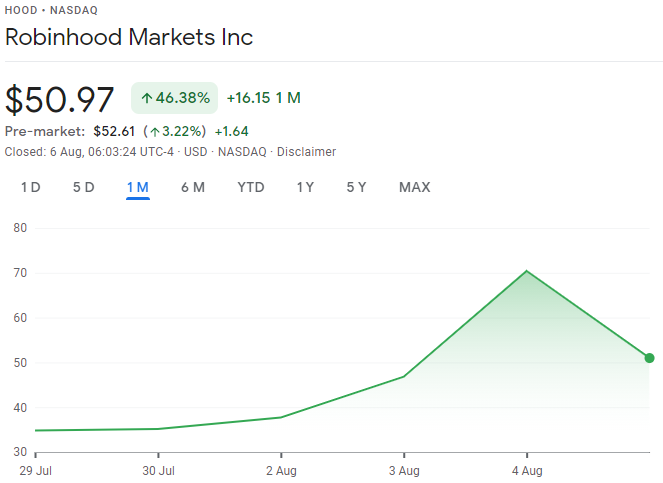
Robinhood debuted at $38 per share - the lower end of the expected pricing range. This indicates that the company’s IPO achieved a lower level of market demand than was initially anticipated. However, the pessimism proved to be short lived, with shares rocketing over 70% in the week that followed, with high volumes of interest arriving from the infamous Reddit group, r/WallStreetBets.
The post-IPO furore surrounding Robinhood has gathered momentum in recent days as Ark Invest, an investment management fund, confirmed that it had bought 89,622 shares on the 3rd of August, topping up the firm’s 1.3 million shares from Robinhood’s debut and a further 1.85 million a day later. In fact, Robinhood shares now account for around 0.9% of the company’s portfolio.
Data from Vanda Securities Pte, retail investors bought $19.4 million worth of shares in HOOD on Tuesday after the stock went public, making it the sixth most purchased share and the eleventh most traded security on retail platforms. Robinhood was also the best selling company on Fidelity’s platform, with over 32,000 purchase orders from customers - almost twice of AMC Entertainment, which stood in second place.
Furthermore, Robinhood became the top asset highlighted on the infamous Reddit forum, r/WallStreetBets - with 72% of the accompanying comments indicating a positive sentiment, according to the stock tracker SwaggyStocks. The 1,700 mentions that Robinhood attained far outstripped the second most frequent stock, AMD, which only generated 388 mentions.
After filing a secondary offering of 97.8 million shares on Friday, we’ve seen a 14.5% decline in trading. Selling investors have included Andreessen Horowitz and New Enterprise Associates. However, the sentiment surrounding Robinhood’s shares, it appears that the future’s bright for the stock after a testing opening 48 hours.
It appears as though optimism surrounding Robinhood is high, so what was behind the company’s difficult takeoff at the IPO level? And what’s driving the subsequent growth of the stock today? Let’s take a deeper look at the curious case of the Robinhood initial public offering:
Addressing Robinhood’s Controversies
One of the biggest concerns surrounding Robinhood is its collections of fines that appear to fly in the face of the company’s values.
Throughout 2021, Robinhood has rarely strayed from the headlines, and the company acknowledges its missteps in its S-1 filing. Furthermore, the platform paid a recent $57 million fine plus $12.6 million interest to the Financial Industry Regulatory Authority (FINRA).
The reason for this fine was confirmed on the company’s website: “FINRA found in its investigation that, despite Robinhood's self-described mission to 'de-mystify finance for all,' during certain periods since September 2016, the firm has negligently communicated false and misleading information to its customers. The false and misleading information concerned a variety of critical issues, including whether customers could place trades on margin, how much cash was in customers' accounts, how much buying power or 'negative buying power' customers had, the risk of loss customers faced in certain options transactions, and whether customers faced margin calls."
This disconnect between the app and its users may have interrupted Robinhood’s revolutionary new process for creating greater levels of retail investor engagement within IPO shares. In May 2021, Robinhood announced IPO Access - a dedicated portal designed to put more retail investors in touch with upcoming IPOs, including that of Robinhood.
Maxim Manturov, head of investment research at Freedom Finance Europe notes: “Robinhood wants to provide easy access to IPO trading, which may result in platform failure, as well as in limited access to many IPOs, since underwriters are unlikely to give up their earnings.”
However, just 1.3% of Robinhood’s user base opted to participate in the firm’s IPO, amounting to a total of 301,573 holders. This lack of investor enthusiasm following on from such scathing fines for misleading investors may have been a significant factor behind the flat arrival of the IPO.
Life as a Meme
Another argument as to why Robinhood’s price is fluctuating wildly in the short time it's spent as a public company is down to the meme investing landscape that the platform has helped to create.
Some argue that Robinhood has set itself up for a volatile ‘meme stock’ trajectory similar to that of GameStop and AMC - two stocks that have become extremely erratic having been traded heavily throughout 2021 on Robinhood’s app.
Though many of the high volumes of mentions for Robinhood on r/WallStreetBets were reportedly negative about the company, this can be pretty commonplace for a public internet forum. However, it also adds an element of uncertainty surrounding the stock’s longer-term future.
Although there’s plenty of potential for Robinhood to get the meme stock treatment, it’s important to note that there are plenty of factors that sets the platform apart from the likes of GameStop and AMC. Most notably, Robinhood has attracted investments from institutional investors - a factor that doesn’t tend to invite the level of short squeezes that we’ve become used to seeing in the cases of GME and AMC.
Ultimately, this makes the early stages of Robinhood’s floatation difficult to read with some certainty. The company pioneered a revolutionary new IPO Access service that appears to have done the platform no favours in leveraging a strong initial public offering, and Robinhood’s close relationship with the pumping of meme stocks means that there’s a danger the company becomes a meme itself.
However, with plenty of esteemed backers, the chances are that Robinhood continues to find its feet on Wall Street and carries on appreciating in value. Provided there are no more nasty fines or regulatory hurdles emerging, HOOD could find its feet over time.
Author

Dmytro Spilka
Solvid
Dmytro is a tech, blockchain and crypto writer based in London. Founder and CEO at Solvid. Founder of Pridicto, an AI-powered web analytics SaaS.