|

Key levels and divergences: What the S&P 500 chart is telling us

Price patterns in technical analysis are valuable tools for uncovering potential trading opportunities. These patterns can manifest across various time frames, making them useful for short- and long-term traders. For instance, a day trader may leverage multiple time frame analyses within intraday data to pinpoint strategic entry and exit points. Meanwhile, long-term traders might focus on weekly and monthly data to detect possible trend reversals, allowing them to take informed actions to safeguard their portfolios.

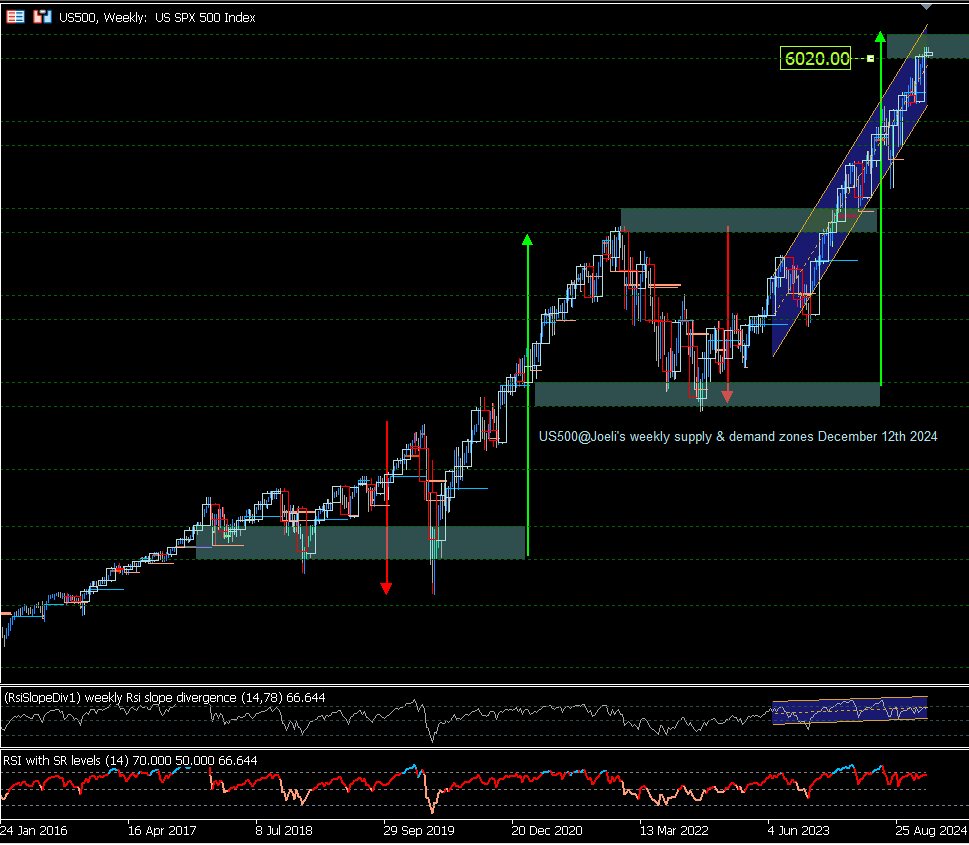
A closer look at the attached combined S&P 500 weekly and monthly chart reveals a compelling example of a long-term price pattern that originated in 2017. Traders should pay attention to the critical 6020 zone highlighted on the chart, as a failure to maintain this level could signal a repetition of past patterns. Additionally, price divergence must be given special attention, which occurs when the index reaches new highs while the relative strength index (RSI) registers lower lows. This divergence can be a telltale sign of underlying market weakness. For instance, during the significant correction in 2021, the S&P 500 experienced a drop of over 25% before it eventually rebounded and resumed its upward trajectory, forming the current pattern.

While identifying market reversals isn't always straightforward, combining price patterns with additional analytical tools—such as volume profiles and supply and demand zones—can enhance a trader's ability to recognise potential trend changes. This synergistic approach allows traders and investors to prepare effectively for shifts in market direction, positioning themselves to adjust their strategies accordingly.
Chart

Author

Denis Joeli Fatiaki

Denis Joeli Fatiaki

Independent Analyst

Denis Joeli Fatiaki possesses over a decade of extensive experience as a multi-asset trader and Market Strategist.


More from Denis Joeli Fatiaki
Share:

Editor's Picks

EUR/USD hits two-day highs near 1.1820

EUR/USD picks up pace and reaches two-day tops around 1.1820 at the end of the week. The pair’s move higher comes on the back of renewed weakness in the US Dollar amid growing talk that the Fed could deliver an interest rate cut as early as March. On the docket, the flash US Consumer Sentiment improves to 57.3 in February.

GBP/USD reclaims 1.3600 and above

GBP/USD reverses two straight days of losses, surpassing the key 1.3600 yardstick on Friday. Cable’s rebound comes as the Greenback slips away from two-week highs in response to some profit-taking mood and speculation of Fed rate cuts. In addition, hawkish comments from the BoE’s Pill are also collaborating with the quid’s improvement.

Gold climbs further, focus is back to 45,000

Gold regains upside traction and surpasses the $4,900 mark per troy ounce at the end of the week, shifting its attention to the critical $5,000 region. The move reflects a shift in risk sentiment, driving flows back towards traditional safe haven assets and supporting the yellow metal.

Crypto Today: Bitcoin, Ethereum, XRP rebound amid risk-off, $2.6 billion liquidation wave

Bitcoin edges up above $65,000 at the time of writing on Friday, as dust from the recent macro-triggered sell-off settles. The leading altcoin, Ethereum, hovers above $1,900, but resistance at $2,000 caps the upside. Meanwhile, Ripple has recorded the largest intraday jump among the three assets, up over 10% to $1.35.

Three scenarios for Japanese Yen ahead of snap election

The latest polls point to a dominant win for the ruling bloc at the upcoming Japanese snap election. The larger Sanae Takaichi’s mandate, the more investors fear faster implementation of tax cuts and spending plans. 

XRP rally extends as modest ETF inflows support recovery

Ripple is accelerating its recovery, trading above $1.36 at the time of writing on Friday, as investors adjust their positions following a turbulent week in the broader crypto market. The remittance token is up over 21% from its intraday low of $1.12.