Japanese Yen seems poised to register weekly gains against a softer USD
- The Japanese Yen attracts buyers as the upbeat data reaffirms BoJ rate hike bets.
- US fiscal concerns undermine the USD and further weigh on the USD/JPY pair.
- The divergent BoJ-Fed expectations back the case for further losses for the pair.

The Japanese Yen (JPY) sticks to intraday bullish bias through the first half of the European session on Friday, which, along with a softer US Dollar (USD), keeps the USD/JPY pair depressed below mid-144.00s. Strong Household Spending data released earlier today from Japan revives Bank of Japan (BoJ) rate hike bets and boosts the JPY. Apart from this, the uncertainty over US President Donald Trump's policies further benefits the safe-haven JPY.
Meanwhile, investors remain worried that trade tensions triggered by Trump's threat to impose more tariffs on Japan, over its alleged unwillingness to buy American-grown rice, could complicate the BoJ's efforts to normalise monetary policy. Apart from this, the prevalent risk-on environment might contribute to capping further gains for the JPY. Traders also seem reluctant amid a relatively thin liquidity on the back of the Independence Day holiday in the US.
Japanese Yen sticks to strong Household spending data-inspired gains
- The US Bureau of Labor Statistics (BLS) reported on Thursday that the economy added 147,000 new jobs in June compared to the previous month's upwardly revised reading of 144,000 and the 110,000 expected. Moreover, the Unemployment Rate edged lower to 4.1% from 4.2% in May and pointed to a still resilient US labor market.
- The topline beat gives the Federal Reserve space to stick to its wait-and-see approach amid the uncertainty stemming from US President Donald Trump's trade policies. This, in turn, pushed the US Dollar (USD) and the USD/JPY pair to a fresh weekly high, though the momentum lacked strong follow-through or bullish conviction.
- Additional details revealed that annual wage inflation growth, as measured by the change in the Average Hourly Earnings, retreated to 3.7% from 3.8% in May. This was short of the analysts' estimate of a 3.9% rise. This, along with concerns about the worsening US fiscal condition, contributes to capping the upside for the buck.
- US President Donald Trump’s tax-cut and spending bill cleared its final hurdle in Congress on Thursday, averting the near-term prospect of a US government default. The legislation would explode the federal deficit as it is estimated to add $3.4 trillion to the nation’s debt over the next decade. This would make America’s long-term debt problems even worse and hold back the USD bulls from placing aggressive bets, capping the USD/JPY pair.
- Meanwhile, the Japanese Yen attracts some buying during the Asian session on Friday after a government report showed that Household Spending surpassed even the most optimistic estimates and rose 4.7% in May from a year earlier. The upbeat data reignites speculation of near-term interest rate hikes by the Bank of Japan.
- In contrast, traders still see a greater chance that the Fed will resume its rate-cutting cycle in September and lower borrowing costs by at least 50 basis points by the end of this year. This contributes to the USD/JPY pair's slide, though trade uncertainties might hold back traders from placing aggressive directional bets.
USD/JPY attempted recovery could attract fresh selling around 144.65 confluence
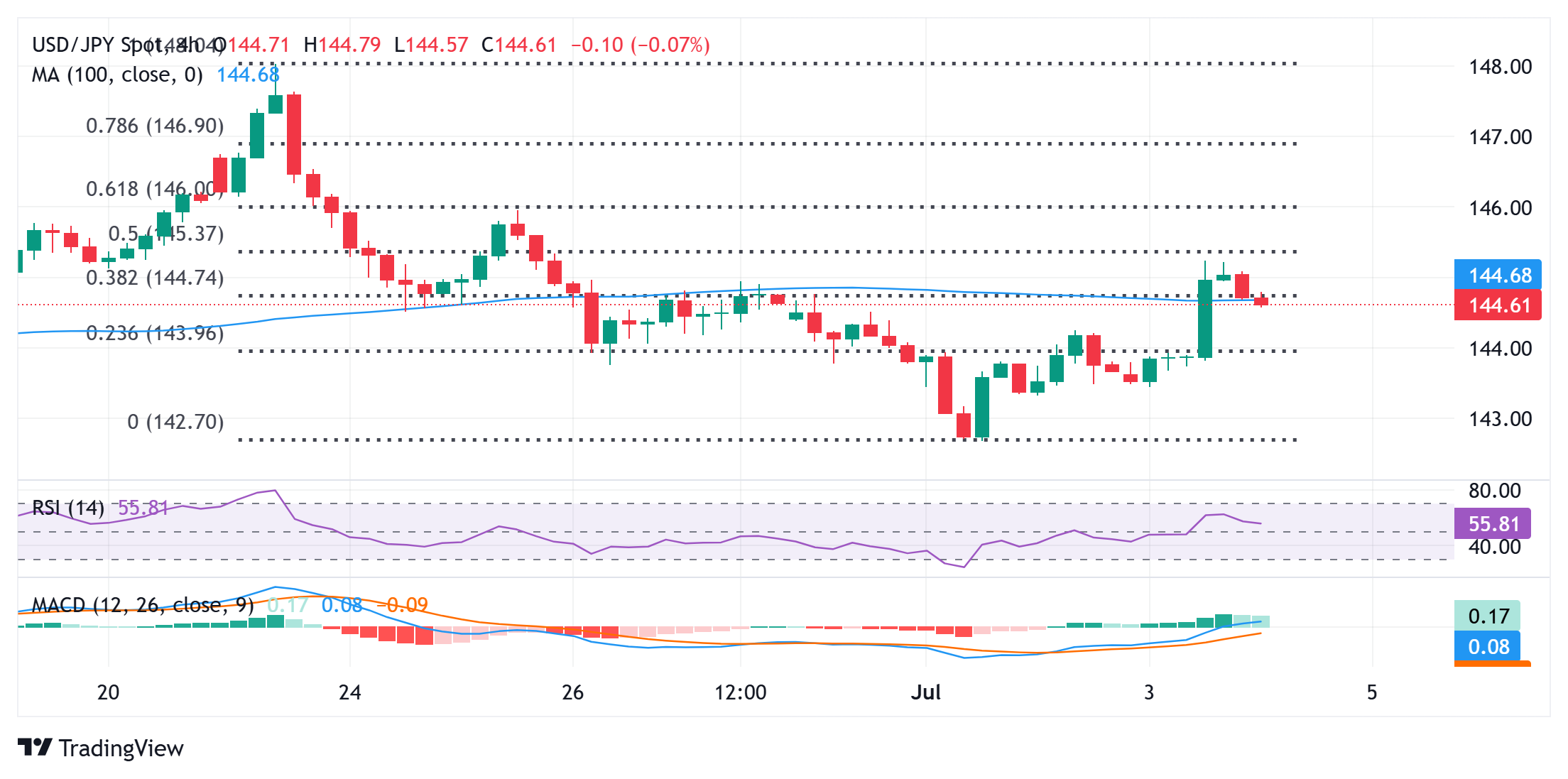
The overnight breakout through the 144.65-144.70 confluence – comprising the 100-period Simple Moving Average (SMA) on the 4-hour chart and the 38.2% Fibonacci retracement level of the June-July downfall – was seen as a key trigger for the USD/JPY bulls. However, failure near the 145.25 supply zone, which nears the 50% retracement level, and the subsequent pullback warrant some caution before positioning for any meaningful upside.
Meanwhile, any further slide is likely to find some support near the 144.20 horizontal zone ahead of the 144.00 round figure, or the 23.6% Fibo. retracement level. A convincing break below the latter might shift the bias back in favor of bearish traders and drag the USD/JPY pair to the 143.45 intermediate support en route to the 143.00 mark. The downward trajectory could extend further towards the 142.70-142.65 region, or a one-month low touched on Tuesday.
On the flip side, the 145.00 psychological mark might now act as an immediate hurdle ahead of the 145.25-145.30 zone. Some follow-through buying should allow the USD/JPY pair to test the 61.8% Fibo. retracement level and conquer the 146.00 round figure.
Tariffs FAQs
Tariffs are customs duties levied on certain merchandise imports or a category of products. Tariffs are designed to help local producers and manufacturers be more competitive in the market by providing a price advantage over similar goods that can be imported. Tariffs are widely used as tools of protectionism, along with trade barriers and import quotas.
Although tariffs and taxes both generate government revenue to fund public goods and services, they have several distinctions. Tariffs are prepaid at the port of entry, while taxes are paid at the time of purchase. Taxes are imposed on individual taxpayers and businesses, while tariffs are paid by importers.
There are two schools of thought among economists regarding the usage of tariffs. While some argue that tariffs are necessary to protect domestic industries and address trade imbalances, others see them as a harmful tool that could potentially drive prices higher over the long term and lead to a damaging trade war by encouraging tit-for-tat tariffs.
During the run-up to the presidential election in November 2024, Donald Trump made it clear that he intends to use tariffs to support the US economy and American producers. In 2024, Mexico, China and Canada accounted for 42% of total US imports. In this period, Mexico stood out as the top exporter with $466.6 billion, according to the US Census Bureau. Hence, Trump wants to focus on these three nations when imposing tariffs. He also plans to use the revenue generated through tariffs to lower personal income taxes.
Author

Haresh Menghani
FXStreet
Haresh Menghani is a detail-oriented professional with 10+ years of extensive experience in analysing the global financial markets.