Japanese Yen extends steady intraday descent; USD/JPY climbs back closer to mid-145.00s
- The Japanese Yen weakens slightly amid receding safe-haven demand.
- Expectations that the BoJ will hike rates again should limit JPY losses.
- The USD hangs near a one-week low and might cap the USD/JPY pair.

The Japanese Yen (JPY) remains on the back foot against its American counterpart, with the USD/JPY pair climbing back closer to mid-145.00s during the early European session on Wednesday. The optimism over the Israel-Iran ceasefire optimism remains supportive of a positive risk tone and acts as a headwind for traditional safe-haven assets. Moreover, the Summary of Opinions from the Bank of Japan's (BoJ) June meeting showed that some policymakers called for keeping interest rates steady for the time being due to uncertainty over the impact of US tariffs on Japan's economy. This, in turn, prompts some selling around the JPY.
Investors, however, seem convinced that the BoJ will hike interest rates further amid signs of broadening inflationary pressures in Japan. The bets were reaffirmed by Japan’s Services Producer Price Index (PPI), which rose for the third straight month and remained above the 3% YoY rate in May. This could act as a tailwind for the JPY. Adding to this, expectations that the Federal Reserve (Fed) would lower borrowing costs further keep the US Dollar (USD) bulls on the defensive and might contribute to capping the USD/JPY pair.
Japanese Yen bulls seem reluctant amid positive risk tone; not ready to give up amid BoJ rate hike bets
- The Bank of Japan published the Summary of Opinions from the June monetary policy meeting earlier this Wednesday, which revealed that several board members warned of the expected hit to Japan's fragile economy from sweeping US tariffs. Some policymakers said that consumer inflation was moving at higher-than-expected levels, partly due to surging prices of the staple rice.
- In fact, data released last week showed that Japan's annual National Consumer Price Index (CPI) rose by 3.5% YoY in May and remained above the BoJ's 2% target. Further details revealed that the National core CPI – excluding volatile fresh food prices – shot to the highest level since January 2023, while a core gauge that excludes both fresh food and energy prices climbed 3.3% YoY in May.
- Adding to this, Japan's Services Producer Price Index, released earlier this Wednesday, increased 3.3% YoY in May, slightly lower than the previous month's upwardly revised reading of 3.4%. The Services PPI is a key gauge of domestic inflation pressures and back-to-back readings above the 3% mark keep alive market expectations for further interest rate hikes by the central bank.
- Moreover, BoJ board member Naoki Tamura said on Wednesday that inflation rose more than expected back in May and he fog surrounding US tariffs is clearing somewhat, though it is difficult to predict the outlook. Tamura added that the Japanese central bank may need to act decisively if upside price risks heighten further.
- Meanwhile, Federal Reserve Chair Jerome Powell, in his prepared remarks for the Semiannual Monetary Policy Report to Congress, said that the central bank expects inflation to start rising soon and is in no rush to ease borrowing costs. Powell's remarks come after his colleagues recently suggested a rate cut at the July policy meeting, though it does little to impress the US Dollar bulls.
- The Israel-Iran ceasefire came into effect on Tuesday and appeared to hold for now, despite an Israeli attack on Tehran and an Iranian missile strike. Both Iran and Israel have claimed victory in the war and warned they were ready to renew hostilities if the other attacks. This keeps geopolitical risks in play and benefits the safe-haven Japanese Yen amid the divergent BoJ-Fed expectations.
USD/JPY could extend the intraday positive move once the 145.30 static barrier is cleared decisively
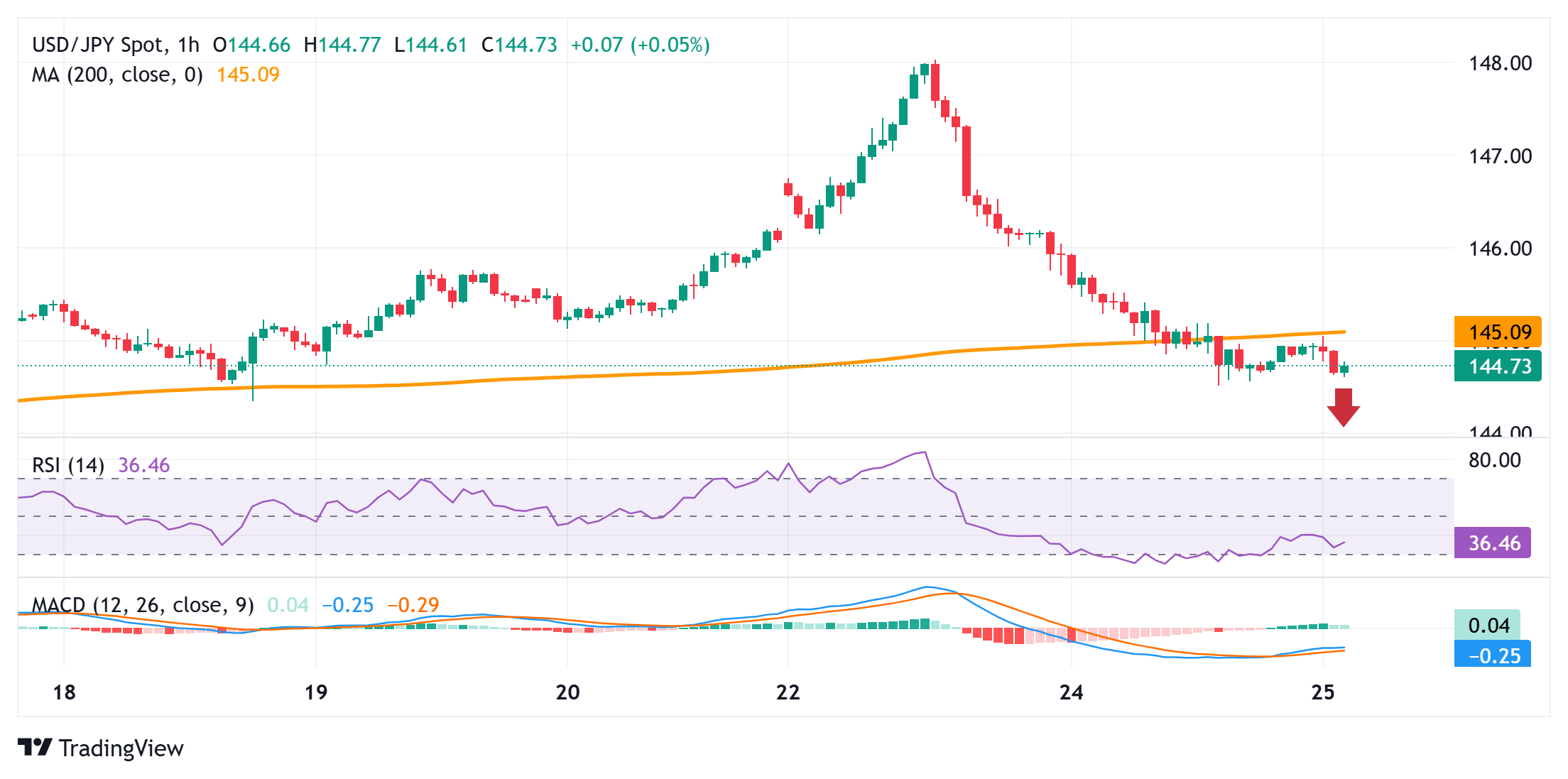
From a technical perspective, the overnight decline below the 145.35-145.25 resistance-turned-support and acceptance below the 200-hour Simple Moving Average (SMA) was seen as a key trigger for the USD/JPY bears. Moreover, oscillators on the daily chart have just started gaining negative traction and validate the near-term negative outlook for the currency pair. Some follow-through selling below mid-144.00s, or the overnight trough, should pave the way for a slide towards the 144.00 round figure en route to the 143.70-143.65 region before spot prices aim to test sub-143.00 levels.
On the flip side, any attempted recovery might now attract fresh sellers near the 145.00 psychological mark and remain capped near the 145.25-145.35 static barrier. A sustained strength beyond the latter might trigger a short-covering rally and allow the USD/JPY pair to reclaim the 146.00 mark. The momentum could extend further, though it runs the risk of fizzling out quickly near the 146.65-146.70 region. The latter should act as a pivotal point, which if cleared would negate the negative outlook and shift the near-term bias back in favor of bullish traders.
US Dollar PRICE This week
The table below shows the percentage change of US Dollar (USD) against listed major currencies this week. US Dollar was the strongest against the Canadian Dollar.
| USD | EUR | GBP | JPY | CAD | AUD | NZD | CHF | |
|---|---|---|---|---|---|---|---|---|
| USD | -1.27% | -1.63% | -0.97% | -0.17% | -1.04% | -1.25% | -1.42% | |
| EUR | 1.27% | -0.39% | 0.35% | 1.12% | 0.19% | 0.03% | -0.19% | |
| GBP | 1.63% | 0.39% | 0.77% | 1.52% | 0.59% | 0.42% | 0.18% | |
| JPY | 0.97% | -0.35% | -0.77% | 0.78% | -0.11% | -0.22% | -0.55% | |
| CAD | 0.17% | -1.12% | -1.52% | -0.78% | -0.83% | -1.08% | -1.31% | |
| AUD | 1.04% | -0.19% | -0.59% | 0.11% | 0.83% | -0.19% | -0.39% | |
| NZD | 1.25% | -0.03% | -0.42% | 0.22% | 1.08% | 0.19% | -0.23% | |
| CHF | 1.42% | 0.19% | -0.18% | 0.55% | 1.31% | 0.39% | 0.23% |
The heat map shows percentage changes of major currencies against each other. The base currency is picked from the left column, while the quote currency is picked from the top row. For example, if you pick the US Dollar from the left column and move along the horizontal line to the Japanese Yen, the percentage change displayed in the box will represent USD (base)/JPY (quote).
Author

Haresh Menghani
FXStreet
Haresh Menghani is a detail-oriented professional with 10+ years of extensive experience in analysing the global financial markets.