Japanese Yen remains on the front foot amid reviving safe-haven demand; lacks bullish conviction
- The Japanese Yen attracts some dip-buyers amid fading optimism over the US-China trade deal.
- Bets that the BoJ will continue raising interest rates in 2025 further lend support to the JPY.
- Dovish Fed expectations cap the USD recovery from a multi-year low and weigh on USD/JPY.

The Japanese Yen (JPY) retains bullish bias heading into the European session on Thursday, though it lacks follow-through and remains close to over a one-week low touched against its American counterpart the previous day. Fading hopes for a quick resolution to the US-China tradeoff, along with expectations that Japan will strike a trade deal with the US and bets for more interest rate hikes by the Bank of Japan (BoJ), help revive demand for the safe-haven JPY.
Meanwhile, the prospects for more aggressive policy easing by the Federal Reserve (Fed) mark a big divergence in comparison to hawkish BoJ expectations and further underpin the lower-yielding JPY. The US Dollar (USD), on the other hand, struggles to capitalize on a two-day-old recovery move from a multi-year low and contributes to the offered tone surrounding the USD/JPY pair. That said, a positive risk tone is holding back the JPY bulls from placing fresh bets.
Japanese Yen bulls have the upper hand amid US tariffs uncertainty, BoJ rate hike bets
- US President Donald Trump said that the 145% tariffs on Chinese imports will eventually come down substantially. Meanwhile, US Treasury Secretary Scott Bessent denied a Wall Street Journal report that the White House is considering unilaterally slashing tariffs on Chinese imports.
- Bessent's remarks suggested that the Trump administration could be waiting for China to make the first move, which cooled some optimism that the trade war between the world's two largest economies would de-escalate soon. This, in turn, drives some safe-haven flows towards the Japanese Yen.
- Japan's Finance Minister Katsunobu Kato told G7 countries on Thursday that US tariffs are highly disappointing and creating uncertainties in financial market. Meanwhile, Japan's Economic Revitalization Minister Ryosei Akazawa will visit the US for tariff talks from April 30.
- Bank of Japan Governor Kazuo Ueda said last week that the central bank may need to take policy action if US tariffs hurt the Japanese economy. Moreover, reports suggested that the BoJ will cut its economic growth forecasts and warn of escalating risks from Trump's sweeping trade tariff.
- Investors, however, seem convinced that the BoJ will continue raising interest rates in 2025 amid the broadening inflation in Japan, which has been running at or above the 2% target for around three years. This marks a big divergence in comparison to dovish Federal Reserve expectations.
- In fact, traders have been pricing in the possibility that the Fed will resume its rate-cutting cycle in June and lower borrowing costs at least three times by the end of this year. This fails to assist the US Dollar to capitalize on a two-day-old recovery, led by easing fears over the Fed's independence.
- Trump slammed Ukraine’s President Volodymyr Zelensky for his comments that Ukraine wouldn’t recognize Russian control of Crimea. Trump added that a deal to end the war was very close, but that Zelensky's refusal to accept US terms "will do nothing but prolong the conflict.”
- This keeps the geopolitical risk premium in play, which, along with the divergent BoJ-Fed policy expectations, should continue to benefit the lower-yielding JPY. Traders now look to the US economic docket – featuring Weekly Initial Jobless Claims, Durable Goods Orders, and Existing Home Sales data.
USD/JPY could resume its recent downtrend once the 142.00 mark is broken decisively
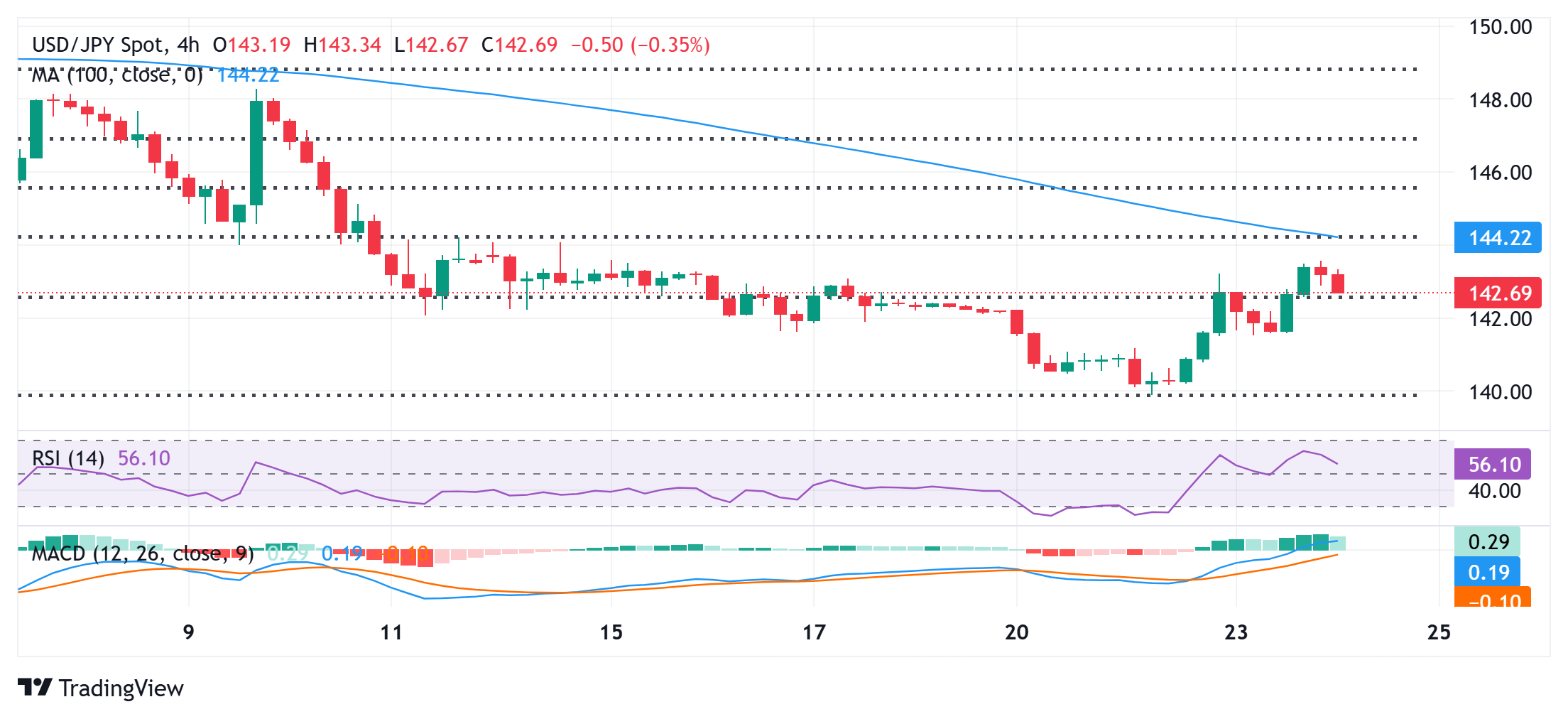
From a technical perspective, the overnight close above the 23.6% Fibonacci retracement level of the March-April downfall and the 143.00 mark was seen as a key trigger for the USD/JPY bulls. Moreover, oscillators on hourly charts have been gaining positive traction and support prospects for the emergence of dip-buyers near the 142.45-142.40 region. This should help limit the downside near the 142.00 round figure, below which spot prices could slide to mid-141.00s en route to the 141.10-141.00 region. The downward trajectory could extend further towards the 140.50 intermediate support and eventually expose the multi-month low – levels below the 140.00 psychological mark touched on Tuesday.
On the flip side, momentum back above the 143.00 mark might confront some hurdle near the 143.55 area or the overnight swing high. Some follow-through buying has the potential to lift the USD/JPY pair beyond the 144.00 round figure, towards the 144.35 confluence. The latter comprises 38.2% Fibo. level and the 200-period Simple Moving Average (SMA) on the 4-hour chart, which if cleared decisively should pave the way for some meaningful recovery in the near term.
Economic Indicator
Durable Goods Orders
The Durable Goods Orders, released by the US Census Bureau, measures the cost of orders received by manufacturers for durable goods, which means goods planned to last for three years or more, such as motor vehicles and appliances. As those durable products often involve large investments they are sensitive to the US economic situation. The final figure shows the state of US production activity. Generally speaking, a high reading is bullish for the USD.
Read more.Last release: Wed Mar 26, 2025 12:30
Frequency: Monthly
Actual: 0.9%
Consensus: -1%
Previous: 3.1%
Source: US Census Bureau
Author

Haresh Menghani
FXStreet
Haresh Menghani is a detail-oriented professional with 10+ years of extensive experience in analysing the global financial markets.