Japanese Yen trims a part of intraday losses against USD; bullish potential seems intact
- The Japanese Yen weakens further against USD amid concerns about Trump’s trade tariffs.
- Bets for more BoJ rate hikes and the risk-off mood help limit losses for the safe-haven JPY.
- The narrowing US-Japan rate differential further contributes to capping the USD/JPY pair.

The Japanese Yen (JPY) recovers slightly from a multi-day low touched against its American counterpart this Monday and drags the USD/JPY pair back below mid-155.00s during the early European session. The Bank of Japan (BoJ) Summary of Opinions showed that policymakers discussed the likelihood of raising interest rates further. Adding to this, a rise in Tokyo's core inflation by the fastest annual pace in nearly a year supports prospects for further policy tightening by the BoJ, which, in turn, offers some support to the JPY.
Apart from this, the narrowing interest rate differentials between Japan and the rest of the world, including the US, along with the risk-off impulse, turn out to be another factor underpinning the safe-haven JPY. That said, concerns about the economic fallout from US President Donald Trump’s trade tariffs keep the JPY bulls on the back foot. Apart from this, broad-based US Dollar (USD) strength could assist the USD/JPY pair to stick to its positive bias for the second straight day ahead of the release of the US ISM Manufacturing PMI.
Japanese Yen attracts some dip-buyers amid BoJ rate hike bets and trade war fears
- US President Donald Trump signed an order on Saturday to impose 25% tariffs on Canadian and Mexican imports and 10% on goods from China starting on Tuesday.
- Canada's Prime Minister Justin Trudeau, Mexico's President Claudia Sheinbaum, and China's foreign ministry were quick to respond with the upcoming tit-for-tat moves.
- The US Dollar rallies across the board and advances back closer to over a two-year high touched in January, which assists the USD/JPY pair to build on Friday's move up.
- The Bank of Japan's Summary of Opinions released earlier this Monday showed that policymakers discussed the likelihood of raising rates further at the January meeting.
- BoJ board members reiterated that it will be necessary to continue hiking rates, if economic activity and prices remain on track, though it does little to boost the Japanese Yen.
- Japan's Finance Minister Katsunobu Kato said that the government intends to monitor the impact of Trump's new tariffs on its currency amid worries about the fallout.
- Japan's Economy Minister Ryosei Akazawa said that the officials aim to reach the 2% BoJ's inflation goal and plan measures to mitigate the impact of increasing living costs.
- The US-Japan yield differential hovers near a multi-week low. This, along with the risk-off impulse, could help limit a further JPY depreciation in the near term.
- Traders now look forward to this week's important US macro releases scheduled at the start of a new month, starting with the ISM Manufacturing PMI later today.
- The focus, however, will remain glued to the US monthly employment data – popularly known as the Nonfarm Payrolls (NFP) report due for release on Friday.
USD/JPY bears have the upper hand while below the 156.25 pivotal resistance
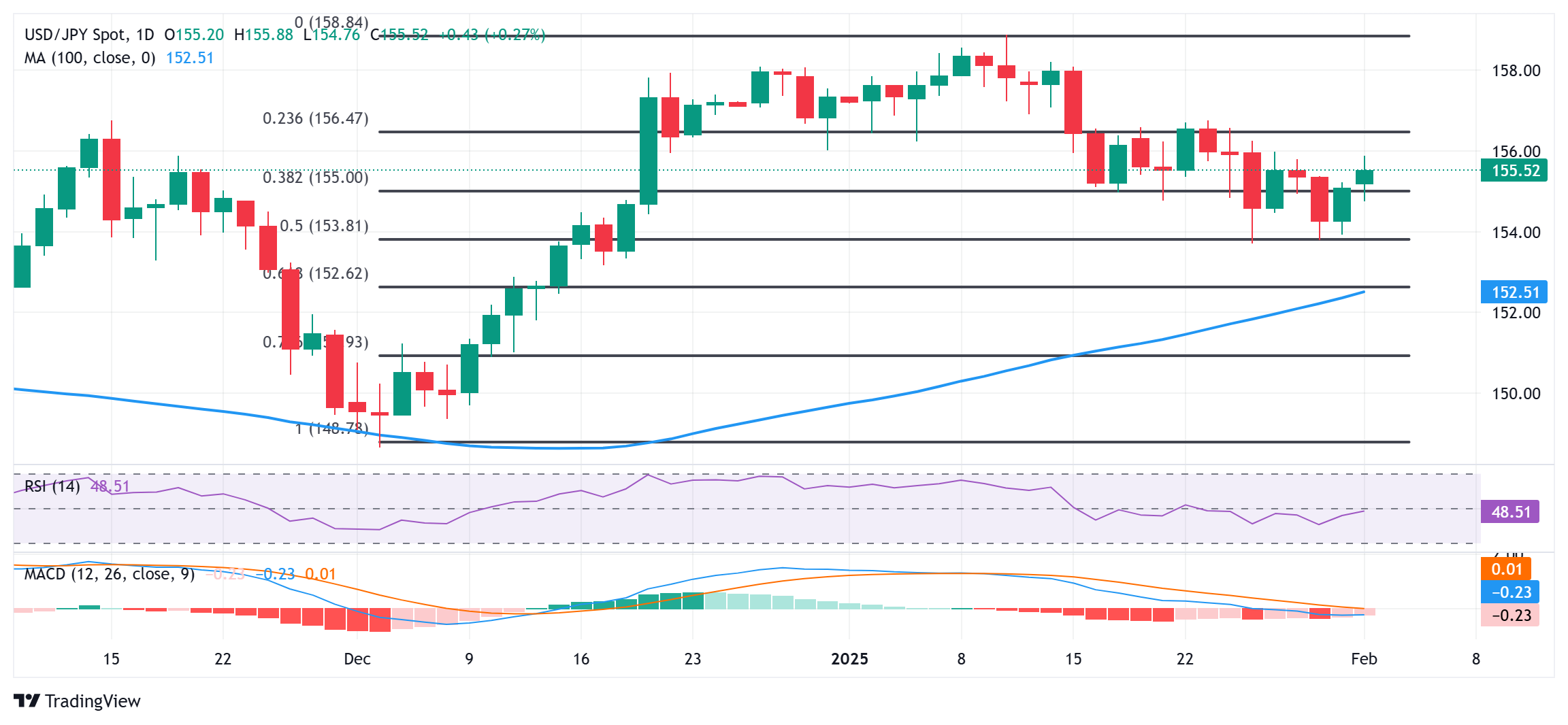
From a technical perspective, last week's goodish rebound from the 50% retracement level of the December-January rally and the subsequent move up favor bullish traders. That said, any further strength beyond the 156.00 mark might confront some hurdle near last week's swing high, around the 156.25 area. A sustained strength beyond the said barrier could trigger a fresh bout of a short-covering rally and lift the USD/JPY pair to the 156.70-156.75 region en route to the 157.00 round figure and the 157.60 horizontal barrier. The momentum could extend further towards the 158.00 mark, above which spot prices could aim to retest the multi-month top, around the 158.85-158.90 region touched on January 10.
On the flip side, the 155.00 psychological mark now seems to protect the immediate downside ahead of the 154.55-154.50 horizontal zone and the 154.00 round figure. This is closely followed by the January monthly trough, around the 153.70 area touched last Monday. A convincing break below the latter would be seen as a fresh trigger for bearish traders and make the USD/JPY pair vulnerable to accelerate the fall further towards the 153.30 support. Spot prices could eventually drop to the 153.00 mark.
Tariffs FAQs
Tariffs are customs duties levied on certain merchandise imports or a category of products. Tariffs are designed to help local producers and manufacturers be more competitive in the market by providing a price advantage over similar goods that can be imported. Tariffs are widely used as tools of protectionism, along with trade barriers and import quotas.
Although tariffs and taxes both generate government revenue to fund public goods and services, they have several distinctions. Tariffs are prepaid at the port of entry, while taxes are paid at the time of purchase. Taxes are imposed on individual taxpayers and businesses, while tariffs are paid by importers.
There are two schools of thought among economists regarding the usage of tariffs. While some argue that tariffs are necessary to protect domestic industries and address trade imbalances, others see them as a harmful tool that could potentially drive prices higher over the long term and lead to a damaging trade war by encouraging tit-for-tat tariffs.
During the run-up to the presidential election in November 2024, Donald Trump made it clear that he intends to use tariffs to support the US economy and American producers. In 2024, Mexico, China and Canada accounted for 42% of total US imports. In this period, Mexico stood out as the top exporter with $466.6 billion, according to the US Census Bureau. Hence, Trump wants to focus on these three nations when imposing tariffs. He also plans to use the revenue generated through tariffs to lower personal income taxes.
Author

Haresh Menghani
FXStreet
Haresh Menghani is a detail-oriented professional with 10+ years of extensive experience in analysing the global financial markets.