Japanese Yen rises due to the hawkish BoJ, safe-haven flows
- The Japanese Yen advances as traders expect the BoJ to implement another rate hike in the near term.
- Japan’s Machinery Orders rose by 2.1% MoM in June, surpassing the expected 1.1% rise.
- The US Dollar loses ground as dovish Fedspeak raises odds of a Fed rate cut in September.

The Japanese Yen (JPY) appreciates for the second consecutive day against the US Dollar (USD), driven by hawkish sentiment surrounding the Bank of Japan (BoJ). Recent data showing growth in Japan’s second-quarter GDP supports the potential for an interest rate hike by the BoJ in the near term.
The safe-haven flows amid rising geopolitical tensions might have supported the Japanese Yen. Hamas has rejected the terms for a hostage release-ceasefire deal discussed in Doha on Thursday and Friday, according to Reuters citing a local news agency Times of Israel. Additionally, concerns about escalating tensions between Ukraine and Russia were heightened as Ukraine initiated the largest invasion of Russia since World War II.
The US Dollar continues to lose ground following dovish comments from Federal Reserve (Fed) officials, which have heightened expectations for an interest rate cut by the US central bank in September. Additionally, last week’s US economic data showed that both the Producer Price Index (PPI) and Consumer Price Index (CPI) indicate that inflation is easing.
Federal Reserve Bank of San Francisco President Mary Daly emphasized Sunday that the US central bank should take a gradual approach to reducing borrowing costs, according to the Financial Times. Additionally, Federal Reserve Bank of Chicago President Austan Goolsbee warned that central bank officials should be cautious about keeping a restrictive policy in place longer than necessary.
Daily Digest Market Movers: Japanese Yen appreciates due to a hawkish BoJ
- Japan’s Machinery Orders, a key indicator of capital expenditure, increased by 2.1% month-on-month in June, surpassing the forecasted 1.1% rise. Markets are now anticipating Japanese inflation figures later this week for further insight into the Bank of Japan’s monetary policy direction.
- On Friday, US Housing Starts dropped by 6.8% in July to 1.238 million units, following a 1.1% increase in June. Meanwhile, the University of Michigan’s Consumer Sentiment Index rose to 67.8 in August, showing its first increase in five months, surpassing expectations and up from 66.4 in July.
- The US Census Bureau reported on Thursday that US Retail Sales climbed 1.0% month-over-month in July, a sharp turnaround from June's 0.2% decline, surpassing the projected 0.3% increase. Moreover, Initial Jobless Claims for the week ending August 9 reached 227,000, lower than the forecast of 235,000 and down from 234,000 the previous week.
- On Thursday, Japanese Economy Minister Yoshitaka Shindo stated that the economy is anticipated to recover gradually as wages and income improve. Shindo also added that the government will collaborate closely with the Bank of Japan to implement flexible macroeconomic policies.
- Japan's Gross Domestic Product (GDP) grew by 0.8% quarter-on-quarter in Q2, surpassing market forecasts of 0.5% and rebounding from a 0.6% decline in Q1. This marked the strongest quarterly growth since Q1 of 2023. Meanwhile, the annualized GDP growth reached 3.1%, exceeding the market consensus of 2.1% and reversing a 2.3% contraction in Q1. This was the strongest yearly expansion since Q2 of 2023.
- US headline Consumer Price Index (CPI) rose 2.9% year-over-year in July, slightly down from the 3% increase in June and below market expectations. The Core CPI, which excludes food and energy, climbed 3.2% year-over-year, a slight decrease from the 3.3% rise in June but aligned with market forecasts.
- Rabobank's senior FX strategist, Jane Foley, observes that this week's series of US data releases, along with next week's Jackson Hole event, should provide the market with clearer insights into the potential responses of US policymakers. However, their main expectation is that the Fed will reduce rates by 25 basis points in September and likely cut them again before the end of the year.
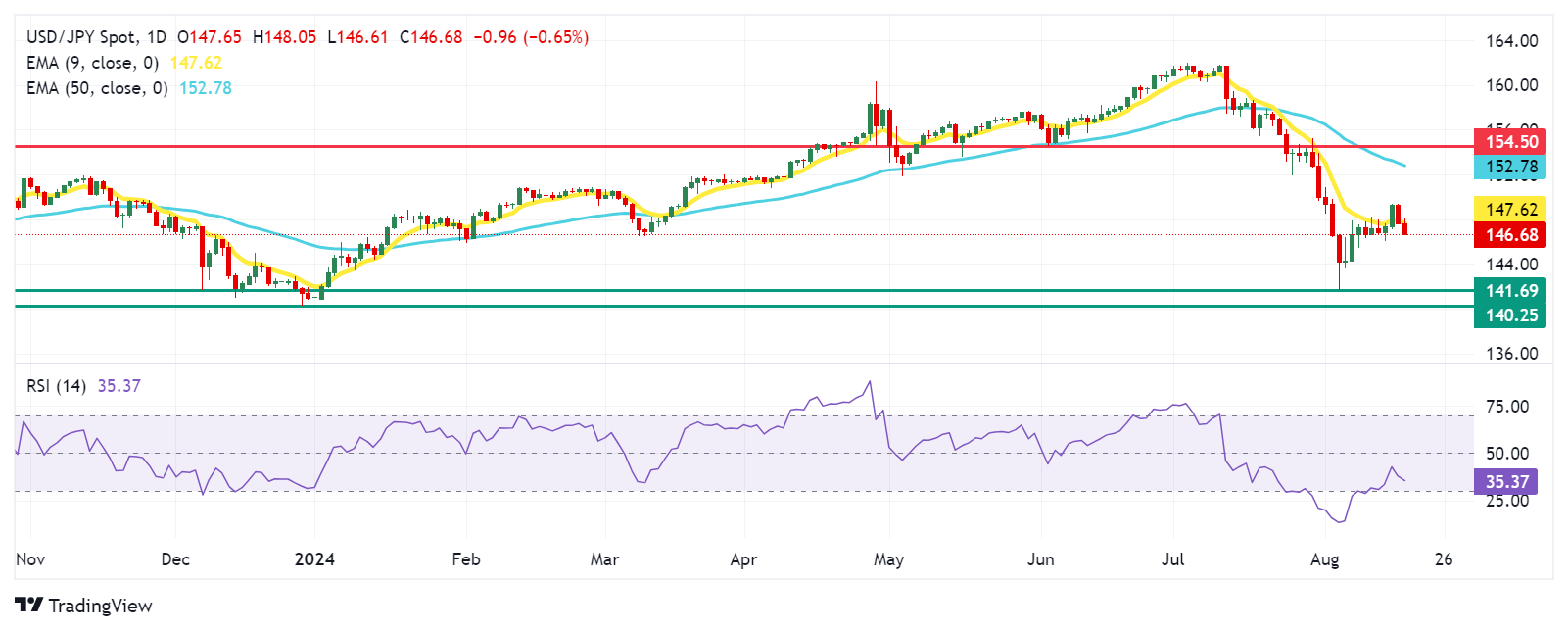
Technical Analysis: USD/JPY falls to near 146.50
USD/JPY trades around 146.40 on Monday. Daily chart analysis indicates that the pair is slightly below the nine-day Exponential Moving Average (EMA), signaling a short-term bearish trend. Additionally, the 14-day Relative Strength Index (RSI) remains below 50, confirming the bearish momentum.
For support levels, the USD/JPY pair may test the area around its seven-month low of 141.69, reached on August 5. A further decline could push the pair toward the next “throwback support” level at 140.25.
On the upside, the USD/JPY pair could face an immediate barrier around the nine-day Exponential Moving Average (EMA) at 147.60. A break above this level might see the pair targeting the 50-day EMA at 152.78, with the potential to test the resistance level at 154.50, which has shifted from previous throwback support to current pullback resistance.
USD/JPY: Daily Chart
(This story was corrected on August 19 at 07:10 GMT to state in the title "Japanese Yen rises" instead of "Japanese Yen drops.")
Japanese Yen PRICE Today
The table below shows the percentage change of Japanese Yen (JPY) against listed major currencies today. Japanese Yen was the strongest against the US Dollar.
| USD | EUR | GBP | JPY | CAD | AUD | NZD | CHF | |
|---|---|---|---|---|---|---|---|---|
| USD | -0.18% | -0.16% | -1.05% | -0.08% | -0.27% | -0.47% | -0.17% | |
| EUR | 0.18% | -0.05% | -0.84% | 0.10% | -0.18% | -0.45% | -0.02% | |
| GBP | 0.16% | 0.05% | -0.95% | 0.12% | -0.14% | -0.34% | 0.03% | |
| JPY | 1.05% | 0.84% | 0.95% | 0.92% | 0.77% | 0.73% | 0.77% | |
| CAD | 0.08% | -0.10% | -0.12% | -0.92% | -0.21% | -0.30% | -0.12% | |
| AUD | 0.27% | 0.18% | 0.14% | -0.77% | 0.21% | -0.12% | 0.16% | |
| NZD | 0.47% | 0.45% | 0.34% | -0.73% | 0.30% | 0.12% | 0.32% | |
| CHF | 0.17% | 0.02% | -0.03% | -0.77% | 0.12% | -0.16% | -0.32% |
The heat map shows percentage changes of major currencies against each other. The base currency is picked from the left column, while the quote currency is picked from the top row. For example, if you pick the Japanese Yen from the left column and move along the horizontal line to the US Dollar, the percentage change displayed in the box will represent JPY (base)/USD (quote).
Risk sentiment FAQs
In the world of financial jargon the two widely used terms “risk-on” and “risk off'' refer to the level of risk that investors are willing to stomach during the period referenced. In a “risk-on” market, investors are optimistic about the future and more willing to buy risky assets. In a “risk-off” market investors start to ‘play it safe’ because they are worried about the future, and therefore buy less risky assets that are more certain of bringing a return, even if it is relatively modest.
Typically, during periods of “risk-on”, stock markets will rise, most commodities – except Gold – will also gain in value, since they benefit from a positive growth outlook. The currencies of nations that are heavy commodity exporters strengthen because of increased demand, and Cryptocurrencies rise. In a “risk-off” market, Bonds go up – especially major government Bonds – Gold shines, and safe-haven currencies such as the Japanese Yen, Swiss Franc and US Dollar all benefit.
The Australian Dollar (AUD), the Canadian Dollar (CAD), the New Zealand Dollar (NZD) and minor FX like the Ruble (RUB) and the South African Rand (ZAR), all tend to rise in markets that are “risk-on”. This is because the economies of these currencies are heavily reliant on commodity exports for growth, and commodities tend to rise in price during risk-on periods. This is because investors foresee greater demand for raw materials in the future due to heightened economic activity.
The major currencies that tend to rise during periods of “risk-off” are the US Dollar (USD), the Japanese Yen (JPY) and the Swiss Franc (CHF). The US Dollar, because it is the world’s reserve currency, and because in times of crisis investors buy US government debt, which is seen as safe because the largest economy in the world is unlikely to default. The Yen, from increased demand for Japanese government bonds, because a high proportion are held by domestic investors who are unlikely to dump them – even in a crisis. The Swiss Franc, because strict Swiss banking laws offer investors enhanced capital protection.
Author

Akhtar Faruqui
FXStreet
Akhtar Faruqui is a Forex Analyst based in New Delhi, India. With a keen eye for market trends and a passion for dissecting complex financial dynamics, he is dedicated to delivering accurate and insightful Forex news and analysis.