Japanese Yen sticks to positive bias against USD amid BoJ-Fed policy divergence
- The Japanese Yen reverses a modest Asian session downtick against a broadly weaker USD.
- The BoJ rate hike expectations and the global flight to safety offer some support to the JPY.
- The divergent BoJ-Fed policy outlook further exerts downward pressure on the USD/JPY.

The Japanese Yen (JPY) remains on the front foot against a broadly weaker US Dollar (USD), with the USD/JPY pair flirting with a four-week-old trading range support just below the 147.00 mark during the early European session on Monday. Moreover, the fundamental backdrop seems tilted in favor of the JPY bulls. Fresh geopolitical risks stemming from Russia's sweeping attack on Ukraine and escalating Israel-Hamas conflict might continue to benefit the JPY's safe-haven status. Adding to this, the growing acceptance that the Bank of Japan (BoJ) will hike interest rates soon validates the positive outlook for the JPY.
Meanwhile, hawkish BoJ expectations mark a significant divergence in comparison to rising bets that the Federal Reserve (Fed) will lower borrowing costs twice by the end of 2025. This has been a key factor behind the US Dollar's (USD) underperformance and further benefits the lower-yielding JPY, suggesting that the path of least resistance for the USD/JPY pair is to the downside. Traders, however, might refrain from placing aggressive bets amid the expected thin liquidity on the back of the Labor Day holiday in the US and ahead of this week's important US macro releases scheduled at the start of a new month.
Japanese Yen benefits from the divergent BoJ-Fed policy expectations, safe-haven demand
- The S&P Global Japan Manufacturing Purchasing Managers’ Index (PMI) was finalized at 49.7 for August, signaling a slower and only marginal deterioration in business conditions across the sector.
- Separately, Japan's Ministry of Finance reported this Monday that companies increased capital spending on plant and equipment by 7.6% in the April-June quarter from the same period a year earlier.
- US President Donald Trump, in an interview with The Daily Caller, expressed doubt over a one-on-one meeting between Russian President Vladimir Putin and Ukrainian President Volodymyr Zelenskyy.
- Russia launched a large-scale attack, involving over 500 drones and 45 missiles, on Ukraine over the weekend, with Zelenskyy vowing to retaliate by ordering more strikes deep inside Russia.
- Israeli forces pounded the suburbs of Gaza City overnight from the air and ground. Israeli Defence Minister Israel Katz said that the spokesperson of Hamas’ armed wing, Abu Ubaida, was killed.
- This keeps geopolitical risks in play and acts as a tailwind for the safe-haven Japanese Yen, which is further underpinned by expectations that the Bank of Japan will hike interest rates soon.
- In contrast, traders are now pricing in a greater chance that the US Federal Reserve will lower borrowing costs by 25 basis points in September and deliver two rate cuts by the year-end.
- The divergent BoJ-Fed policy expectations might continue to benefit the lower-yielding JPY and cap the USD/JPY pair amid the underlying bearish sentiment surrounding the US Dollar.
- The US markets will be closed on Monday in observance of Labor Day. Traders might also refrain from placing aggressive directional bets ahead of this week's important US macro releases.
USD/JPY technical setup backs the case for a break below trading range support near 146.70
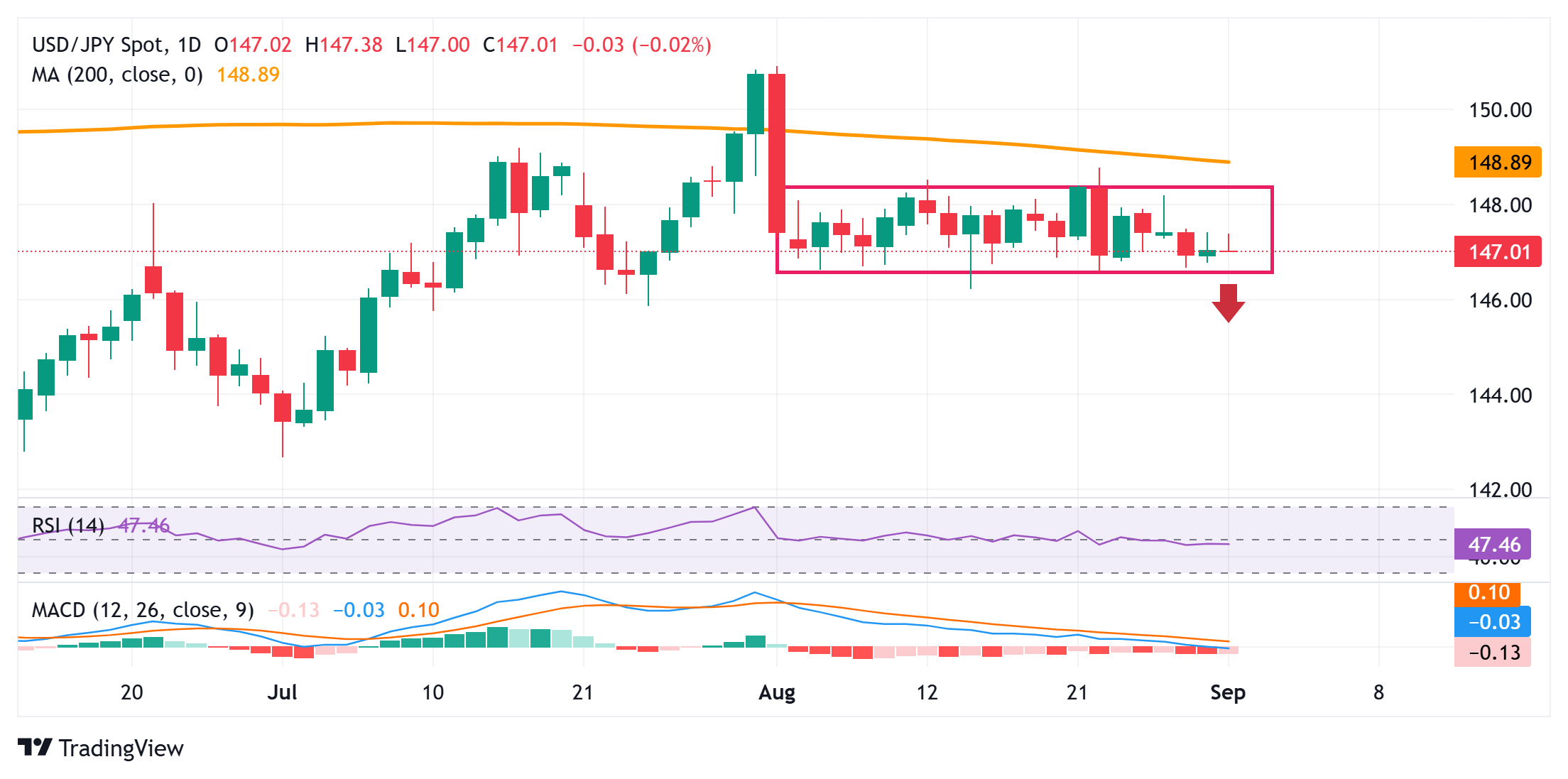
From a technical perspective, the USD/JPY pair remains confined in a four-week-old trading band. The lower end of the range is pegged around the 146.70 area, which should continue to act as an immediate strong support. A convincing break and acceptance below the said support could drag spot prices to the August string low, around the 146.20 area, en route to the 146.00 mark. Some follow-through selling will be seen as a fresh trigger for bearish traders and pave the way for deeper losses.
On the flip side, momentum beyond the 147.45-147.50 immediate hurdle could attract fresh sellers and remain capped ahead of the 148.00 round figure. The latter represents the top end of the aforementioned trading range, which, if cleared decisively, could prompt a short-covering rally towards the recent swing high, around the 148.75-148.80 region. The said area nears the 200-day Simple Moving Average (SMA), and a sustained strength beyond might shift the near-term bias in favor of the USD/JPY bulls.
Fed FAQs
Monetary policy in the US is shaped by the Federal Reserve (Fed). The Fed has two mandates: to achieve price stability and foster full employment. Its primary tool to achieve these goals is by adjusting interest rates. When prices are rising too quickly and inflation is above the Fed’s 2% target, it raises interest rates, increasing borrowing costs throughout the economy. This results in a stronger US Dollar (USD) as it makes the US a more attractive place for international investors to park their money. When inflation falls below 2% or the Unemployment Rate is too high, the Fed may lower interest rates to encourage borrowing, which weighs on the Greenback.
The Federal Reserve (Fed) holds eight policy meetings a year, where the Federal Open Market Committee (FOMC) assesses economic conditions and makes monetary policy decisions. The FOMC is attended by twelve Fed officials – the seven members of the Board of Governors, the president of the Federal Reserve Bank of New York, and four of the remaining eleven regional Reserve Bank presidents, who serve one-year terms on a rotating basis.
In extreme situations, the Federal Reserve may resort to a policy named Quantitative Easing (QE). QE is the process by which the Fed substantially increases the flow of credit in a stuck financial system. It is a non-standard policy measure used during crises or when inflation is extremely low. It was the Fed’s weapon of choice during the Great Financial Crisis in 2008. It involves the Fed printing more Dollars and using them to buy high grade bonds from financial institutions. QE usually weakens the US Dollar.
Quantitative tightening (QT) is the reverse process of QE, whereby the Federal Reserve stops buying bonds from financial institutions and does not reinvest the principal from the bonds it holds maturing, to purchase new bonds. It is usually positive for the value of the US Dollar.
Author

Haresh Menghani
FXStreet
Haresh Menghani is a detail-oriented professional with 10+ years of extensive experience in analysing the global financial markets.