Japanese Yen languishes near monthly low against firmer USD despite reviving safe-haven demand
- The Japanese Yen struggles to lure buyers amid reduced bets for a BoJ rate hike in 2025.
- The USD climbs to over one-week high and further lends support to the USD/JPY pair.
- Rising geopolitical tensions in the Middle East could limit losses for the safe-haven JPY.

The Japanese Yen (JPY) is seen underperforming on Thursday against a broadly firmer US Dollar (USD), with the USD/JPY pair eyeing the monthly swing high retested earlier this week. The Bank of Japan's (BoJ) cautious approach to unwinding its decade-long monetary stimulus forced investors to push back their expectations about the likely timing of the next interest rate hike to Q1 2026. Adding to this concerns about the potential economic fallout from existing 25% US tariffs on Japanese vehicles and 24% reciprocal levies turn out to be key factors undermining the JPY.
The USD, on the other hand, climbs to its highest level in over a week on the back of the Federal Reserve's (Fed) hawkish pause on Wednesday. Meanwhile, the backdrop of the uncertainty surrounding US President Donald Trump's trade policies and rising geopolitical tensions in the Middle East continues to weigh on investors' sentiment. This could help limit deeper losses for the safe-haven JPY and cap the USD/JPY pair. Hence, it will be prudent to wait for a sustained breakout through a short-term trading range barrier before placing fresh bullish bets around the pair.
Japanese Yen bulls remain on the defensive amid diminishing odds for BoJ rate hike in 2025
- The Federal Reserve, as was widely expected, kept interest rates steady at the end of a two-day policy meeting on Wednesday amid expectations of higher inflation ahead. In the closely watched “dot plot,” the committee indicated that two cuts by the end of 2025 are still on the table.
- Fed officials, however, forecasted a single quarter-percentage-point rate cut in each of 2026 and 2027. Moreover, seven of the 19 policymakers indicated they wanted no cuts this year, up from four in March, amid the risk that inflation could stay persistently higher and end the year at 3%.
- This comes on top of US President Donald Trump's remarks earlier this week, that tariffs on the pharma sector are coming soon, and weigh on investors' sentiment. This, along with geopolitical risks stemming from the Israel-Iran conflict, benefits the Japanese Yen's safe-haven status.
- As the Israel-Iran conflict enters its seventh day, reports suggest that US officials are preparing for a possible Iran strike this coming weekend. According to the Wall Street Journal, Trump approved attack plans for Iran but is holding off to see if Tehran will abandon its nuclear program.
- Meanwhile, Iran's Supreme Leader Ayatollah Ali Khamenei said in a national address that Iran will not surrender and warned that any US military intervention would result in irreparable damage. This, in turn, raises the risk of a broader regional conflict in the Middle East.
- On the trade-related front, Japan's Prime Minister Shigeru Ishiba said this week that we have not yet reached an agreement as there are still some differences between the two sides. This comes ahead of the July 9 deadline for higher reciprocal US tariffs and might cap the JPY.
- The US Dollar, on the other hand, stands near its highest level in over a week on the back of the Fed's hawkish pause. This is seen offering some support to the USD/JPY pair and warrants caution for bearish traders in the absence of any relevant US economic data on Thursday.
USD/JPY awaits a breakout through trading range hurdle near 145.45 before the next leg higher
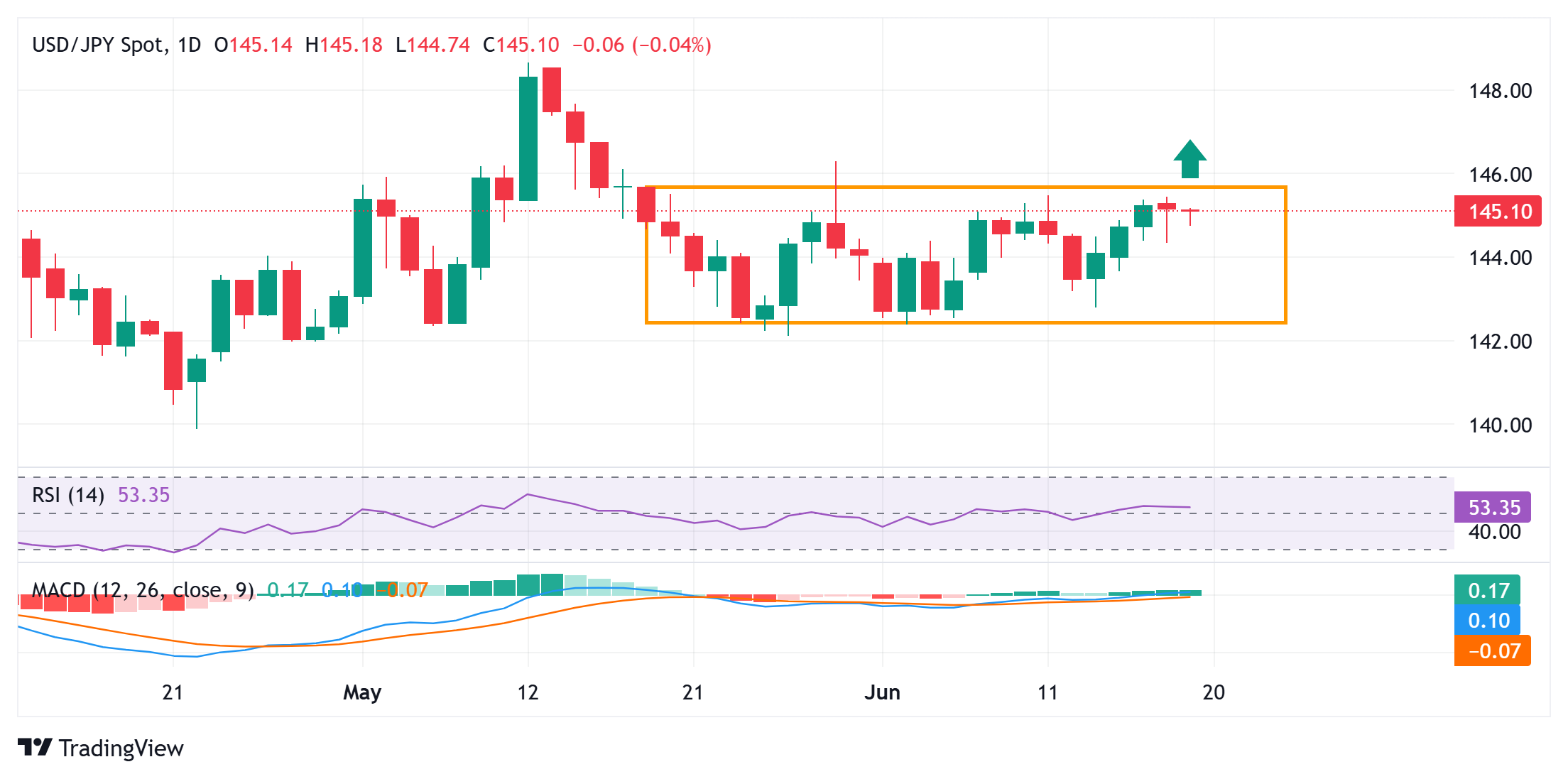
From a technical perspective, any further slide is likely to find decent support and might still be seen as a buying opportunity near the 144.50-144.45 area, below which the USD/JPY pair could slide to the 144.00 mark. A convincing break below the latter would expose the next relevant support near the 143.55-143.50 region before spot prices eventually drop to the 143.00 round figure en route to last Friday's swing low, around the 142.80-142.75 region.
On the flip side, the 145.45 area, representing the top end of a short-term trading range and the monthly swing high, might continue to act as an immediate hurdle. A sustained strength beyond will be seen as a fresh trigger for bullish traders. Given that oscillators on the daily chart have just started gaining positive traction, spot prices might then aim to conquer the 146.00 round figure before climbing further to the 146.25-146.30 region, or the May 29 peak.
Tariffs FAQs
Tariffs are customs duties levied on certain merchandise imports or a category of products. Tariffs are designed to help local producers and manufacturers be more competitive in the market by providing a price advantage over similar goods that can be imported. Tariffs are widely used as tools of protectionism, along with trade barriers and import quotas.
Although tariffs and taxes both generate government revenue to fund public goods and services, they have several distinctions. Tariffs are prepaid at the port of entry, while taxes are paid at the time of purchase. Taxes are imposed on individual taxpayers and businesses, while tariffs are paid by importers.
There are two schools of thought among economists regarding the usage of tariffs. While some argue that tariffs are necessary to protect domestic industries and address trade imbalances, others see them as a harmful tool that could potentially drive prices higher over the long term and lead to a damaging trade war by encouraging tit-for-tat tariffs.
During the run-up to the presidential election in November 2024, Donald Trump made it clear that he intends to use tariffs to support the US economy and American producers. In 2024, Mexico, China and Canada accounted for 42% of total US imports. In this period, Mexico stood out as the top exporter with $466.6 billion, according to the US Census Bureau. Hence, Trump wants to focus on these three nations when imposing tariffs. He also plans to use the revenue generated through tariffs to lower personal income taxes.
Author

Haresh Menghani
FXStreet
Haresh Menghani is a detail-oriented professional with 10+ years of extensive experience in analysing the global financial markets.