Japanese Yen remains on the front foot amid intervention fears; lacks bullish conviction
- The Japanese Yen attracts some intraday buyers in reaction to comments from Japan's Kato.
- Political uncertainty could delay BoJ rate hikes and might keep a lid on further JPY gains.
- Easing fears of a US-China trade war could further undermine the JPY’s safe-haven status.

The Japanese Yen (JPY) trims a part of modest gains against its American counterpart, though bulls retain intraday control amid speculations that authorities could intervene to stem weakness in the domestic currency. Moreover, the prospects for an eventual interest rate hike by the Bank of Japan (BoJ) this year turn out to be another factor lending support to the JPY. Any meaningful appreciation, however, seems elusive in the wake of expectations that domestic political chaos could delay the BoJ's rate hike plans.
Meanwhile, US President Donald Trump's pivot on China tariffs remains supportive of the prevalent risk-on environment. This further holds back traders from placing aggressive bullish bets around the safe-haven JPY. The US Dollar (USD), on the other hand, preserves the previous day's modest gains and further offers support to the USD/JPY pair. Nevertheless, the mixed fundamental backdrop warrants some caution before positioning for a firm direction ahead of Federal Reserve (Fed) Chair Jerome Powell's speech.
Japanese Yen edges up as Kato's comments fuel intervention fears
- Japan's Finance Minister Katsunobu Kato said this Tuesday that he has recently seen one-sided and rapid moves in the foreign exchange, adding that it’s important for currencies to move in a stable manner, reflecting fundamentals. This provides a goodish lift to the Japanese Yen, though political uncertainty might cap gains.
- The long-standing Liberal Democratic Party (LDP)–Komeito coalition came to an abrupt end last week, as the newly elected LDP leader, Sanae Takaichi, awaits a parliamentary vote to confirm her as Japan’s first female Prime Minister. The breakup, in turn, means Takaichi would need support from other parties for her key policies.
- Nevertheless, the heightened political uncertainty might create a challenge for the Bank of Japan to hike interest rates further and continue to undermine the Japanese Yen. Furthermore, the optimism led by US President Donald Trump's pivot on China tariffs turns out to be another factor driving flows away from the safe-haven JPY.
- In fact, Trump softened his stance after threatening additional tariffs of 100% on Chinese imports effective November 1 and posted on Truth Social that the US does not wish to hurt China. Trump added that both countries wish to avoid economic pain, easing concerns about a trade war between the world's two largest economies.
- The US Dollar looks to build on the previous day's positive move and remains within striking distance of its highest level since August touched last week, which further offers support to the USD/JPY pair. However, dovish Federal Reserve expectations might keep a lid on any further USD appreciation and cap the currency pair.
- According to the CME FedWatch tool, the possibility of a 25-basis-point interest rate cut by the Fed in October and December stands at around 97% and 90%, respectively. In contrast, traders are pricing in a greater chance that the BoJ would hike interest rates amid still sticky inflation and a still resilient economic performance.
- The US government shutdown is on track to extend into a third week amid deadlock on a funding plan. Republican Speaker Mike Johnson said that the shutdown could become the longest in history, warning that he won’t negotiate with Democrats until they pause their health care demands and reopen government.
- Important US macro releases have been delayed due to a prolonged US government shutdown, leaving the USD at the mercy of speeches from influential FOMC members. Hence, Tuesday's key focus will be on Fed Chair Jerome Powell's appearance, which could drive the USD and provide some impetus to the USD/JPY pair.
USD/JPY fails near the 100-hour SMA; bears await break below 151.00
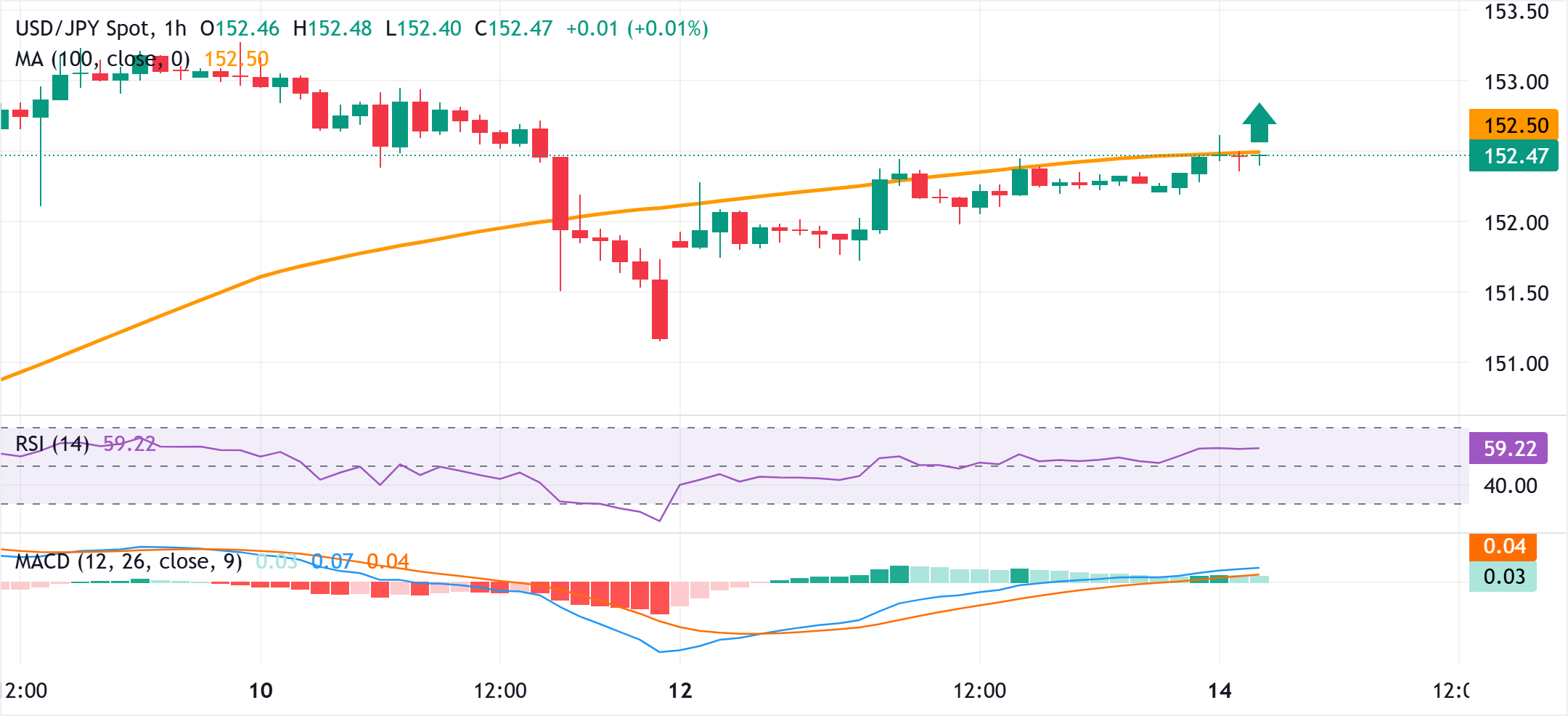
From a technical perspective, the USD/JPY pair has been struggling to move back above the 100-hour Simple Moving Average (SMA). However, positive oscillators on hourly/daily charts back the case for a further appreciating move. Some follow-through buying beyond the 152.70-152.75 hurdle will reaffirm the positive outlook and lift spot prices to the 153.00 mark en route to the eighth-month high, around the 153.25-153.30 region, touched last Friday.
On the flip side, weakness below the Asian session trough, around the 152.15 region, could find some support near the 152.00 mark ahead of the 151.75-151.70 region. Any further slide is more likely to attract some buyers near the 151.15 region (Friday's swing low), which is closely followed by the 151.00 round figure. A convincing break below the latter could make the USD/JPY pair vulnerable to accelerate the fall below the 150.70 intermediate support, towards testing the 150.00 psychological mark. The latter also represents the 200-hour SMA and should act as a key pivotal point.
Bank of Japan FAQs
The Bank of Japan (BoJ) is the Japanese central bank, which sets monetary policy in the country. Its mandate is to issue banknotes and carry out currency and monetary control to ensure price stability, which means an inflation target of around 2%.
The Bank of Japan embarked in an ultra-loose monetary policy in 2013 in order to stimulate the economy and fuel inflation amid a low-inflationary environment. The bank’s policy is based on Quantitative and Qualitative Easing (QQE), or printing notes to buy assets such as government or corporate bonds to provide liquidity. In 2016, the bank doubled down on its strategy and further loosened policy by first introducing negative interest rates and then directly controlling the yield of its 10-year government bonds. In March 2024, the BoJ lifted interest rates, effectively retreating from the ultra-loose monetary policy stance.
The Bank’s massive stimulus caused the Yen to depreciate against its main currency peers. This process exacerbated in 2022 and 2023 due to an increasing policy divergence between the Bank of Japan and other main central banks, which opted to increase interest rates sharply to fight decades-high levels of inflation. The BoJ’s policy led to a widening differential with other currencies, dragging down the value of the Yen. This trend partly reversed in 2024, when the BoJ decided to abandon its ultra-loose policy stance.
A weaker Yen and the spike in global energy prices led to an increase in Japanese inflation, which exceeded the BoJ’s 2% target. The prospect of rising salaries in the country – a key element fuelling inflation – also contributed to the move.
Author

Haresh Menghani
FXStreet
Haresh Menghani is a detail-oriented professional with 10+ years of extensive experience in analysing the global financial markets.