Japanese Yen retains bullish bias against weaker USD, drags USD/JPY closer to 145.00
- The Japanese Yen builds on the overnight recovery from over a one-month low against the USD.
- The divergent BoJ-Fed policy expectations provide a goodish boost to the lower-yielding JPY.
- A broadly weaker USD exerts additional pressure and contributes to the USD/JPY pair decline.

The Japanese Yen (JPY) adds to its strong intraday gains against a broadly weaker US Dollar (USD) and drags the USD/JPY pair closer to the 145.00 psychological mark heading into the European session on Tuesday. Investors seem convinced that the Bank of Japan (BoJ) will hike interest rates again amid the broadening inflation in Japan. This marks a big divergence in comparison to growing expectations that the Federal Reserve (Fed) will lower borrowing costs soon, potentially by July, which, in turn, keeps the USD depressed and benefits the lower-yielding JPY.
Meanwhile, reports that Japan's Economy Minister Ryosei Akazawa is arranging his seventh visit to the US as early as June 26 fuel hopes for an eventual US-Japan trade deal ahead of the July 9 deadline for steep US reciprocal tariffs. This is seen as another factor underpinning the JPY, which seems rather unaffected by the Israel-Iran ceasefire deal and suggests that the path of least resistance for the USD/JPY pair is to the downside. Traders, however, might refrain from placing aggressive bets and opt to wait for Fed Chair Jerome Powell's congressional testimony.
Japanese Yen is underpinned by a weaker USD and divergent BoJ-Fed expectations
- The Bank of Japan's decision last week to slow the pace of reduction in its bond purchases from fiscal 2026 forced investors to push back their expectations about the likely timing of the next interest rate hike. However, data released last Friday showed that Japan's core inflation rose to a more than two-year high in May and remained above the central bank's 2% target for well over three years.
- Moreover, the better-than-expected release of Japan's PMI on Monday keeps the door open for further rate hikes by the BoJ in the coming month. Meanwhile, reports that the first ministerial-level tariff negotiation since the Japan-US summit in Canada could be held as early as June 26 ease concerns about the economic fallout from steep US tariffs and provide an additional boost to the Japanese Yen.
- In contrast, the US Dollar extends the previous day's retracement slide from over a one-week high in the wake of mixed US PMIs and dovish-sounding remarks from Federal Reserve officials on Monday. The S&P Global’s flash Manufacturing PMI held steady at 52 in June, while the gauge for the service sector cooled slightly to 53.1 from 53.7, and the composite index slipped to 52.8 from 53.0 in May.
- Adding to this, Fed Governor Michelle Bowman said that the time to cut rates may be fast approaching as she has grown more worried about risks to the job market and less concerned that tariffs will cause an inflation problem. Furthermore, Chicago Fed President Austan Goolsbee also said that, thus far, the surge in tariffs has had a more modest impact on the economy relative to what was expected.
- This comes on top of Fed Governor Christopher Waller's remarks last Friday that the US central bank should consider cutting rates at its next policy meeting on July 29-30. Traders are now pricing in 58 basis points of interest rate cuts by the Fed this year, suggesting that two 25-bps rate cuts are certain and a rising chance of a third reduction. This marks a sharp divergence from hawkish BoJ expectations.
- On the geopolitical front, US President Donald Trump announced on Truth Social that Israel and Iran have agreed to a complete and total ceasefire. Israel, however, is yet to comment officially, while Iran's foreign minister says that if Israel stops its attacks, Iran will also bring an end to its strikes. This, along with trade-related uncertainties, should keep a lid on the optimism and benefit the safe-haven JPY.
- Traders now look forward to Fed Chair Jerome Powell's congressional testimony, which, along with speeches by a slew of influential FOMC members, will be scrutinized for cues about the future rate-cut path. Apart from this, the US macro data – the Conference Board's Consumer Confidence Index and the Richmond Manufacturing Index – would drive the USD and provide some impetus to the USD/JPY pair.
USD/JPY approaches the 145.00 psychological mark resistance-turned-support
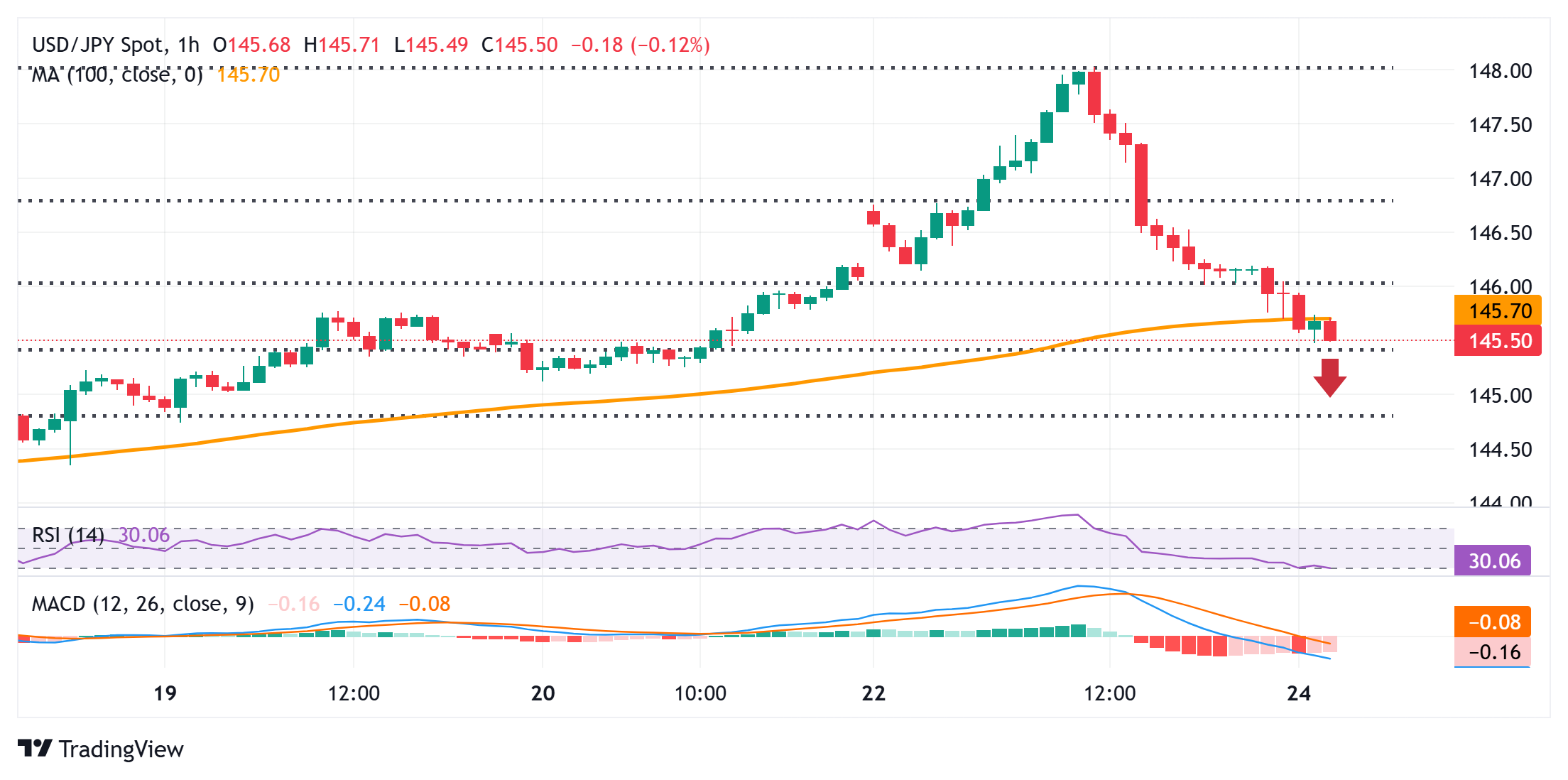
From a technical perspective, the downfall drags the USD/JPY pair below the 100-hour Simple Moving Average (SMA), though stalls ahead of the 50% retracement level of the recent strong move higher. Moreover, mixed oscillators on hourly and daily charts make it prudent to wait for a sustained break below the said support, around the 145.40 area, before positioning for further losses towards the 145.00 psychological mark. The latter should act as a near-term base, which, if broken decisively, might shift the bias in favor of bearish traders and prompt some technical selling.
On the flip side, the 146.00 round figure, which coincides with the 38.2% Fibonacci retracement level, now seems to act as an immediate strong barrier, above which the USD/JPY pair could climb to the 146.70-146.75 area (23.6% Fibo. level). Some follow-through buying, leading to a subsequent strength beyond the 147.00 mark, could lift spot prices to the 147.40-147.45 intermediate hurdle en route to the 148.00 round figure and 148.65 region, or the May monthly swing high.
Economic Indicator
Fed's Chair Powell testifies
Federal Reserve Chair Jerome Powell testifies before Congress, providing a broad overview of the economy and monetary policy. Powell's prepared remarks are published ahead of the appearance on Capitol Hill.
Read more.Next release: Tue Jun 24, 2025 14:00
Frequency: Irregular
Consensus: -
Previous: -
Source: Federal Reserve
Author

Haresh Menghani
FXStreet
Haresh Menghani is a detail-oriented professional with 10+ years of extensive experience in analysing the global financial markets.