Japanese Yen retreats from two-week top against rebounding USD, bullish bias remains
- The Japanese Yen outperforms the USD as a deal with the US eases economic worries.
- The JPY bulls seem reluctant amid domestic political uncertainty and disappointing PMIs.
- A modest USD bounce from multi-week low further lends support to the USD/JPY pair.

The Japanese Yen (JPY) retreats slightly from an over two-week high touched against its American counterpart this Thursday, though any meaningful depreciation still seems elusive. Domestic political uncertainty, the disappointing release of the flash Manufacturing PMI from Japan, and the prevalent risk-on mood turn out to be key factors that fail to assist the safe-haven JPY to capitalize on strong intraday gains. This, along with a modest US Dollar (USD) uptick, contributes to the USD/JPY pair's bounce from the 145.85 region.
Meanwhile, the announcement of the US-Japan trade deal earlier this week eased market concerns about the potential economic fallout from higher tariffs and also seems to have revived bets for another interest rate hike by the Bank of Japan (BoJ) this year. This might continue to offer support to the JPY. The USD, on the other hand, might struggle to attract buyers amid concerns about the Federal Reserve's (Fed) independence, which, in turn, warrants some caution before placing aggressive bullish bets around the USD/JPY pair.
Japanese Yen bulls turn cautious amid receding safe-haven demand; downside seems limited
- Japan's trade deal with the US has removed a key downside risk for the domestic economy, suggesting that conditions for the Bank of Japan to hike interest rates further may start to fall in place. In fact, BoJ Deputy Governor Shinichi Uchida reiterated on Wednesday the central bank's course of action to continue raising interest rates if the economy and prices move in line with forecasts.
- Moreover, a Reuters poll showed that a majority of economists expect the BoJ to hike its key interest rate again by the year-end, though most expect the central bank could wait for some time and would stand pat at this month's meeting. Nevertheless, reviving BoJ rate hike bets continues to underpin the Japanese Yen and drags the USD/JPY pair below the 146.00 mark on Thursday.
- Meanwhile, Japan's ruling coalition – the Liberal Democratic Party (LDP) and its junior partner Komeito – suffered a defeat in the upper house elections last weekend. This adds a layer of uncertainty and fuels concerns about Japan's fiscal health. Adding to this, a private-sector survey showed on Thursday that Japan’s manufacturing activity unexpectedly slipped into contraction during July.
- In fact, the S&P Global Japan manufacturing Purchasing Managers’ Index (PMI) dropped to 48.8 from June’s final reading of 50.1 as businesses assessed the impact of US tariffs. This, to a larger extent, overshadows the upbeat gauge for the services sector, which increases to 53.5 in July from 51.7 in the previous month. Apart from this, the upbeat market mood could cap the safe-haven JPY.
- The US Dollar struggles to attract any buyers amid fears that the Federal Reserve's independence could be under threat from mounting political interference. US President Donald Trump has been personally attacking Fed Chair Jerome Powell for not lowering interest rates. US Treasury Secretary Scott Bessent said that the new Fed Chair nominee is likely to be announced in December or January.
- Thursday's US economic docket – featuring the usual Weekly Initial Jobless Claims, the flash PMIs, and New Home Sales – might influence the USD price dynamics later during the North American session. Furthermore, the European Central Bank decision could infuse some volatility in the markets, which would drive the safe-haven demand and provide some impetus to the USD/JPY pair.
USD/JPY might struggle to move back above 100-SMA support breakpoint around 146.60
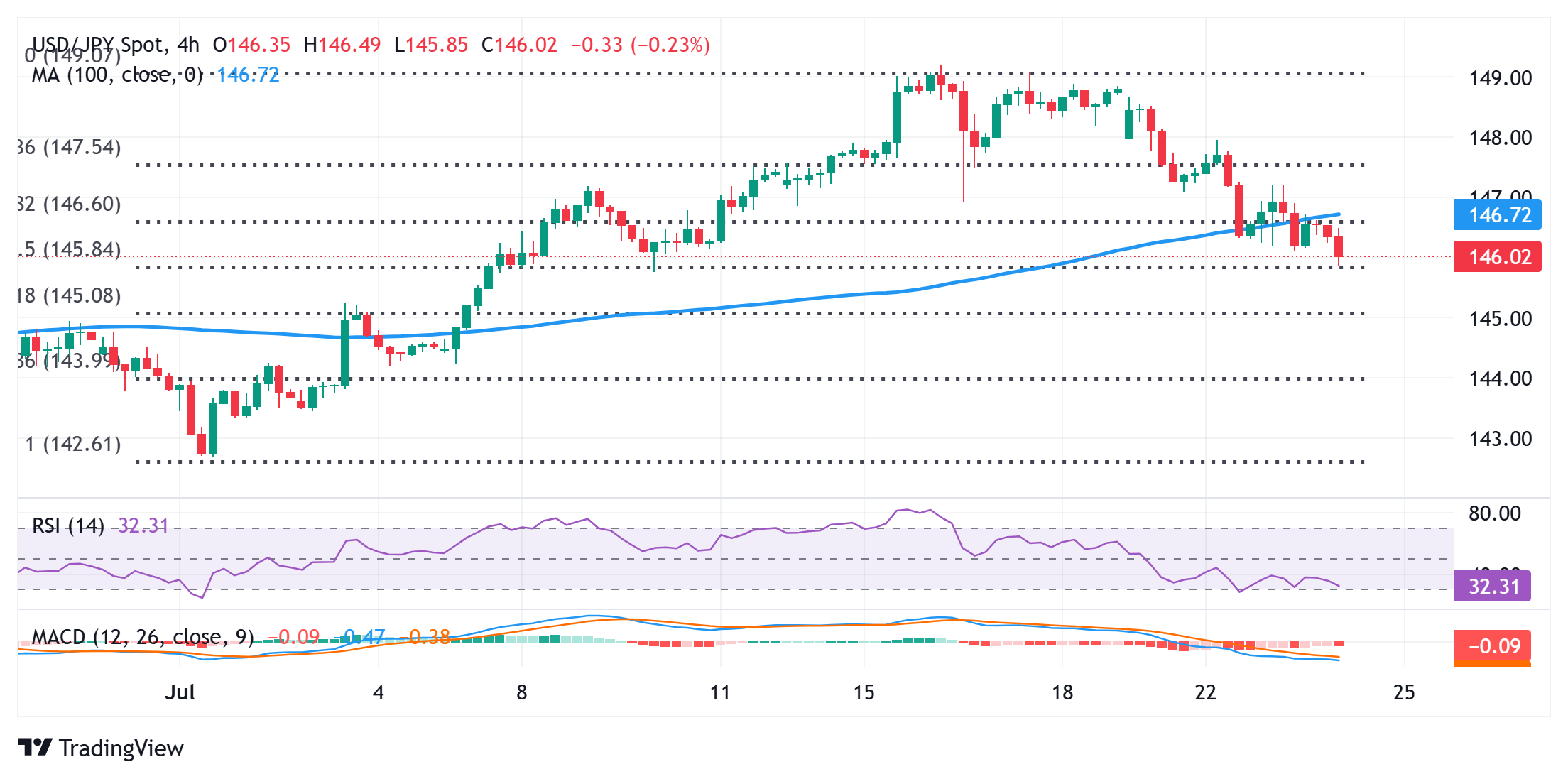
From a technical perspective, an intraday breakdown below the 100-period Simple Moving Average (SMA) and the 146.00 mark could be seen as a key trigger for the USD/JPY bears. Moreover, oscillators on the daily chart have just started gaining negative traction and back the case for a further depreciating move. Some follow-through selling below the 145.75 area (July 10 low) will reaffirm the outlook and drag spot prices to the 145.20-145.15 region, or the 61.8% Fibonacci retracement level of the upswing in July, en route to the 145.00 psychological mark.
On the flip side, the 100-period SMA support breakpoint, currently pegged near the 146.60 area, which now coincides with the 38.2% Fibo. retracement level, should now act as an immediate strong barrier. A sustained strength beyond could lift the USD/JPY pair to the 147.00 round figure. This is closely followed by the overnight swing high, around the 147.20 area, which, if cleared, could allow spot prices to accelerate the move up towards the 147.60-147.65 intermediate hurdle en route to the 148.00 round figure.
Risk sentiment FAQs
In the world of financial jargon the two widely used terms “risk-on” and “risk off'' refer to the level of risk that investors are willing to stomach during the period referenced. In a “risk-on” market, investors are optimistic about the future and more willing to buy risky assets. In a “risk-off” market investors start to ‘play it safe’ because they are worried about the future, and therefore buy less risky assets that are more certain of bringing a return, even if it is relatively modest.
Typically, during periods of “risk-on”, stock markets will rise, most commodities – except Gold – will also gain in value, since they benefit from a positive growth outlook. The currencies of nations that are heavy commodity exporters strengthen because of increased demand, and Cryptocurrencies rise. In a “risk-off” market, Bonds go up – especially major government Bonds – Gold shines, and safe-haven currencies such as the Japanese Yen, Swiss Franc and US Dollar all benefit.
The Australian Dollar (AUD), the Canadian Dollar (CAD), the New Zealand Dollar (NZD) and minor FX like the Ruble (RUB) and the South African Rand (ZAR), all tend to rise in markets that are “risk-on”. This is because the economies of these currencies are heavily reliant on commodity exports for growth, and commodities tend to rise in price during risk-on periods. This is because investors foresee greater demand for raw materials in the future due to heightened economic activity.
The major currencies that tend to rise during periods of “risk-off” are the US Dollar (USD), the Japanese Yen (JPY) and the Swiss Franc (CHF). The US Dollar, because it is the world’s reserve currency, and because in times of crisis investors buy US government debt, which is seen as safe because the largest economy in the world is unlikely to default. The Yen, from increased demand for Japanese government bonds, because a high proportion are held by domestic investors who are unlikely to dump them – even in a crisis. The Swiss Franc, because strict Swiss banking laws offer investors enhanced capital protection.
Author

Haresh Menghani
FXStreet
Haresh Menghani is a detail-oriented professional with 10+ years of extensive experience in analysing the global financial markets.

















