Japanese Yen hits fresh three-week top against USD amid BoJ-Fed divergence
- The Japanese Yen strengthens against the USD for the third consecutive day on Thursday.
- The divergent BoJ-Fed expectations continue to drive flows towards the lower-yielding JPY.
- Even the risk-on mood does little to dent the bullish sentiment around the safe-haven JPY.

The Japanese Yen (JPY) touches a fresh three-week high against its American counterpart heading into the European session on Thursday and looks to build on a three-day-old uptrend amid hawkish Bank of Japan (BoJ) expectations. In fact, the BoJ revised its inflation forecast in July and left the door open for an imminent interest rate hike by the end of this year. This marks a big divergence in comparison to bets that the US Federal Reserve (Fed) will resume its rate-cutting cycle in September, which turns out to be a key factor behind the lower-yielding JPY's relative outperformance.
Meanwhile, the aforementioned supporting factors, to a large extent, offset the prevalent risk-on environment and do little to dent the strong bullish sentiment surrounding the safe-haven JPY. That said, expectations that the prospects for further BoJ rate hikes could be delayed amid concern about consumption-led recovery, domestic political uncertainty, and higher US tariffs might hold back the JPY bulls from positioning for additional gains. Apart from this, a modest US Dollar (USD) bounce could offer support to the USD/JPY pair ahead of the US Producer Price Index (PPI) report.
Japanese Yen outperforms amid BoJ rate hike bets, despite receding safe-haven demand
- The Bank of Japan's hawkish stance in July, signaling that it will raise interest rates further if growth and inflation continue to advance in line with estimates, pushes the Japanese Yen higher for the third straight day on Thursday.
- The US Dollar, on the other hand, hangs near its lowest level in more than two weeks amid the growing acceptance of an imminent interest rate cut by the Federal Reserve at the upcoming monetary policy meeting in September.
- The expectations were reaffirmed by a series of disappointing US macroeconomic data released recently, including the closely watched Nonfarm Payrolls report for July, which pointed to signs of deteriorating labor market conditions.
- Adding to this, the broadly in-line US consumer inflation figures on Tuesday backed the view that recent tariff-related price pressures will be largely transitory and lifted bets for more rate cuts by the Fed than previously expected.
- Data released last week showed that Japan's real wages fell for the sixth consecutive month in June. Adding to this, a deceleration in Japan's Corporate Goods Price Index (CGPI) fueled concern about a consumption-led recovery.
- Furthermore, domestic political uncertainty and concerns about the economic impact of higher US tariffs suggest that the prospects for BoJ policy normalization could be delayed. This, however, does little to impress the JPY bears.
- The global risk sentiment remains supported by expectations for more rate cuts from the US Fed, an extension of the US-China tariff truce for three months, and the optimism over the US-Russia summit aimed at ending the Ukraine war.
- The risk-on mood lifted Japan’s Nikkei225 to the 43,000 level for the first time ever on Wednesday. Moreover, the benchmark S&P 500 and the tech-heavy Nasdaq Composite Index scored record highs for the second straight session.
- Traders now look forward to the release of the US Producer Price Index, which, along with comments from influential FOMC members, will drive the USD demand and provide some impetus to the USD/JPY pair later this Thursday.
- The market attention will then shift to the Preliminary Q2 GDP print from Japan and the University of Michigan US Consumer Sentiment Index on Friday. Nevertheless, the fundamental backdrop seems tilted in favor of the JPY bulls.
USD/JPY seems poised to extend the decline further towards testing sub-146.00 levels
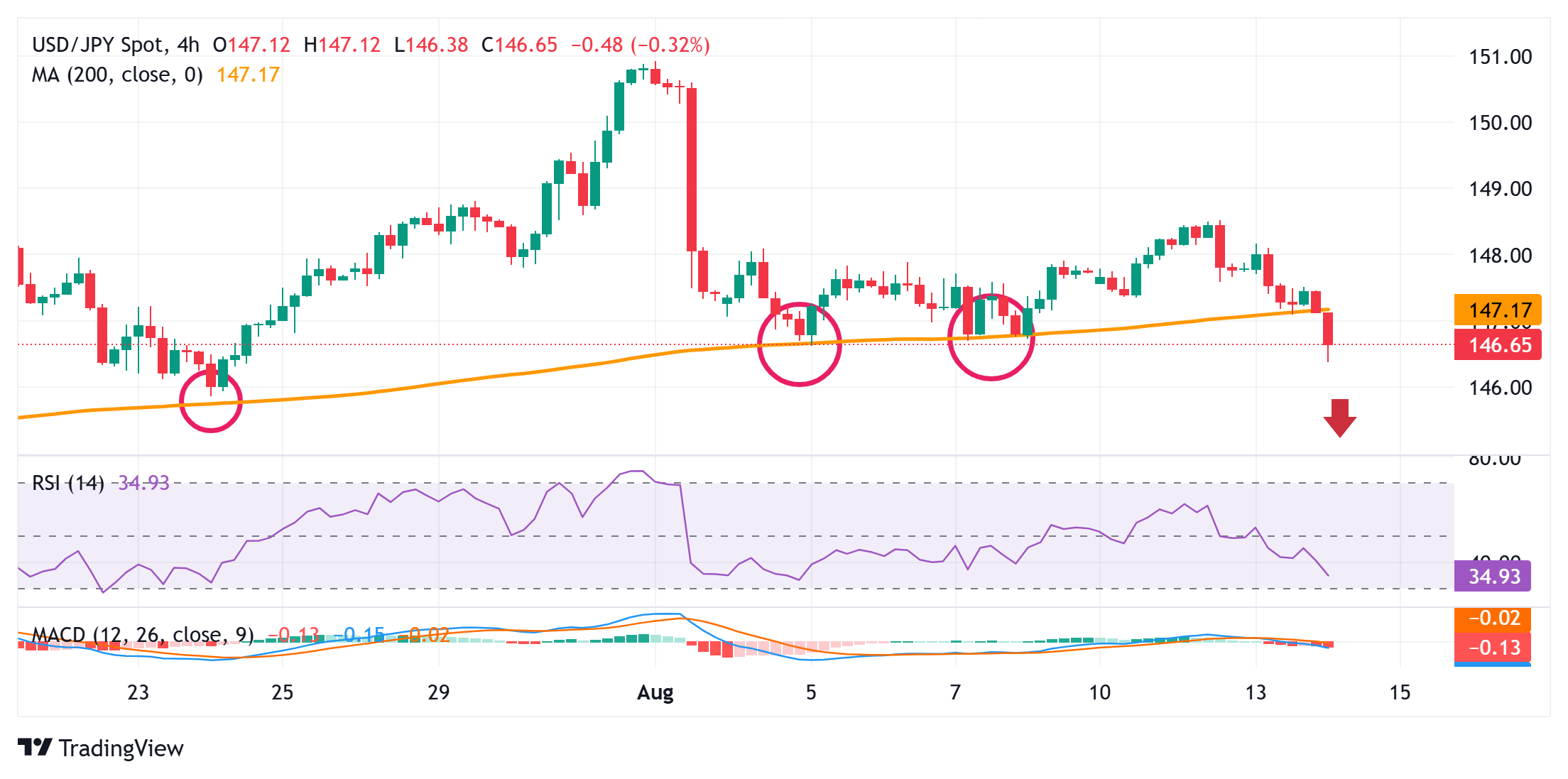
From a technical perspective, an intraday breakdown and acceptance below the 200-period Simple Moving Average (SMA) on the 4-hour, around the 147.00 mark, could be seen as a fresh trigger for the USD/JPY bears. However, the Relative Strength Index on the said charts has moved to the verge of breaking into the oversold zone, making it prudent to wait for some intraday consolidation or a modest bounce before positioning for deeper losses. That said, any attempted recovery is more likely to attract fresh sellers and remain capped near the 147.00 support-turned-resistance. The latter should now act as a key pivotal point, which, if cleared decisively, could trigger a short-covering move towards the 147.45-147.50 region.
On the flip side, the USD/JPY pair seems poised to slide towards testing sub-146.00 levels (July 24 low) before extending the fall further to the next relevant support near the 145.40-145.30 region. The downward trajectory could eventually drag spot prices to the 145.00 psychological mark.
Economic Indicator
Producer Price Index (YoY)
The Producer Price Index released by the Bureau of Labor statistics, Department of Labor measures the average changes in prices in primary markets of the US by producers of commodities in all states of processing. Changes in the PPI are widely followed as an indicator of commodity inflation. Generally speaking, a high reading is seen as positive (or bullish) for the USD, whereas a low reading is seen as negative (or bearish).
Read more.Next release: Thu Aug 14, 2025 12:30
Frequency: Monthly
Consensus: 2.5%
Previous: 2.3%
Source: US Bureau of Labor Statistics
Author

Haresh Menghani
FXStreet
Haresh Menghani is a detail-oriented professional with 10+ years of extensive experience in analysing the global financial markets.