Japanese Yen stays calm due to the possibility of intervention from authorities
- The Japanese Yen holds ground around its 38-year low of 161.28.
- The JPY may limit its downside as the Tankan Large Manufacturing Index rose to 13 in Q2, hitting the highest level in two years.
- The US Dollar struggles as recent inflation data raise expectations of Fed rate cuts in 2024.


The Japanese Yen (JPY) holds ground on Monday near its lowest level of 161.28 since 1986. The JPY may appreciate as an upbeat Japan’s business confidence data lifts market sentiment. Additionally, the expected speculations about an imminent intervention by Japanese authorities support the JPY and limit the upside of the USD/JPY pair.
Japan’s Tankan Large Manufacturing Index rose to 13 in the second quarter from the previous reading of 11. The index hit the highest level in two years amid an improving economic outlook. Meanwhile, Japan’s Jibun Bank Manufacturing PMI for June was revised slightly lower to 50 from a preliminary reading of 50.1 but remained expansionary for the second straight month.
The US Dollar (USD) depreciates as recent inflation data raises expectations of the US Federal Reserve’s (Fed) deducting interest rates in 2024. The CME FedWatch Tool indicates that the likelihood of a Fed rate cut in December by 25 basis points has increased to nearly 32.0%, up from 28.7% a week earlier.
Daily Digest Market Movers: Japanese Yen declines despite upbeat business confidence data
- Japan’s Tankan Large Manufacturing Outlook rose to 14 in the second quarter from the previous reading of 10. Meanwhile, Large All Industry Capex increased to 11.1% in the second quarter from the previous 4.0% reading.
- On Friday, the Federal Reserve Bank of San Francisco President Mary Daly said that monetary policy is working. Still, it’s too early to tell when it will be appropriate to cut the interest rate. Daly stated, "If inflation stays sticky or comes down slowly, rates would need to be higher for longer,” per Reuters.
- On Friday, the US Bureau of Economic Analysis reported that US inflation eased to its lowest annual rate in over three years. The US Personal Consumption Expenditures (PCE) Price Index increased by 2.6% year-over-year in May, down from 2.7% in April, meeting market expectations. Core PCE inflation also rose by 2.6% year-over-year in May, down from 2.8% in April, aligning with estimates.
- Reuters reported on Friday that Japanese Finance Minister Shunichi Suzuki said that the authorities were "deeply concerned" about the impact of "rapid and one-sided" foreign exchange moves on the economy. Suzuki added that excessive volatility in the currency market is undesirable and that authorities will respond appropriately to such moves.
- On Friday, the data showed that Consumer Price Index (CPI) inflation in Tokyo rose to 2.3% year-over-year in June, up from the previous period's 2.2%. Core Tokyo CPI inflation, which excludes volatile food prices, also increased during the same period, reaching 2.1% YoY compared to the previous 1.9%, surpassing the median market forecast of 2.0% YoY.
Technical Analysis: USD/JPY hovers around 161.00
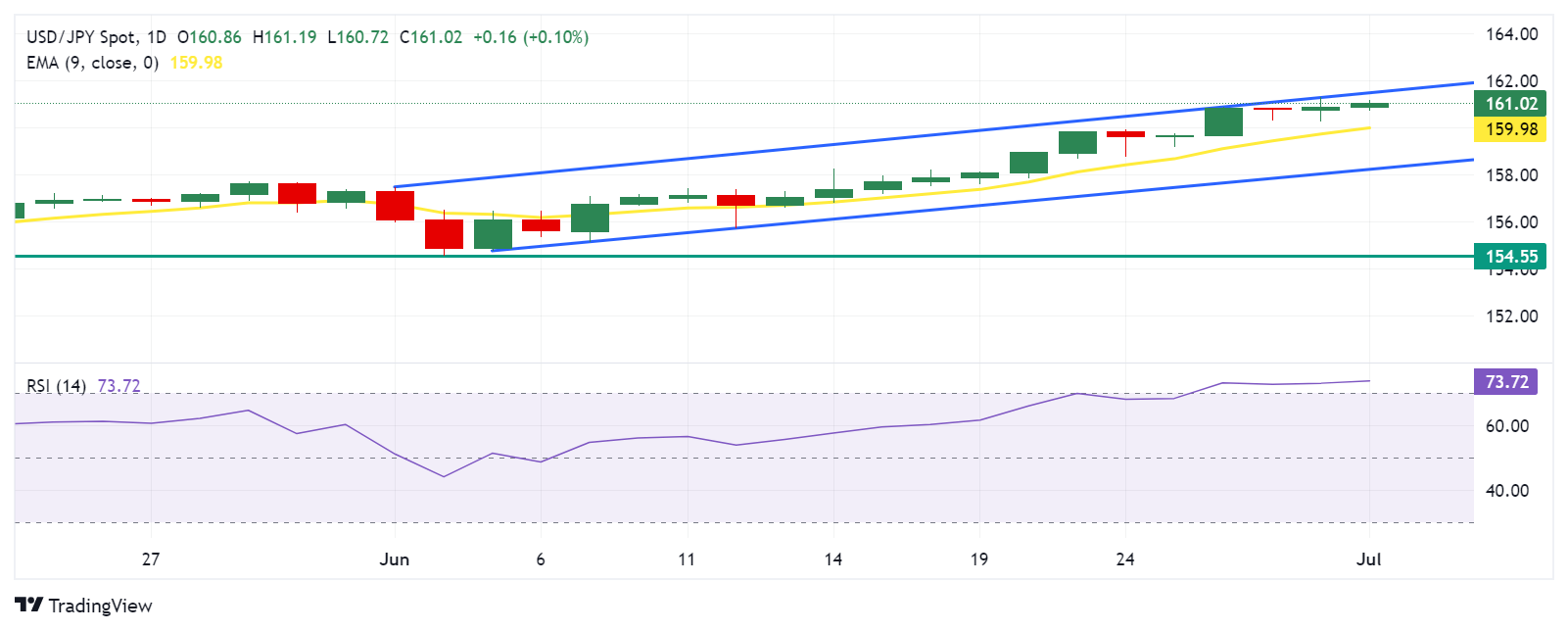
USD/JPY trades around 161.00 on Monday. The analysis of the daily chart shows a bullish bias, with the pair hovering near the upper boundary of an ascending channel pattern. The 14-day Relative Strength Index (RSI) is positioned above the 50 level, indicating upward momentum.
Surpassing the upper boundary of the ascending channel pattern around 161.50 will reinforce the bullish sentiment, potentially driving the USD/JPY pair toward the psychological level of 162.00.
On the downside, immediate support appears at the nine-day Exponential Moving Average (EMA) at 159.98. A breach below this level could intensify downward pressure on the USD/JPY pair, potentially driving it toward the lower boundary of the ascending channel around 158.20. A break below this level could push the pair to test June’s low at 154.55.
USD/JPY: Daily Chart
Japanese Yen PRICE Today
The table below shows the percentage change of Japanese Yen (JPY) against listed major currencies today. Japanese Yen was the weakest against the Euro.
| USD | EUR | GBP | JPY | CAD | AUD | NZD | CHF | |
|---|---|---|---|---|---|---|---|---|
| USD | -0.38% | -0.15% | 0.18% | 0.03% | -0.09% | -0.06% | 0.23% | |
| EUR | 0.38% | 0.00% | 0.28% | 0.10% | 0.17% | 0.02% | 0.31% | |
| GBP | 0.15% | -0.01% | 0.24% | 0.13% | 0.17% | 0.01% | 0.30% | |
| JPY | -0.18% | -0.28% | -0.24% | -0.15% | -0.21% | -0.24% | 0.07% | |
| CAD | -0.03% | -0.10% | -0.13% | 0.15% | -0.09% | -0.09% | 0.20% | |
| AUD | 0.09% | -0.17% | -0.17% | 0.21% | 0.09% | -0.16% | 0.21% | |
| NZD | 0.06% | -0.02% | -0.01% | 0.24% | 0.09% | 0.16% | 0.31% | |
| CHF | -0.23% | -0.31% | -0.30% | -0.07% | -0.20% | -0.21% | -0.31% |
The heat map shows percentage changes of major currencies against each other. The base currency is picked from the left column, while the quote currency is picked from the top row. For example, if you pick the Japanese Yen from the left column and move along the horizontal line to the US Dollar, the percentage change displayed in the box will represent JPY (base)/USD (quote).
Economic Indicator
Jibun Bank Services PMI
The Services Purchasing Managers Index (PMI), released on a monthly basis by Jibun Bank and S&P Global, is a leading indicator gauging business activity in Japan’s services sector. As the services sector dominates a large part of total GDP, the services PMI is an important indicator of the overall economic conditions in Japan. The data is derived from surveys of senior executives at private-sector companies from the services sector. Survey responses reflect the change, if any, in the current month compared to the previous month and can anticipate changing trends in official data series such as Gross Domestic Product (GDP), employment and inflation. A reading above 50 indicates that the services economy is generally expanding, a bullish sign for the Japanese Yen (JPY). Meanwhile, a reading below 50 signals that activity among service providers is generally declining, which is seen as bearish for JPY.
Read more.Next release: Wed Jul 03, 2024 00:30
Frequency: Monthly
Consensus: 49.8
Previous: 49.8
Source: S&P Global
Author
Akhtar Faruqui
FXStreet
Akhtar Faruqui is a Forex Analyst based in New Delhi, India. With a keen eye for market trends and a passion for dissecting complex financial dynamics, he is dedicated to delivering accurate and insightful Forex news and analysis.