Japanese Yen seems vulnerable as Takaichi's comments add to BoJ rate hike uncertainty
- The Japanese Yen remains depressed as Takaichi flags a looser fiscal goal, urges BoJ rate hike caution.
- A positive development to end the US government shutdown also undermines the safe-haven JPY.
- Dovish Fed expectations and economic concerns weigh on the USD and might cap the USD/JPY pair.

The Japanese Yen (JPY) maintains its offered tone through the early European session on Wednesday and currently trades near its lowest level since February 12 against a firmer US Dollar (USD). Comments from Japan's Prime Minister Sanae Takaichi earlier today underscored her preference for keeping interest rates low to support a fragile recovery. Moreover, the Bank of Japan (BoJ) has been reluctant to commit to further interest rate hikes on the back of Takaichi's pro-stimulus stance. This, along with the optimism over a potential deal to end the US government shutdown, continues to undermine the safe-haven JPY.
Meanwhile, a summary of BoJ policymakers' opinions at the October meeting released on Monday left the door open for an imminent interest rate hike in December. Adding to this, speculation that Japanese authorities may step into the market to stem any further weakness in the domestic currency might hold back bears from placing fresh bets around the JPY. Moreover, dovish Federal Reserve (Fed) expectations and concerns about an economic fallout from the US government closure might keep a lid on any meaningful appreciation for the US Dollar (USD), which might contribute to capping gains for the USD/JPY pair.
Japanese Yen is pressured by diminishing odds for December BoJ rate hike
- Japan's Prime Minister, Sanae Takaichi, said this Wednesday that inflation driven by food prices could hurt the economy and the government will work closely with the Bank of Japan to ensure Japan sees inflation driven by wages. Takaichi hopes for the BoJ to conduct policy so that Japan sees sustainable achievement of price target.
- Takuji Aida – an economist chosen to join Premier Sanae Takaichi's panel to debate her administration's growth strategy – told the Nikkei newspaper that the Bank of Japan should avoid raising interest rates in December. Aida added that the central bank should wait at least until January next year as Japan's economy likely contracted in the third quarter.
- The Japanese government is expected to finalise an economic stimulus package on November 21. According to a draft outline, the package will urge the BoJ to focus on achieving strong economic growth accompanied by stable prices, underscoring Prime Minister Sanae Takaichi’s preference for keeping interest rates low to support a fragile recovery.
- The US Senate voted to pass legislation to reopen the federal government and end the longest government shutdown in the nation’s history. The positive development triggers a fresh wave of the global risk-on trade, which, along with the BoJ rate hike uncertainties, continues to undermine the safe-haven Japanese Yen during the Asian session on Wednesday.
- Meanwhile, economists estimate that the prolonged US government closure might have already shaved approximately 1.5 to 2.0% off quarterly GDP growth. Moreover, investors seem tilted towards a more dovish US Federal Reserve and have been pricing in a greater chance of another rate cut in December. This, in turn, keeps the US Dollar depressed.
- In contrast, a summary of BoJ policymakers' opinions at their October meeting released on Monday reflected a view that the time for another interest-rate hike is approaching. Adding to this, the risk of a government intervention to stem further JPY weakness warrants caution for bears, and before positioning for further upside for the USD/JPY pair.
- In the absence of any relevant market-moving US economic releases on Wednesday, traders will look forward to speeches from a slew of influential FOMC members for cues about the Fed's future rate-cut path. This will drive the USD demand, which, along with the broader risk sentiment, should provide short-term impetus to the currency pair.
USD/JPY could extend the positive momentum towards reclaiming the 155.00 mark
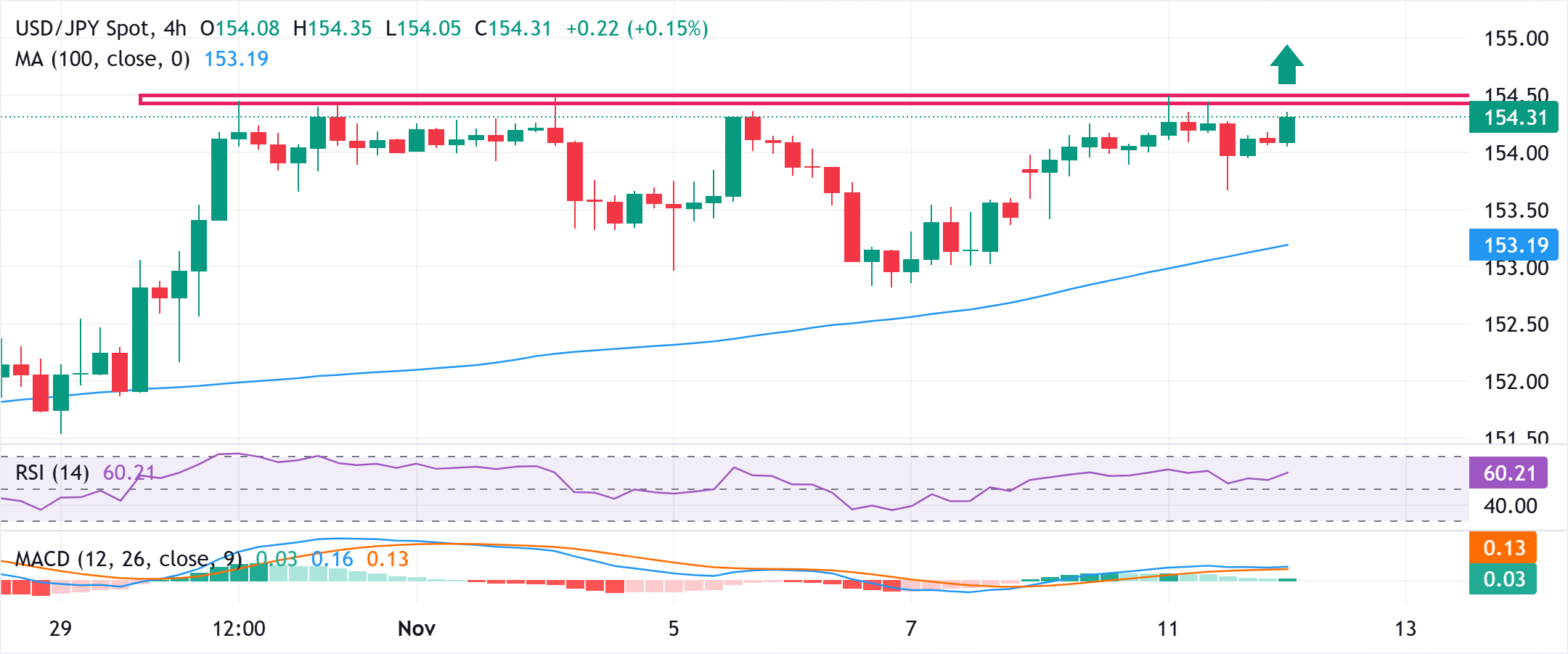
From a technical perspective, the USD/JPY bulls need to wait for a sustained strength beyond the 154.45-154.50 pivotal hurdle before placing fresh bets. Given that oscillators on the daily chart are holding comfortably in positive territory and are still away from being in the overbought zone, spot prices might then aim to conquer the 155.00 psychological mark. The momentum could extend further towards the 155.60-155.65 intermediate barrier en route to the 156.00 round figure.
On the flip side, any corrective pullback below the 154.00 mark could be seen as a buying opportunity near the overnight swing low, around the 153.65 region. This should help limit the downside for the USD/JPY pair near the 153.00 mark. A convincing break below, however, could pave the way for deeper losses and drag spot prices to the 152.15-152.10 region. The latter should now act as a strong near-term base for the currency pair, which, if broken decisively, might shift the near-term bias in favor of bearish traders.
Risk sentiment FAQs
In the world of financial jargon the two widely used terms “risk-on” and “risk off'' refer to the level of risk that investors are willing to stomach during the period referenced. In a “risk-on” market, investors are optimistic about the future and more willing to buy risky assets. In a “risk-off” market investors start to ‘play it safe’ because they are worried about the future, and therefore buy less risky assets that are more certain of bringing a return, even if it is relatively modest.
Typically, during periods of “risk-on”, stock markets will rise, most commodities – except Gold – will also gain in value, since they benefit from a positive growth outlook. The currencies of nations that are heavy commodity exporters strengthen because of increased demand, and Cryptocurrencies rise. In a “risk-off” market, Bonds go up – especially major government Bonds – Gold shines, and safe-haven currencies such as the Japanese Yen, Swiss Franc and US Dollar all benefit.
The Australian Dollar (AUD), the Canadian Dollar (CAD), the New Zealand Dollar (NZD) and minor FX like the Ruble (RUB) and the South African Rand (ZAR), all tend to rise in markets that are “risk-on”. This is because the economies of these currencies are heavily reliant on commodity exports for growth, and commodities tend to rise in price during risk-on periods. This is because investors foresee greater demand for raw materials in the future due to heightened economic activity.
The major currencies that tend to rise during periods of “risk-off” are the US Dollar (USD), the Japanese Yen (JPY) and the Swiss Franc (CHF). The US Dollar, because it is the world’s reserve currency, and because in times of crisis investors buy US government debt, which is seen as safe because the largest economy in the world is unlikely to default. The Yen, from increased demand for Japanese government bonds, because a high proportion are held by domestic investors who are unlikely to dump them – even in a crisis. The Swiss Franc, because strict Swiss banking laws offer investors enhanced capital protection.
Author

Haresh Menghani
FXStreet
Haresh Menghani is a detail-oriented professional with 10+ years of extensive experience in analysing the global financial markets.

















