Japanese Yen stands firm near daily peak as USD drifts lower ahead of Fed rate decision
- The Japanese Yen retests the monthly swing low against its American counterpart.
- Reduced bets for a BoJ rate hike in 2025 and trade uncertainties weigh on the JPY.
- A modest USD downtick weighs on USD/JPY ahead of the crucial FOMC decision.

The Japanese Yen (JPY) remains on the front foot against a broadly weaker US Dollar (USD) heading into the European session on Wednesday, with the USD/JPY pair languishing below the 145.00 mark or the daily low. The global risk sentiment remains fragile on the back of persistent trade-related uncertainties and rising geopolitical tensions in the Middle East, which, in turn, is underpinning the safe-haven JPY.
Meanwhile, the Bank of Japan's (BoJ) cautious approach to unwinding its decade-long monetary stimulus forced investors to push back their expectations about the likely timing of the next interest rate hike to Q1 2026. Furthermore, US President Donald Trump and Japan's Prime Minister Shigeru Ishiba failed to achieve a breakthrough on tariffs at the G7 summit, which, in turn, should cap the upside for the JPY.
Traders might also refrain from placing aggressive directional bets and opt to wait for the outcome of a two-day FOMC policy meeting, due later today. Investors will look for cues about the Federal Reserve's (Fed) rate-cut path. The outlook, in turn, will play a key role in influencing the near-term USD price dynamics and determining the next leg of a directional move for the USD/JPY pair.
Japanese Yen retains intraday positive bias; lacks bullish conviction amid mixed BoJ rate hike cues
- The Bank of Japan, as was widely expected, left the benchmark rate unchanged at 0.5% on Tuesday amid rising growth risks and said that it will slow the pace of reductions in its government bond purchases from April next year. The BoJ added that Japan’s economic growth was likely to moderate and that accommodative financial conditions are expected to provide support.
- This reinforced market expectations that the central bank might forego another rate hike this year. In fact, a recent Reuters poll indicated that a slight majority of economists expect the next 25-basis-point rate increase in early 2026. This could undermine the Japanese Yen amid roadblocks on the trade front ahead of the July 9 deadline for higher reciprocal US tariffs.
- Japan's Prime Minister Shigeru Ishiba, talking to reporters after the G7 summit on Tuesday, said that he and US President Donald Trump agreed to instruct their ministers to further engage in trade talks. Ishiba added that there are still some points on which the two sides are not on the same page, so we have not yet reached an agreement on the trade package.
- Meanwhile, Japan Machinery Orders fell 9.1% in April ––marking a sharp reversal from a 13% surge in March and the weakest reading since April 2020. Moreover, the monthly Reuters Tankan poll showed that Japanese manufacturers grew less confident about business conditions in June and expressed caution about the outlook for the next three months.
- From the US, the US Census Bureau reported on Tuesday that Retail Sales declined by 0.9% in May compared to a contraction of 0.7% expected. Adding to this, US Industrial Production also fell short of consensus estimates and contracted 0.2% in May, pointing to a softening economy and reaffirming bets for an interest rate cut by the Federal Reserve in September.
- The initial market reaction, however, turned out to be short-lived as rising geopolitical tensions in the Middle East drove safe-haven flows toward the US Dollar. Investors now look forward to the outcome of a two-day FOMC policy meeting for more cues about the future rate-cut path, which will drive the USD and provide a fresh impetus to the USD/JPY pair.
USD/JPY could extend intraday corrective slide; 144.50-144.45 pivotal support holds the key for bulls
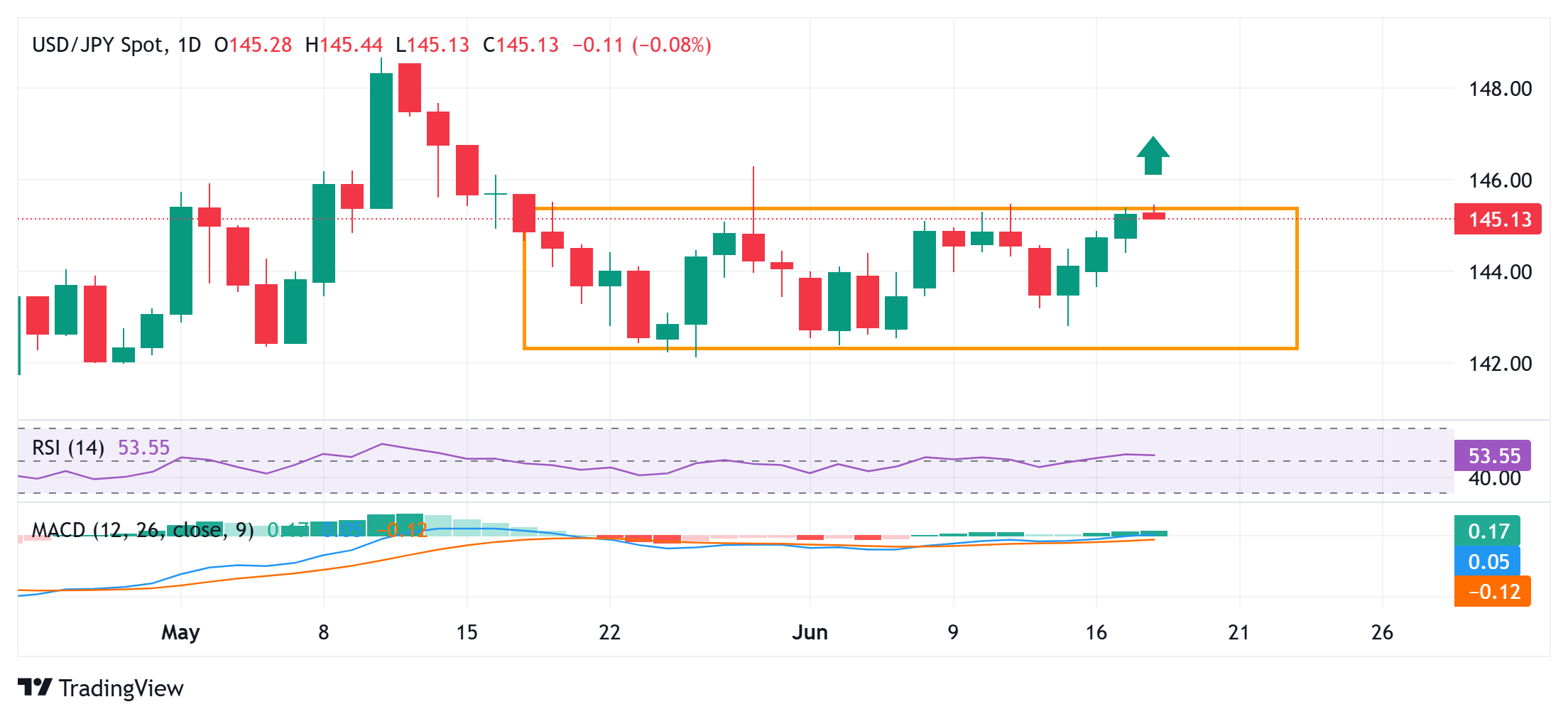
From a technical perspective, the overnight breakout and a daily close above the 145.00 psychological mark could be seen as a fresh trigger for the USD/JPY bulls. Moreover, oscillators on the daily chart have just started gaining positive traction and suggest that the path of least resistance for spot prices is to the upside. Some follow-through buying beyond the monthly swing high, around the 145.45 area, will affirm the constructive outlook and allow the pair to conquer the 146.00 round figure before aiming to test the 146.25-146.30 region or the May 29 peak.
On the flip side, any corrective pullback below the 145.00 mark might now attract some dip-buyers and find decent support near the 144.50-144.45 region, below which the USD/JPY pair could slide to the 144.00 mark. A convincing break below the latter would expose the next relevant support near the 143.55-143.50 region before spot prices eventually drop to the 143.00 round figure en route to last Friday's swing low, around the 142.80-142.75 region.
Economic Indicator
Fed Interest Rate Decision
The Federal Reserve (Fed) deliberates on monetary policy and makes a decision on interest rates at eight pre-scheduled meetings per year. It has two mandates: to keep inflation at 2%, and to maintain full employment. Its main tool for achieving this is by setting interest rates – both at which it lends to banks and banks lend to each other. If it decides to hike rates, the US Dollar (USD) tends to strengthen as it attracts more foreign capital inflows. If it cuts rates, it tends to weaken the USD as capital drains out to countries offering higher returns. If rates are left unchanged, attention turns to the tone of the Federal Open Market Committee (FOMC) statement, and whether it is hawkish (expectant of higher future interest rates), or dovish (expectant of lower future rates).
Read more.Next release: Wed Jun 18, 2025 18:00
Frequency: Irregular
Consensus: 4.5%
Previous: 4.5%
Source: Federal Reserve
Author

Haresh Menghani
FXStreet
Haresh Menghani is a detail-oriented professional with 10+ years of extensive experience in analysing the global financial markets.

















