Japanese Yen loses ground as US Dollar appreciates due to risk-off mood
- The Japanese Yen loses its daily gains as the US Dollar appreciates due to improved risk aversion.
- Japan's Current Account surplus increased to ¥2,849.9 billion ($17.78 billion) in May, extending its growth streak to the 15th month.
- Friday’s employment data prompt speculation that the Fed could initiate rate cuts sooner.

The Japanese Yen (JPY) breaks its two-day winning streak on Monday. The USD/JPY pair recovers its daily losses as the US Dollar (USD) gains ground due to risk-off sentiment.
The Bank of Japan (BOJ) has maintained its economic assessment for 5 of Japan's 9 regions in its latest 'Sakura Report'. The assessment for 2 regions was raised, while it was lowered for another 2 regions in the report released on Monday. Regarding price trends, the BOJ noted that many regions report wage hikes spreading among smaller firms.
The US Dollar may struggle due to the dovish sentiment surrounding the Federal Reserve (Fed) following weaker-than-expected US employment growth data released on Friday. US Nonfarm Payrolls (NFP) surpassed market expectations in June, although the pace of growth was slower compared to May. Additionally, the Unemployment Rate also increased in June. These developments have prompted speculation among traders that the Federal Reserve (Fed) could potentially initiate interest rate cuts sooner rather than later.
According to the CME's FedWatch Tool, rate markets are currently pricing in a 70.7% probability of a rate cut in September, up from 64.1% just a week earlier.
Daily Digest Market Movers: Japanese Yen improves due to dovish sentiment surrounding Fed
- Japan's Current Account surplus extended its growth streak to the 15th month in May. The Ministry of Finance reported on Monday that the current account increased to ¥2,849.9 billion ($17.78 billion) in May, up from ¥2,050.5 billion in the previous month, surpassing market expectations of ¥2,450.0 billion.
- Japan's Labor Cash Earnings rose by 1.9% year-on-year in May, marking an acceleration from April's 1.6% increase and achieving the highest level since January. However, this growth rate fell short of market expectations, which had anticipated a 2.1% increase.
- US Nonfarm Payrolls (NFP) increased by 206,000 in June, following a rise of 218,000 in May. This figure surpassed the market expectation of 190,000.
- The US Unemployment Rate edged up to 4.1% in June from 4.0% in May. Meanwhile, Average Hourly Earnings decreased to 3.9% year-over-year in June from the previous reading of 4.1%, aligning with market expectations.
- OCBC strategists Frances Cheung and Christopher Wong observe that the persistent strength of USD/JPY is raising intervention expectations. However, there is speculation that authorities may monitor to what extent they allow for further depreciation before intervening.
- Federal Reserve Bank of Chicago President Austan Goolsbee stated on BBC Radio on Wednesday that bringing inflation back to 2% will take time and that more economic data are needed. However, on Tuesday, Fed Chair Jerome Powell said that the central bank is getting back on the disinflationary path, per Reuters.
- The Minutes from the Federal Reserve's June 11-12 monetary policy meeting, released on Wednesday, suggested that Fed officials were in a wait-and-see mode. "Some participants emphasized the Committee’s data-dependent approach, with monetary policy decisions being conditional on the evolution of the economy rather than being on a preset path."
- Rabobank FX strategists pointed out on Wednesday that yield differentials appear crucial to the USD/JPY outlook. They suggested that FX intervention could be imminent due to the weakness of the Japanese Yen, which is exerting downward pressure on consumer confidence.
Technical Analysis: USD/JPY hovers around 160.50
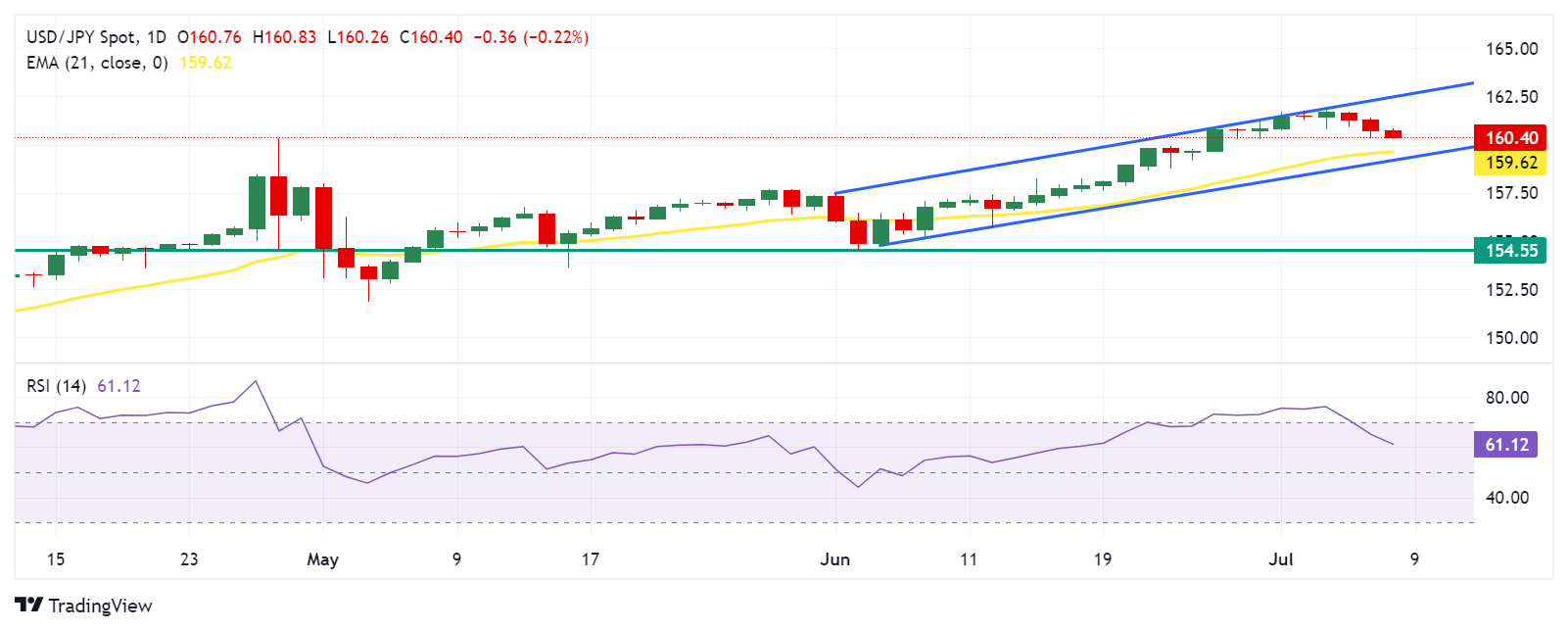
USD/JPY trades around 160.30 on Monday, showing a bullish inclination based on daily chart analysis. The pair remains within an ascending channel pattern. However, caution is warranted as the 14-day Relative Strength Index (RSI) has dropped below 70, indicating a potential weakening of the ongoing uptrend.
In the short term, USD/JPY could approach resistance near 162.50, which marks the upper boundary of the ascending channel. A breakout above this level might strengthen bullish sentiment, potentially driving the pair toward psychological resistance at 163.00.
On the downside, immediate support is seen around the 21-day Exponential Moving Average (EMA) at 159.62, followed by the lower boundary of the ascending channel around 159.00. A further decline below this channel support could see USD/JPY testing the vicinity of June's low at 154.55.
USD/JPY: Daily Chart
Japanese Yen PRICE Today
The table below shows the percentage change of Japanese Yen (JPY) against listed major currencies today. Japanese Yen was the weakest against the Euro.
| USD | EUR | GBP | JPY | CAD | AUD | NZD | CHF | |
|---|---|---|---|---|---|---|---|---|
| USD | 0.14% | 0.08% | 0.05% | -0.03% | 0.11% | -0.05% | -0.18% | |
| EUR | -0.14% | 0.15% | 0.24% | 0.15% | 0.13% | 0.15% | 0.02% | |
| GBP | -0.08% | -0.15% | 0.06% | 0.02% | -0.02% | -0.00% | -0.13% | |
| JPY | -0.05% | -0.24% | -0.06% | -0.08% | 0.08% | 0.05% | -0.17% | |
| CAD | 0.03% | -0.15% | -0.02% | 0.08% | 0.09% | -0.02% | -0.13% | |
| AUD | -0.11% | -0.13% | 0.02% | -0.08% | -0.09% | 0.02% | -0.11% | |
| NZD | 0.05% | -0.15% | 0.00% | -0.05% | 0.02% | -0.02% | -0.13% | |
| CHF | 0.18% | -0.02% | 0.13% | 0.17% | 0.13% | 0.11% | 0.13% |
The heat map shows percentage changes of major currencies against each other. The base currency is picked from the left column, while the quote currency is picked from the top row. For example, if you pick the Japanese Yen from the left column and move along the horizontal line to the US Dollar, the percentage change displayed in the box will represent JPY (base)/USD (quote).
Interest rates FAQs
Interest rates are charged by financial institutions on loans to borrowers and are paid as interest to savers and depositors. They are influenced by base lending rates, which are set by central banks in response to changes in the economy. Central banks normally have a mandate to ensure price stability, which in most cases means targeting a core inflation rate of around 2%. If inflation falls below target the central bank may cut base lending rates, with a view to stimulating lending and boosting the economy. If inflation rises substantially above 2% it normally results in the central bank raising base lending rates in an attempt to lower inflation.
Higher interest rates generally help strengthen a country’s currency as they make it a more attractive place for global investors to park their money.
Higher interest rates overall weigh on the price of Gold because they increase the opportunity cost of holding Gold instead of investing in an interest-bearing asset or placing cash in the bank. If interest rates are high that usually pushes up the price of the US Dollar (USD), and since Gold is priced in Dollars, this has the effect of lowering the price of Gold.
The Fed funds rate is the overnight rate at which US banks lend to each other. It is the oft-quoted headline rate set by the Federal Reserve at its FOMC meetings. It is set as a range, for example 4.75%-5.00%, though the upper limit (in that case 5.00%) is the quoted figure. Market expectations for future Fed funds rate are tracked by the CME FedWatch tool, which shapes how many financial markets behave in anticipation of future Federal Reserve monetary policy decisions.
Author

Akhtar Faruqui
FXStreet
Akhtar Faruqui is a Forex Analyst based in New Delhi, India. With a keen eye for market trends and a passion for dissecting complex financial dynamics, he is dedicated to delivering accurate and insightful Forex news and analysis.

















