Japanese Yen edges lower as trade deficit widens, FOMC Minutes eyed
- The Japanese Yen eases following the release of Trade Balance data on Wednesday.
- Reuters poll suggests that more than half of the economists expect the BoJ to raise rates again by the end of the year.
- The US Dollar holds ground due to market caution ahead of the FOMC Meeting Minutes.

The Japanese Yen (JPY) halts its three-day winning streak against the US Dollar (USD) following the release of Trade Balance data on Wednesday. However, the JPY's decline might be limited due to the growing likelihood of another near-term interest rate hike. Traders are also anticipating Bank of Japan (BoJ) Governor Kazuo Ueda's appearance in parliament on Friday, where he will discuss the central bank's decision last month to raise interest rates.
Japan's Merchandise Trade Balance fell into a deficit of ¥621.84 billion in July, reversing the surplus of ¥224.0 billion reported in June and missing market estimates of a ¥330.7 billion shortfall. This marks the fifth deficit so far this year, as imports increased at a much faster pace than exports.
The US Dollar (USD) attempts to halt its three-day losing streak as traders turn cautious ahead of Wednesday’s FOMC Meeting Minutes for July’s policy decision. Furthermore, traders await Fed Chair Jerome Powell's upcoming speech at Jackson Hole on Friday.
CME FedWatch Tool suggests that the markets are now pricing in a nearly 67.5% odds of a 25 basis points (bps) Fed rate cut in its September meeting, down from 76% a day ago. The probability of a 50 basis points rate cut fell to 32.5% from 53.0% a week earlier.
Daily Digest Market Movers: Japanese Yen declines following Trade Balance data
- According to a Reuters poll published on Wednesday, more than half of the economists expect the Bank of Japan (BoJ) to raise interest rates again by the end of the year. In the August 13-19 survey, 31 out of 54 economists predicted that the BoJ would increase borrowing costs by year-end. The median forecast for the end-of-year rate is 0.50%, marking a 25 basis point increase.
- Japan's imports surged by 16.6% year-on-year in July, reaching a 19-month high of ¥10,241.01 billion, surpassing market expectations of 14.9% and significantly up from the 3.2% rise in June. This marks the strongest growth in imports since January 2023. Meanwhile, exports increased by 10.3% YoY to a seven-month high of ¥9,619.17 billion, accelerating from the previous month's 5.4% growth but falling short of market forecasts of 11.4%.
- Federal Reserve (Fed) Governor Michelle Bowman expressed caution on Tuesday about making any policy changes, citing ongoing upside risks to inflation. Bowman warned that overreacting to individual data points could undermine the progress already achieved, according to Reuters.
- According to Reuters, the Bank of Japan (BoJ) had projected that a strong economic recovery would help inflation reach its 2% target sustainably. This would justify further interest rate increases, following last month's hike as part of the BoJ's ongoing effort to unwind years of extensive monetary stimulus.
- Federal Reserve Bank of San Francisco President Mary Daly emphasized Sunday that the US central bank should take a gradual approach to reducing borrowing costs, according to the Financial Times. Additionally, Federal Reserve Bank of Chicago President Austan Goolsbee warned that central bank officials should be cautious about keeping a restrictive policy in place longer than necessary, per CNBC.
- On Thursday, Kazutaka Maeda, an economist at Meiji Yasuda Research Institute, said that the reports are simply positive overall and “it supports the BoJ’s view and bodes well for further rate hikes, although the central bank would remain cautious as the last rate increase had caused a sharp spike in the Yen.”
- Japan's Gross Domestic Product (GDP) grew by 0.8% quarter-on-quarter in Q2, surpassing market forecasts of 0.5% and rebounding from a 0.6% decline in Q1. This marked the strongest quarterly growth since Q1 of 2023. Meanwhile, the annualized GDP growth reached 3.1%, exceeding the market consensus of 2.1% and reversing a 2.3% contraction in Q1. This was the strongest yearly expansion since Q2 of 2023.
- Rabobank's senior FX strategist, Jane Foley, observes that this week's series of US data releases, along with next week's Jackson Hole event, should provide the market with clearer insights into the potential responses of US policymakers. However, their main expectation is that the Fed will reduce rates by 25 basis points in September and likely cut them again before the end of the year.
Technical Analysis: USD/JPY edges higher to near 145.50
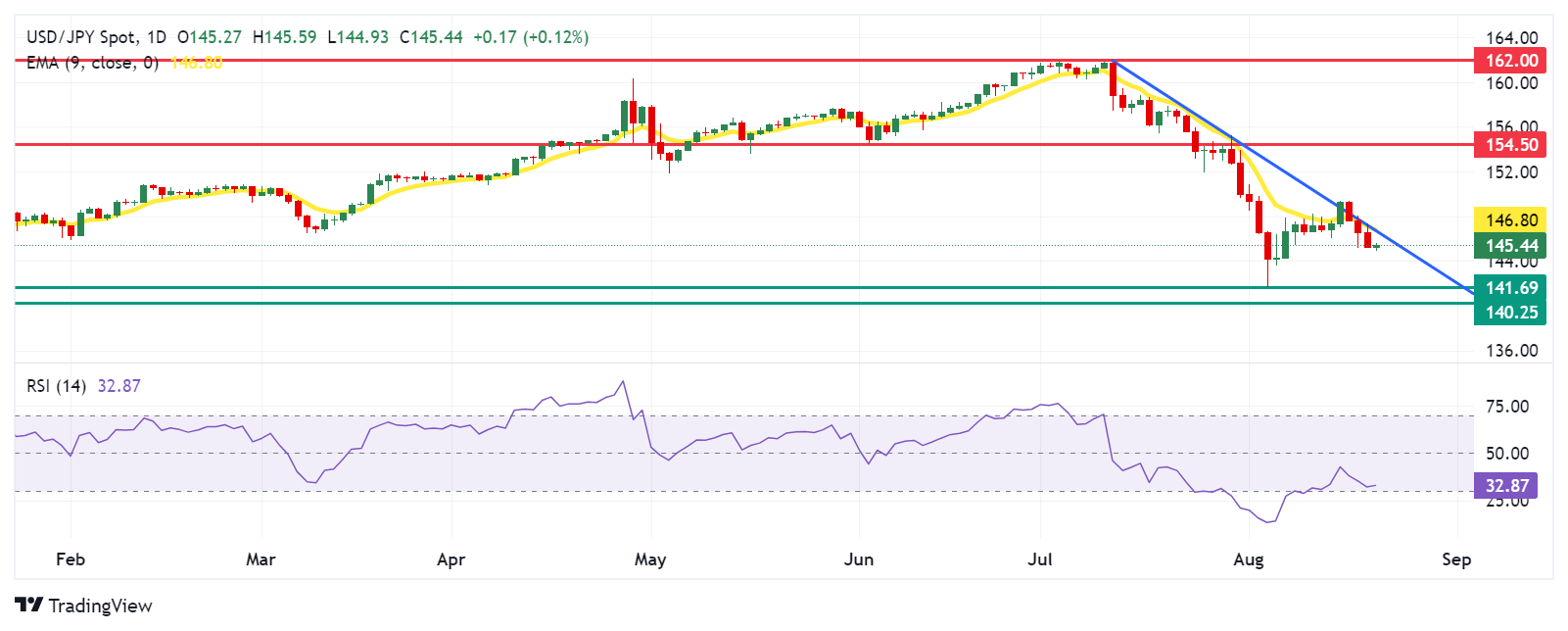
USD/JPY trades around 145.50 on Wednesday. Analysis of the daily chart shows that the pair is consolidating under a downtrend line, suggesting a bearish bias. Furthermore, the 14-day Relative Strength Index (RSI) is slightly above 30, suggesting a potential correction for the pair.
For support levels, the USD/JPY pair might navigate the region around the round numbers at 144.00 before 143.00 before a seven-month low of 141.69, which was recorded on August 5. A further drop could drive the pair toward the next significant support level at 140.25.
On the upside, the USD/JPY pair could encounter an immediate resistance at the downtrend line around the nine-day Exponential Moving Average (EMA) at the 146.80 level. A breakthrough above this level could lead the pair to test the resistance level at 154.50, which has transitioned from previous support to current resistance.
USD/JPY: Daily Chart
Japanese Yen PRICE Today
The table below shows the percentage change of Japanese Yen (JPY) against listed major currencies today. Japanese Yen was the weakest against the Canadian Dollar.
| USD | EUR | GBP | JPY | CAD | AUD | NZD | CHF | |
|---|---|---|---|---|---|---|---|---|
| USD | 0.15% | 0.13% | 0.56% | -0.05% | 0.14% | 0.29% | 0.16% | |
| EUR | -0.15% | -0.03% | 0.36% | -0.20% | -0.00% | 0.12% | 0.00% | |
| GBP | -0.13% | 0.03% | 0.42% | -0.16% | 0.00% | 0.16% | 0.05% | |
| JPY | -0.56% | -0.36% | -0.42% | -0.59% | -0.39% | -0.30% | -0.37% | |
| CAD | 0.05% | 0.20% | 0.16% | 0.59% | 0.20% | 0.31% | 0.21% | |
| AUD | -0.14% | 0.00% | -0.00% | 0.39% | -0.20% | 0.11% | 0.02% | |
| NZD | -0.29% | -0.12% | -0.16% | 0.30% | -0.31% | -0.11% | -0.09% | |
| CHF | -0.16% | -0.00% | -0.05% | 0.37% | -0.21% | -0.02% | 0.09% |
The heat map shows percentage changes of major currencies against each other. The base currency is picked from the left column, while the quote currency is picked from the top row. For example, if you pick the Japanese Yen from the left column and move along the horizontal line to the US Dollar, the percentage change displayed in the box will represent JPY (base)/USD (quote).
Japanese Yen FAQs
The Japanese Yen (JPY) is one of the world’s most traded currencies. Its value is broadly determined by the performance of the Japanese economy, but more specifically by the Bank of Japan’s policy, the differential between Japanese and US bond yields, or risk sentiment among traders, among other factors.
One of the Bank of Japan’s mandates is currency control, so its moves are key for the Yen. The BoJ has directly intervened in currency markets sometimes, generally to lower the value of the Yen, although it refrains from doing it often due to political concerns of its main trading partners. The current BoJ ultra-loose monetary policy, based on massive stimulus to the economy, has caused the Yen to depreciate against its main currency peers. This process has exacerbated more recently due to an increasing policy divergence between the Bank of Japan and other main central banks, which have opted to increase interest rates sharply to fight decades-high levels of inflation.
The BoJ’s stance of sticking to ultra-loose monetary policy has led to a widening policy divergence with other central banks, particularly with the US Federal Reserve. This supports a widening of the differential between the 10-year US and Japanese bonds, which favors the US Dollar against the Japanese Yen.
The Japanese Yen is often seen as a safe-haven investment. This means that in times of market stress, investors are more likely to put their money in the Japanese currency due to its supposed reliability and stability. Turbulent times are likely to strengthen the Yen’s value against other currencies seen as more risky to invest in.
Author

Akhtar Faruqui
FXStreet
Akhtar Faruqui is a Forex Analyst based in New Delhi, India. With a keen eye for market trends and a passion for dissecting complex financial dynamics, he is dedicated to delivering accurate and insightful Forex news and analysis.