Japanese Yen maintains its bid tone against retreating USD, ahead of Fed rate decision
- The Japanese Yen recovers from a one-week low touched against the USD on Tuesday.
- Diminishing odds for an immediate BoJ rate hike and trade optimism could cap the JPY.
- Traders might also opt to move to the sidelines ahead of the key central bank events.

The Japanese Yen (JPY) sticks to its intraday gains, which, along with a broadly softer US Dollar (USD), keep the USD/JPY pair depressed below the 148.00 mark through the early European session on Wednesday. The market nervousness ahead of the crucial Federal Reserve (Fed) decision later today and the Bank of Japan (BoJ) policy update on Thursday is seen benefiting the JPY's safe-haven status. Any meaningful JPY appreciation, however, seems elusive in the wake of reduced bets for an immediate interest rate hike by the BoJ.
Furthermore, the latest trade optimism, fueled by the recent US deals with Japan and the European Union (EU), could act as a headwind for the JPY. The USD, on the other hand, might draw support from the growing acceptance that the Fed will keep interest rates higher for longer. This might further contribute to limiting losses for the USD/JPY pair. Heading into the key central bank events, the US ADP report on private-sector employment and the Advanced US Q2 GDP print could produce short-term trading opportunities.
Japanese Yen bulls retain intraday control amid reviving safe-haven demand, ahead of Fed/BoJ meetings
- Investors move to the sidelines heading into this week's key central bank events, which is evident from a softer tone around the equity markets and drives some safe-haven flows towards the Japanese Yen during the Asian session on Wednesday. However, any meaningful JPY appreciation seems elusive in the wake of reduced bets for an immediate interest rate hike by the Bank of Japan.
- In fact, data released last Friday showed that consumer inflation in Tokyo – Japan's capital city – eased more than expected in July. Moreover, Japan's ruling coalition – the Liberal Democratic Party (LDP) and its junior partner Komeito – suffered a defeat in the upper house elections earlier this month, which adds a layer of uncertainty and could further complicate the BoJ's policy normalization path.
- Meanwhile, the Federal Reserve is expected to leave interest rates unchanged in the 4.25-4.50% range at the end of a two-day meeting later this Wednesday, despite rising political pressure to lower borrowing costs. Hence, investors will scrutinize the accompanying policy statement and Fed Chair Jerome Powell’s remarks during the post-meeting presser for cues about the future rate-cut path.
- The BoJ is also scheduled to announce its policy decision on Thursday and is set to hold off raising interest rates. The central bank, however, may offer a less gloomy outlook on the back of the recent trade agreement with the US last week and signal that rate hikes may resume later this year. The focus will also be on the BoJ's quarterly outlook report and Governor Kazuo Ueda's news conference.
- Market participants will look for fresh clues about the likely timing of the next interest rate hike, which will influence the near-term JPY price dynamics. Apart from this, investors this week will confront important US macro releases – the Advanced Q2 GDP print on Wednesday, the Personal Consumption Expenditure (PCE) Price Index on Thursday, and the Nonfarm Payrolls (NFP) report on Friday.
- In the meantime, the US Bureau of Labor Statistics (BLS) reported in the Job Openings and Labor Turnover Survey (JOLTS) on Tuesday that the number of job openings on the last business day of June stood at 7.43 million. This follows the previous month's downwardly revised reading of 7.71 million and came in below the market expectation of 7.55 million, pointing to a slowdown in the labor market.
- Separately, the Conference Board's Consumer Confidence Index rose to 97.2 in July from 95.2 the previous month, suggesting that consumers are feeling optimistic. This could translate into increased consumer spending and play a significant role in stimulating economic activity, which, in turn, contributed to the US Dollar's overnight strong follow-through rally to the highest level since June 23.
USD/JPY is more likely to attract some dip-buyers and find decent support near the 147.00 round figure
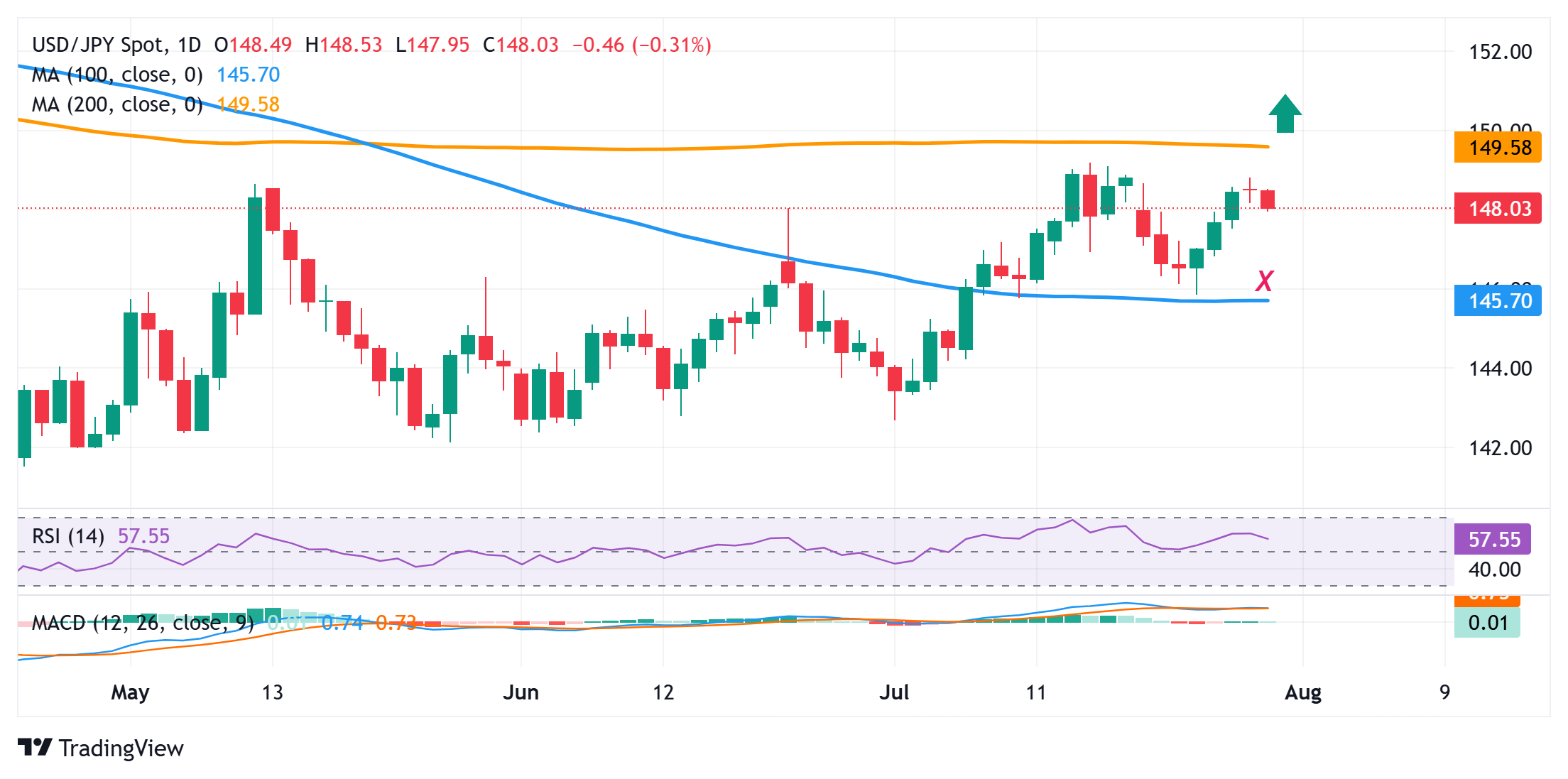
Any subsequent slide is likely to find decent support near the 147.75-147.70 area, below which the USD/JPY pair could test the 147.00 round figure before dropping to the 100-day Simple Moving Average (SMA), currently around the 146.70 region. The latter coincides with last week's swing low, which, if broken decisively, might shift the near-term bias in favor of bearish traders and make spot prices vulnerable to retest sub-146.00 levels.
On the flip side, the 148.50 area, followed by the overnight swing high near the 148.80 region, now seems to act as immediate hurdles. This is followed by the 149.00-149.10 region, or the monthly top, and the very important 200-day SMA, around the 149.55 region. A sustained strength beyond the latter will be seen as a fresh trigger for the USD/JPY bulls and pave the way for a move towards reclaiming the 150.00 psychological mark.
Economic Indicator
BoJ Interest Rate Decision
The Bank of Japan (BoJ) announces its interest rate decision after each of the Bank’s eight scheduled annual meetings. Generally, if the BoJ is hawkish about the inflationary outlook of the economy and raises interest rates it is bullish for the Japanese Yen (JPY). Likewise, if the BoJ has a dovish view on the Japanese economy and keeps interest rates unchanged, or cuts them, it is usually bearish for JPY.
Read more.Next release: Thu Jul 31, 2025 03:00
Frequency: Irregular
Consensus: 0.5%
Previous: 0.5%
Source: Bank of Japan
Author

Haresh Menghani
FXStreet
Haresh Menghani is a detail-oriented professional with 10+ years of extensive experience in analysing the global financial markets.