Japanese Yen jumps back closer to weekly top against a broadly weaker USD
- The Japanese Yen attracts dip-buyers as traders digest reports of additional US tariffs.
- Rising September Fed rate cut bets undermine the USD and weigh on the USD/JPY pair.
- Mixed BoJ rate hike cues might cap any further JPY gains amid a positive risk tone.

The Japanese Yen (JPY) attracts strong buying following an intraday slide led by reports that US President Donald Trump could impose an additional 15% tariff on all imports from Japan. The latest development revives concerns about the potential negative impact of higher tariffs on the global economy, which, in turn, prompts aggressive safe-haven buying and benefits the JPY.
Apart from this, expectations for an imminent interest rate hike by the Bank of Japan (BoJ) later this year lend additional support to the JPY. The US Dollar (USD), on the other hand, continues to be weighed down by the growing acceptance that the Federal Reserve (Fed) will lower borrowing costs in September, which contributes to the USD/JPY pair's steep intraday decline.
It, however, remains to be seen if the JPY bulls are able to retain control amid the uncertainty over the likely timing of the next BoJ rate hike. This, along with a positive tone around the equity markets, might contribute to capping the JPY and warrants caution before placing fresh bearish bets around the USD/JPY pair. Traders now look to the US Weekly Jobless Claims for a fresh impetus.
Japanese Yen bulls regain control as trade tensions boost safe-haven demand
- Asahi newspaper, citing a White House official, reported this Thursday that US President Donald Trump could impose an extra 15% tariff on all Japanese imports. The US will not apply exceptions to Japan for products that already have tariffs exceeding 15%, the report added further.
- This adds a layer of uncertainty on the back of the recent political developments in Japan. In fact, the ruling Liberal Democratic Party’s loss in the upper house election on July 20 raised concerns about Japan's fiscal health amid calls from the opposition to boost spending and cut taxes.
- Moreover, data released on Wednesday showed that real wages in Japan fell for the sixth straight month in June and fueled worries about a consumption-led recovery. This suggests that prospects for Bank of Japan rate hikes could be delayed and undermines the Japanese Yen.
- The BoJ, however, has repeatedly said that it will hike interest rates further if growth and inflation continue to advance in line with its estimates. This is holding back the JPY bears from placing aggressive bets and acting as a tailwind for the USD/JPY pair despite a bearish US Dollar.
- The USD Index (DXY), which tracks the greenback against a basket of currencies, fell to a one-week low on Wednesday amid expectations for more interest rate cuts than previously expected by the Federal Reserve this year. The bets were lifted by the incoming weaker US macro data.
- The US Nonfarm Payrolls report for July pointed to a sharp deterioration in labor market conditions. Furthermore, the US ISM Services PMI released on Tuesday underscored the ongoing drag on the economy amid the uncertainty surrounding Trump's erratic trade policies.
- This, in turn, affirmed market bets that the Fed will resume its rate-cutting cycle in September and lower borrowing costs by 25 basis points at least two times by the year-end. This keeps the US Treasury bond yields and the USD depressed, which could cap gains for the USD/JPY pair.
- Traders now look forward to the release of the US Weekly Initial Jobless Claims data, due later during the North American session. Apart from this, speeches from FOMC members could drive the USD demand. This, along with trade headlines, might influence the currency pair.
USD/JPY bears await break below the 146.75-146.70 confluence support
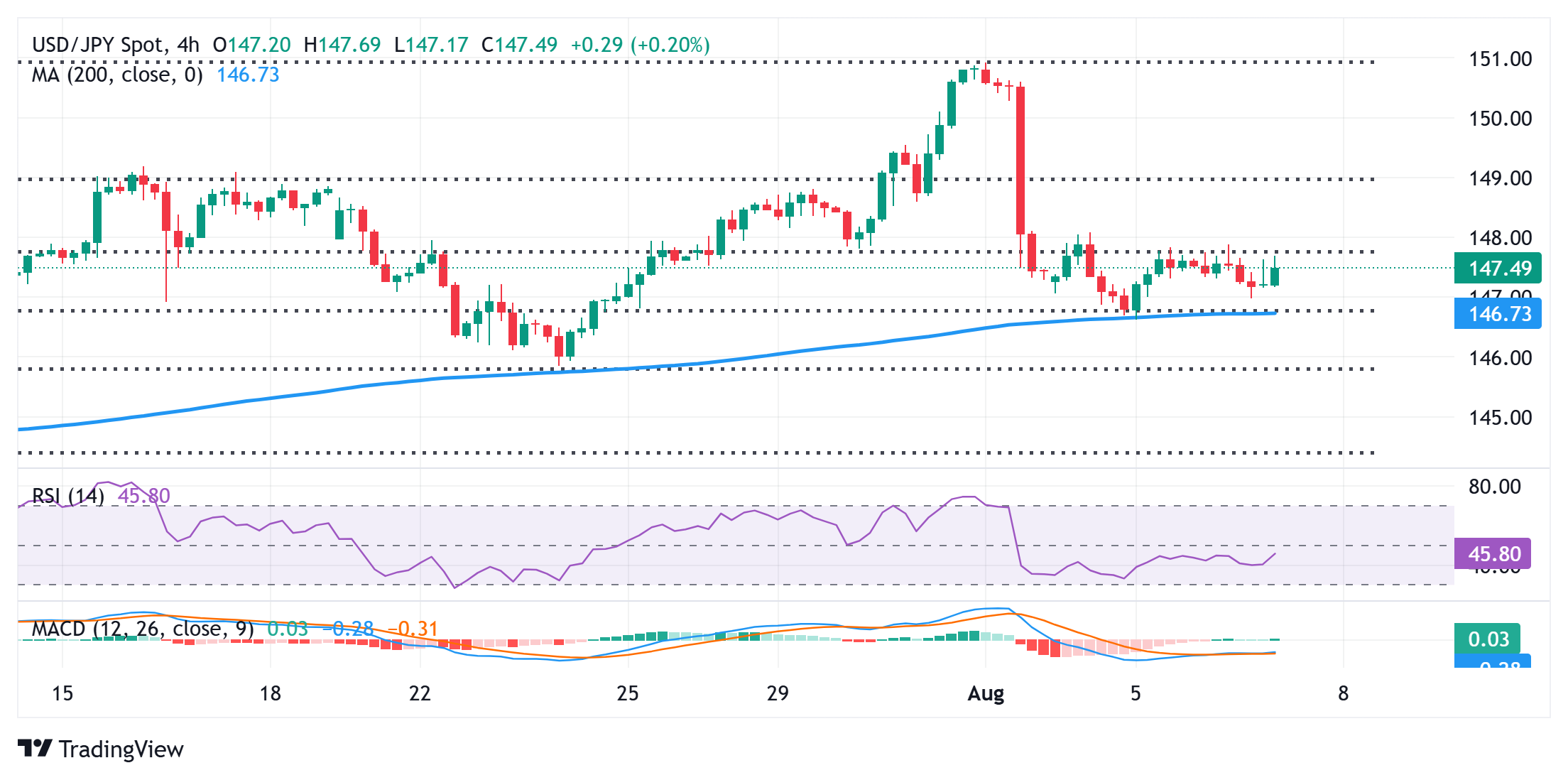
From a technical perspective, this week's rebound from the 200-period Simple Moving Average (SMA), around the 146.60 area, or the weekly low, and the subsequent move up favors the USD/JPY bulls. However, oscillators on the said chart are yet to confirm the positive outlook. Moreover, spot prices, so far, have been struggling to clear the 38.2% Fibonacci retracement level of the upswing from the July monthly low. This, in turn, makes it prudent to wait for a sustained move beyond the 147.80-147.85 region before positioning for any further gains. The currency pair might then surpass the 148.00 round figure and climb to the 148.45-148.50 region. The momentum could extend further towards the 149.00 neighborhood, or the 23.6% Fibo. retracement level.
On the flip side, the Asian session low, around the 147.15 region, closely followed by the 147.00 mark, could offer immediate support to the USD/JPY pair ahead of the 146.75 confluence. The latter represents the 200-period SMA on the 4-hour and the 50% Fibo. retracement level, which, if broken decisively, should pave the way for deeper losses. Spot prices might then accelerate the fall towards testing sub-146.00 levels, or the 61.8% Fibo. retracement level. Some follow-through selling below the latter could expose the 145.00 psychological mark.
US Dollar PRICE This week
The table below shows the percentage change of US Dollar (USD) against listed major currencies this week. US Dollar was the strongest against the Swiss Franc.
| USD | EUR | GBP | JPY | CAD | AUD | NZD | CHF | |
|---|---|---|---|---|---|---|---|---|
| USD | -0.78% | -0.70% | -0.32% | -0.39% | -0.78% | -0.81% | -0.04% | |
| EUR | 0.78% | 0.13% | 0.46% | 0.40% | -0.13% | -0.04% | 0.73% | |
| GBP | 0.70% | -0.13% | 0.37% | 0.27% | -0.27% | -0.18% | 0.60% | |
| JPY | 0.32% | -0.46% | -0.37% | -0.07% | -0.60% | -0.50% | 0.44% | |
| CAD | 0.39% | -0.40% | -0.27% | 0.07% | -0.54% | -0.43% | 0.33% | |
| AUD | 0.78% | 0.13% | 0.27% | 0.60% | 0.54% | 0.10% | 0.87% | |
| NZD | 0.81% | 0.04% | 0.18% | 0.50% | 0.43% | -0.10% | 0.76% | |
| CHF | 0.04% | -0.73% | -0.60% | -0.44% | -0.33% | -0.87% | -0.76% |
The heat map shows percentage changes of major currencies against each other. The base currency is picked from the left column, while the quote currency is picked from the top row. For example, if you pick the US Dollar from the left column and move along the horizontal line to the Japanese Yen, the percentage change displayed in the box will represent USD (base)/JPY (quote).
Author

Haresh Menghani
FXStreet
Haresh Menghani is a detail-oriented professional with 10+ years of extensive experience in analysing the global financial markets.

















