Japanese Yen sticks to modest losses amid positive risk tone, BoJ uncertainty
- The Japanese Yen drifts lower amid receding safe-haven demand and BoJ rate hike uncertainty.
Reduced bets for a jumbo Fed rate cut in September support the USD and the USD/JPY pair.
The divergent BoJ-Fed policy expectations warrant caution before placing aggressive bullish bets.

The Japanese Yen (JPY) maintains its offered tone through the first half of the European session on Monday, which, along with a pickup in the US Dollar (USD) demand, assists the USD/JPY pair to hold steady just below mid-147.00s. Despite the Bank of Japan's (BoJ) hawkish outlook, investors remain uncertain over the likely timing of the next interest rate hike. This, along with the prevalent risk-on environment, undermines the safe-haven JPY. The USD, on the other hand, benefits from reduced bets for a more aggressive policy easing by the Federal Reserve (Fed).
Meanwhile, the growing acceptance that the BoJ will stick to its policy normalization path marks a big divergence in comparison to other major central banks, including the Fed, which is expected to resume its rate-cutting cycle in September. This, in turn, might hold back the USD bulls from placing aggressive bets and offer some support to the lower-yielding JPY. Investors might also opt to move to the sidelines ahead of the release of FOMC meeting Minutes and Fed Chair Jerome Powell's speech at the Jackson Hole Symposium during the latter part of the week.
Japanese Yen bulls remain on the sidelines amid positive risk tone; BoJ rate hike uncertainty
- The high-stakes meeting between US President Donald Trump and Russian leader Vladimir Putin in Alaska yielded no clear breakthrough. Investors, however, remain hopeful that the dialogue has increased the chances of ending the prolonged war in Ukraine.
- Trump said early Monday that Ukrainian President Volodymyr Zelenskiy can end the war with Russia almost immediately if he wants to. Trump and Zelenskiy will have a bilateral meeting prior to the European leaders joining a larger conversation later today.
- The development helps ease geopolitical risks and remains supportive of the prevalent risk-on environment. This, in turn, prompts some selling around the safe-haven Japanese Yen during the Asian session on Monday amid the Bank of Japan rate-hike uncertainty.
- Domestic political uncertainty following the ruling Liberal Democratic Party’s loss in the upper house election, along with concern about the negative economic impact of higher US tariffs, suggests that the prospects for further BoJ policy normalization could be delayed.
- Meanwhile, data released on Friday showed that Japan's economy expanded more than expected in the second quarter despite US tariff headwinds. This, along with an upward revision of the BoJ's inflation forecast, keeps the door open for a rate hike by the year-end.
- In contrast, market participants are pricing in about 85% chances that the Federal Reserve will lower borrowing costs at the next policy meeting in September. Moreover, the US central bank is expected to deliver at least two 25-basis-point interest rate cuts in 2025.
- On the economic data front, the US Census Bureau reported on Friday that the US Retail Sales increased by 0.5% on a monthly basis in July. This followed the 0.9% increase (revised up from 0.6%) recorded in June and came in line with the market expectation.
- However, the preliminary data from the University of Michigan showed that the US Consumer Sentiment Index unexpectedly dropped to 58.6 from 61.7 in July, signalling a poor backdrop in public confidence. Moreover, the Expectations Index eased to 57.2 from 57.7.
- However, the one-year inflation expectations climbed to 4.9% from 4.5% and the five-year forecast increased to 3.9% from 3.4%. This comes on top of the strong US Producer Price Index released last Thursday and points to some gain of momentum in price pressures.
- This, in turn, further tempers bets for a more aggressive policy easing by the Fed and bets for a jumbo rate cut in September, which offers some support to the US Dollar and the USD/JPY pair. The lack of any meaningful buying, however, warrants caution for bulls.
- Traders might also refrain from placing aggressive directional bets and opt to wait for the release of the FOMC meeting minutes on Wednesday. Apart from this, Fed Chair Jerome Powell's speech at the Jackson Hole Symposium is expected to provide rate-cut cues and some meaningful impetus.
USD/JPY needs to breakout through a two-week-old range for traders to place fresh directional bets
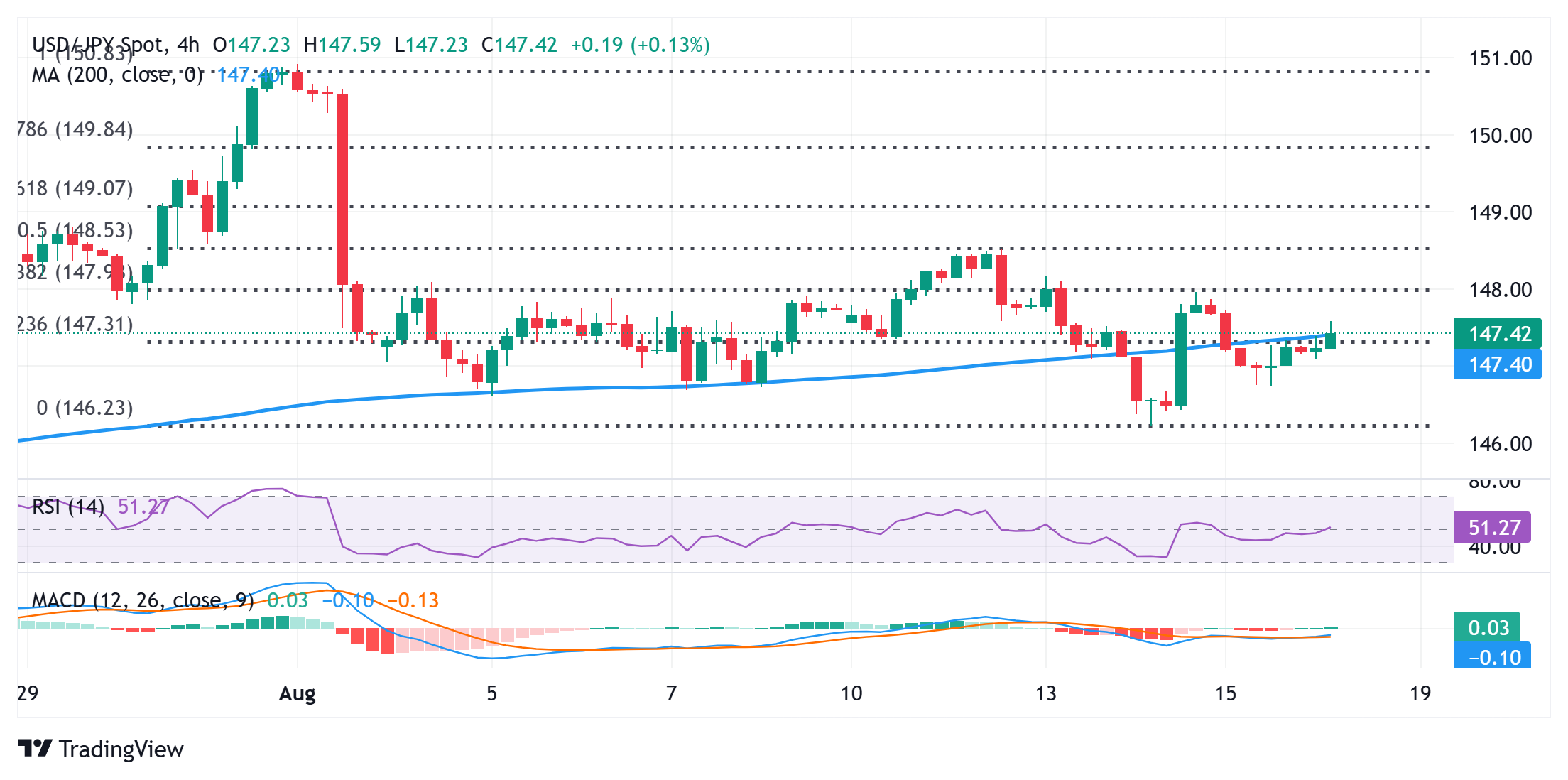
The USD/JPY pair has been oscillating in a familiar range over the past two weeks or so. This points to a consolidation phase and makes it prudent to wait for an eventual break on either side before positioning for the next leg of a directional move amid neutral technical indicators on the daily chart.
Meanwhile, an intraday rise beyond the 23.6% Fibonacci retracement level of the downfall from the monthly swing high backs the case for additional gains. Any further move up beyond the 200-period Simple Moving Average (SMA) on the 4-hour chart, however, is likely to confront stiff resistance near the 148.00 mark, or the 38.2% Fibo. retracement level.
A sustained strength and acceptance above the said handle might shift the near-term bias in favor of bulls. The USD/JPY pair might then climb to the 148.55-148.60 region, or the 50% retracement level, and extend the positive momentum further towards the 149.00 round figure.
On the flip side, the 147.10-147.00 area could offer immediate support, below which the USD/JPY pair could retest the multi-week low, around the 146.20 zone, touched last Thursday, Some follow-through selling, leading to a subsequent fall below the 146.00 round figure, will be seen as a fresh trigger for bearish traders and make spot prices vulnerable to extend the fall to the the 145.40-145.30 region en route to the 145.00 psychological mark.
Risk sentiment FAQs
In the world of financial jargon the two widely used terms “risk-on” and “risk off'' refer to the level of risk that investors are willing to stomach during the period referenced. In a “risk-on” market, investors are optimistic about the future and more willing to buy risky assets. In a “risk-off” market investors start to ‘play it safe’ because they are worried about the future, and therefore buy less risky assets that are more certain of bringing a return, even if it is relatively modest.
Typically, during periods of “risk-on”, stock markets will rise, most commodities – except Gold – will also gain in value, since they benefit from a positive growth outlook. The currencies of nations that are heavy commodity exporters strengthen because of increased demand, and Cryptocurrencies rise. In a “risk-off” market, Bonds go up – especially major government Bonds – Gold shines, and safe-haven currencies such as the Japanese Yen, Swiss Franc and US Dollar all benefit.
The Australian Dollar (AUD), the Canadian Dollar (CAD), the New Zealand Dollar (NZD) and minor FX like the Ruble (RUB) and the South African Rand (ZAR), all tend to rise in markets that are “risk-on”. This is because the economies of these currencies are heavily reliant on commodity exports for growth, and commodities tend to rise in price during risk-on periods. This is because investors foresee greater demand for raw materials in the future due to heightened economic activity.
The major currencies that tend to rise during periods of “risk-off” are the US Dollar (USD), the Japanese Yen (JPY) and the Swiss Franc (CHF). The US Dollar, because it is the world’s reserve currency, and because in times of crisis investors buy US government debt, which is seen as safe because the largest economy in the world is unlikely to default. The Yen, from increased demand for Japanese government bonds, because a high proportion are held by domestic investors who are unlikely to dump them – even in a crisis. The Swiss Franc, because strict Swiss banking laws offer investors enhanced capital protection.
Author

Haresh Menghani
FXStreet
Haresh Menghani is a detail-oriented professional with 10+ years of extensive experience in analysing the global financial markets.