Japanese Yen sticks to intraday losses; USD/JPY remains below mid-147.00s
- The Japanese Yen meets with a fresh supply during the Asian session amid mixed BoJ rate hike cues.
- A positive risk tone further undermines the safe-haven JPY, though the downside seems cushioned.
- Rising Fed rate cut bets should cap any USD recovery and contribute to capping the USD/JPY pair.

The Japanese Yen (JPY) remains on the back foot against the broadly rebounding US Dollar (USD) through the early European session on Friday amid the uncertainty over the likely timing of the next Bank of Japan (BoJ) rate hike. In fact, the Summary of Opinions from the Bank of Japan's (BoJ) July meeting showed earlier today that policymakers remain worried about the negative impact of higher US tariffs on the domestic economy. This, in turn, suggests that prospects for BoJ rate hikes could be delayed further and weigh on the JPY.
Moreover, a generally positive risk tone turns out to be another factor undermining the safe-haven JPY. Investors, however, seem convinced that the BoJ will raise interest rates by the year-end. This marks a significant divergence in comparison to expectations that the Federal Reserve (Fed) will resume its rate-cutting cycle in September, which should cap the USD recovery and support the lower-yielding JPY. Hence, it will be prudent to wait for strong follow-through buying before positioning for any further move up for the USD/JPY pair.
Japanese Yen remains confined in weekly range as BoJ uncertainty keeps traders on the sidelines
- The Bank of Japan published the Summary of Opinions of its July 30-31 meeting earlier this Friday, which showed that board members maintained their view for further interest-rate increases despite high uncertainty over tariffs. The summary further revealed that Japan's economic growth will moderate, and the improvement in underlying inflation will be sluggish temporarily.
- Earlier, the Ministry of Internal Affairs and Communications reported that Japan's Household Spending rose in June at a slower rate than expected as higher prices added pressure to broader consumption trends. Consumer spending fell 5.2% on a monthly basis, marking the steepest decline since January 2021, suggesting that prospects for BoJ rate hikes could be delayed further.
- Japan's Topix index rose above the 3000 psychological mark for the first time ever, while the tech-focused Nikkei 225 rallied to its highest since July 25. This, in turn, prompts some selling around traditional safe-haven assets, including the Japanese Yen. Apart from this, a modest US Dollar recovery assists the USD/JPY pair to rebound around 60-70 pips from the Asian session low.
- Any meaningful USD appreciation, however, seems elusive amid bets that the Federal Reserve will resume its rate-cutting cycle in September. The expectations were reaffirmed by the US Weekly Initial Jobless Claims data released on Thursday, which rose more than expected last week to the highest level in a month. This further pointed to signs of a cooling US labor market.
- Moreover, concerns about the Fed's independence might contribute to capping gains for the USD and the USD/JPY pair. Meanwhile, US President Donald Trump nominated Council of Economic Advisers Chairman Stephen Miran to serve out the rest of Fed Governor Adriana Kugler's term and has short-listed four candidates as replacements for Fed Chair Jerome Powell.
- Moving ahead, there isn't any relevant market-moving economic data due for release from the US on Friday, leaving the USD at the mercy of speeches from influential FOMC members. Apart from this, the broader risk sentiment could provide some impetus heading into the weekend. Nevertheless, the mixed fundamental backdrop warrants caution for aggressive USD/JPY traders.
USD/JPY bulls need to wait for move beyond the 38.2% Fibo. hurdle near the 147.75-147.80 area
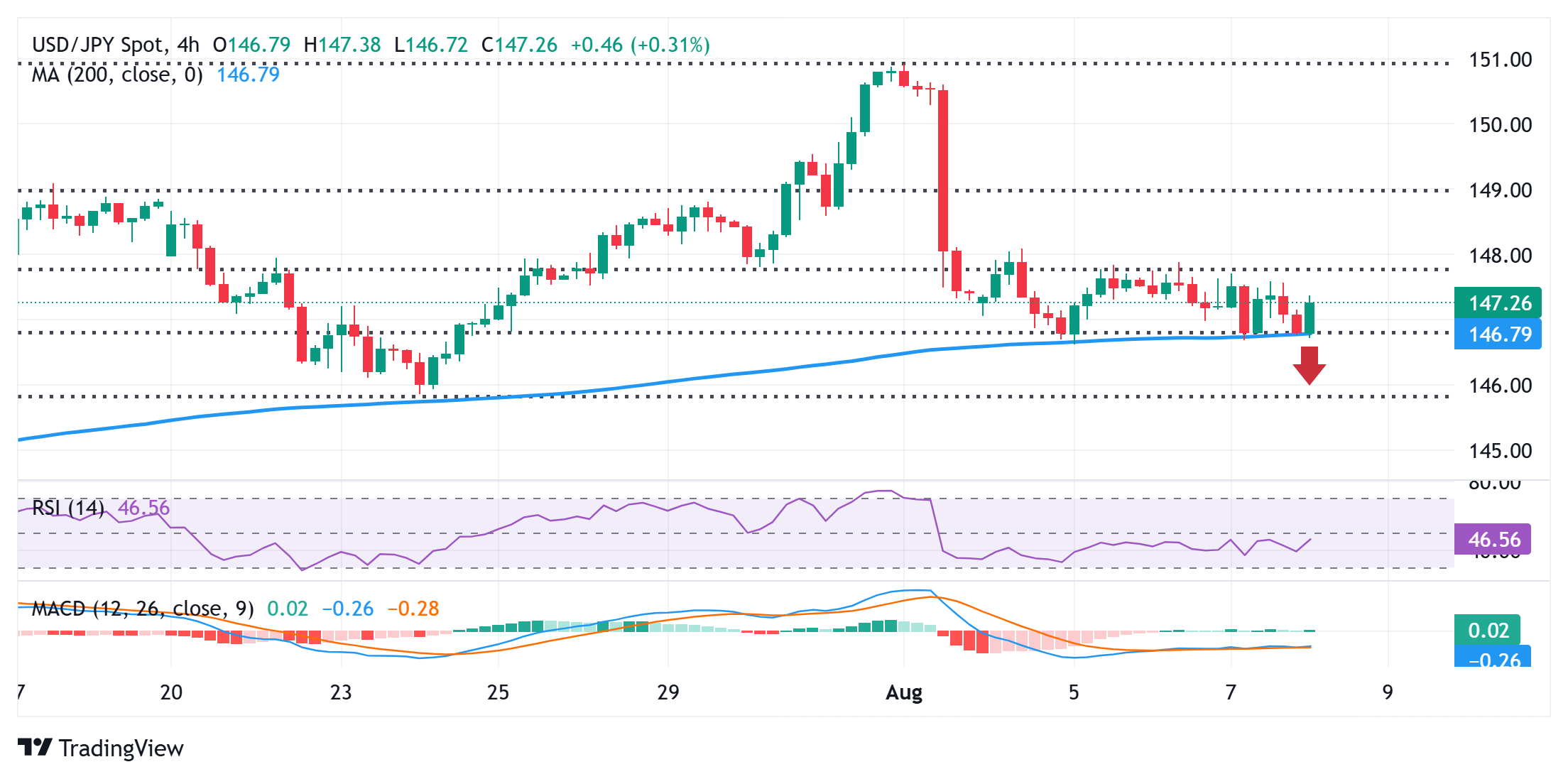
From a technical perspective, spot prices remain confined in the weekly trading band. Against the backdrop of last week's sharp pullback from the 151.00 neighborhood, or the highest level since March 28, the range-bound price action might still be categorized as a bearish consolidation phase. Moreover, slightly negative oscillators on the daily chart suggest that the path of least resistance for the USD/JPY pair is to the downside.
Hence, any further move up might continue to attract fresh sellers and remain capped near the 147.75-147.80 region, representing the 38.2% Fibonacci retracement level of the upswing in July. That said, some follow-through buying, leading to a subsequent strength beyond the 148.00 mark, could lift the USD/JPY pair to the 148.45-148.50 region. The momentum could extend further towards the 23.6% Fibo. retracement level, just ahead of the 149.00 mark.
On the flip side, the 146.75-146.70 confluence – comprising the 200-period Simple Moving Average (SMA) on the 4-hour and the 50% Fibo. retracement level – might continue to protect the immediate downside. A convincing break below should pave the way for deeper losses and drag the USD/JPY pair to sub-146.00 levels, or the 61.8% Fibo. retracement level. Some follow-through selling below the latter could expose the 145.00 psychological mark.
Tariffs FAQs
Tariffs are customs duties levied on certain merchandise imports or a category of products. Tariffs are designed to help local producers and manufacturers be more competitive in the market by providing a price advantage over similar goods that can be imported. Tariffs are widely used as tools of protectionism, along with trade barriers and import quotas.
Although tariffs and taxes both generate government revenue to fund public goods and services, they have several distinctions. Tariffs are prepaid at the port of entry, while taxes are paid at the time of purchase. Taxes are imposed on individual taxpayers and businesses, while tariffs are paid by importers.
There are two schools of thought among economists regarding the usage of tariffs. While some argue that tariffs are necessary to protect domestic industries and address trade imbalances, others see them as a harmful tool that could potentially drive prices higher over the long term and lead to a damaging trade war by encouraging tit-for-tat tariffs.
During the run-up to the presidential election in November 2024, Donald Trump made it clear that he intends to use tariffs to support the US economy and American producers. In 2024, Mexico, China and Canada accounted for 42% of total US imports. In this period, Mexico stood out as the top exporter with $466.6 billion, according to the US Census Bureau. Hence, Trump wants to focus on these three nations when imposing tariffs. He also plans to use the revenue generated through tariffs to lower personal income taxes.
Author

Haresh Menghani
FXStreet
Haresh Menghani is a detail-oriented professional with 10+ years of extensive experience in analysing the global financial markets.