Japanese Yen flat lines against USD amid mixed cues; bearish bias seems intact
- The Japanese Yen attracts some intraday sellers and stalls its recovery from a two-week low against USD.
- Trade jitters keep investors on edge and help limit deeper losses for the safe-haven JPY, capping USD/JPY.
- Expectations that the Fed will cut rates in 2025 weigh on the USD and also act as a headwind for the pair.

The Japanese Yen (JPY) attracts fresh sellers following an intraday uptick on Thursday and hangs near the daily low against its American counterpart heading into the European session. Investors now seem convinced that rising trade tensions would add to woes for Japan’s economy, and force the Bank of Japan (BoJ) to forgo raising interest rates this year. The expectations were reaffirmed by Japan's Producer Price Index (PPI) released earlier this Thursday, which hinted that inflation pressures might be cooling off. This, along with domestic political uncertainty, undermines the JPY.
Furthermore, a generally positive tone around the equity markets turns out to be another factor that dents demand for the safe-haven JPY and assists the USD/JPY pair to rebound around 60 pips from the 145.75 area, or the daily swing low. However, concerns about the potential economic fallout from US President Donald Trump's tariffs keep a lid on the market optimism. Furthermore, the US Dollar (USD) bulls remain on the defensive amid prospects for more interest rate cuts by the Federal Reserve (Fed) this year. This further contributes to capping the upside for the pair.
Japanese Yen traders seem non-committed as safe-haven buying offsets trade tensions
- US President Donald Trump issued a new round of trade letters, outlining individual tariff rates ranging from 20% to 50% for eight countries starting August 1. A notable aspect of the 20 letters sent so far was Trump's direct threat to increase tariffs if any countermeasures are taken.
- Moreover, Trump announced 50% tariffs on copper and has also threatened to impose levies of up to 200% on foreign drugs, fueling concerns about the economic fallout from trade tensions. This assists the safe-haven Japanese Yen to attract buyers for the second straight day on Thursday.
- Japan hopes to arrange meetings between its chief negotiator Ryosei Akazawa and US Treasury Secretary Scott Bessent during his visit to the World Expo on July 19. Japan also aims to secure a call prior to the meeting, and possibly a meeting between Prime Minister Shigeru Ishiba and Bessent.
- Minutes from the June 17–18 FOMC meeting released on Wednesday indicated that policymakers anticipate that rate cuts would be appropriate later this year and that any price shock from tariffs could be temporary or modest. This is seen weighing on the US Dollar and the USD/JPY pair.
- A report released by the Bank of Japan on Thursday revealed that Japan's Producer Price Index (PPI) fell 0.2% in June and rose by 2.9% compared to the same time period last year. The readings were in line with estimates, though the annual rate marked a deceleration from May's 3.3%.
- Moreover, data released earlier this week showed that the growth in Japan's nominal wages decelerated for the third straight month in May 2025, and inflation-adjusted real wages posted the steepest decline in 20 months. This backs the case for the BoJ caution in the near term.
- Recent media polls raised doubts about whether the ruling coalition of the Liberal Democratic Party (LDP) and Komeito will be able to secure enough seats to maintain their majority at the House of Councillors election on July 20. This adds a layer of uncertainty and could cap the JPY.
- Traders now look forward to the release of the US Weekly Initial Jobless Claims, due later during the North American session. Apart from this, speeches from Fed officials will be scrutinized for cues about the future rate-cut path, which should drive the USD and the USD/JPY pair.
USD/JPY needs to surpass the 146.30 resistance for bulls to retain short-term control
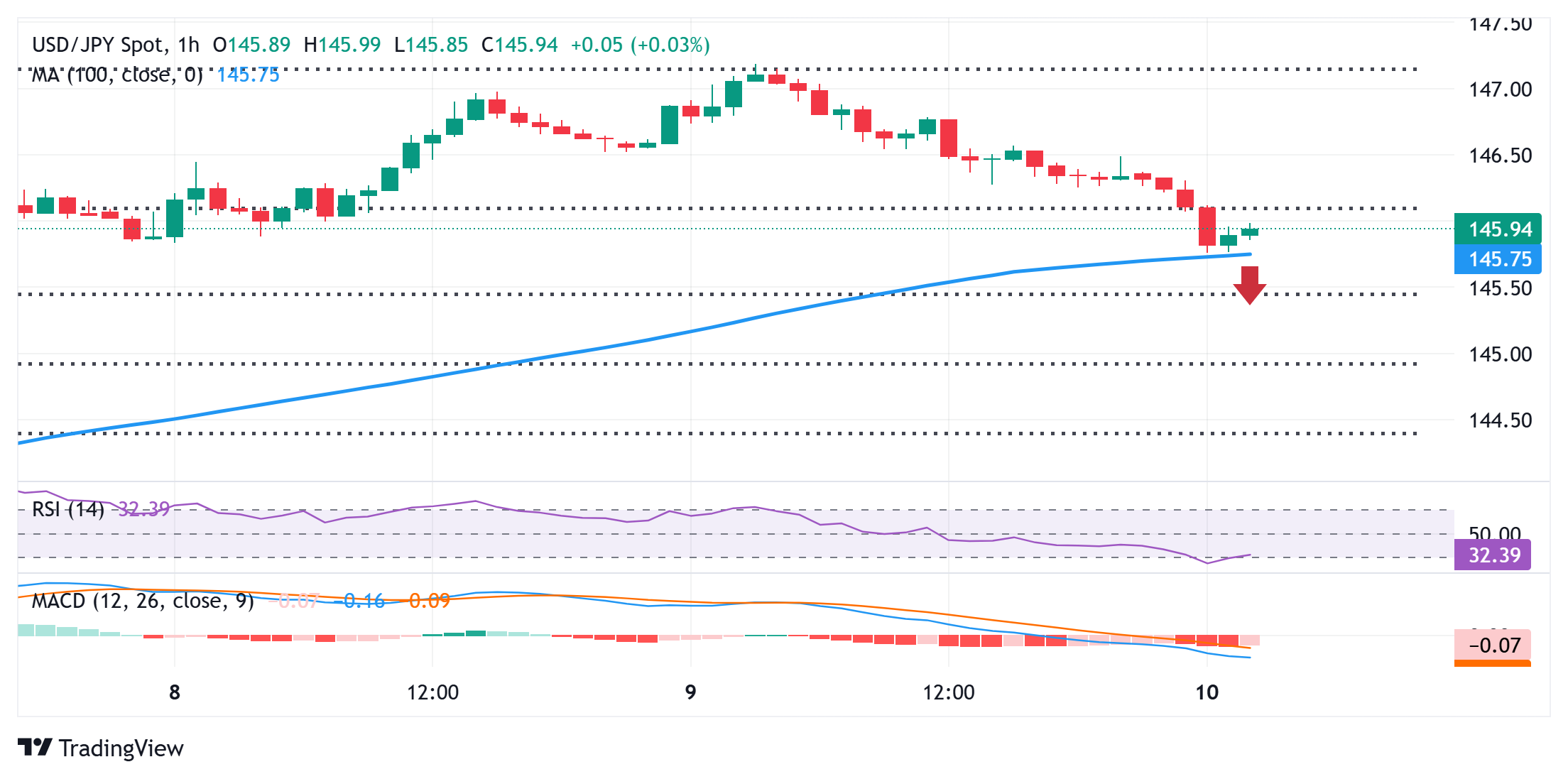
From a technical perspective, intraday breakdown below the 23.6% Fibonacci retracement level of the recent move up from the monthly swing low could be seen as a key trigger for the USD/JPY bears. The subsequent fall, however, finds some support near the 145.75 region, representing the 100-hour Simple Moving Average (SMA). The said area should now act as a pivotal point, below which spot prices could extend the fall towards the 38.2% Fibo. retracement level, around the 145.50-145.45 area. Some follow-through selling could eventually drag the pair to the next relevant support near the 145.00 psychological mark, or the 50% retracement level.
On the flip side, any recovery beyond the 146.00 mark might now confront resistance near the 146.25-146.30 area ahead of the 146.55 region. A sustained strength beyond the latter will suggest that the corrective pullback has run its course and allow the USD/JPY pair to reclaim the 147.00 round figure. The momentum could extend further towards the 147.60-147.65 intermediate hurdle en route to the 148.00 mark, or the June monthly swing high.
Risk sentiment FAQs
In the world of financial jargon the two widely used terms “risk-on” and “risk off'' refer to the level of risk that investors are willing to stomach during the period referenced. In a “risk-on” market, investors are optimistic about the future and more willing to buy risky assets. In a “risk-off” market investors start to ‘play it safe’ because they are worried about the future, and therefore buy less risky assets that are more certain of bringing a return, even if it is relatively modest.
Typically, during periods of “risk-on”, stock markets will rise, most commodities – except Gold – will also gain in value, since they benefit from a positive growth outlook. The currencies of nations that are heavy commodity exporters strengthen because of increased demand, and Cryptocurrencies rise. In a “risk-off” market, Bonds go up – especially major government Bonds – Gold shines, and safe-haven currencies such as the Japanese Yen, Swiss Franc and US Dollar all benefit.
The Australian Dollar (AUD), the Canadian Dollar (CAD), the New Zealand Dollar (NZD) and minor FX like the Ruble (RUB) and the South African Rand (ZAR), all tend to rise in markets that are “risk-on”. This is because the economies of these currencies are heavily reliant on commodity exports for growth, and commodities tend to rise in price during risk-on periods. This is because investors foresee greater demand for raw materials in the future due to heightened economic activity.
The major currencies that tend to rise during periods of “risk-off” are the US Dollar (USD), the Japanese Yen (JPY) and the Swiss Franc (CHF). The US Dollar, because it is the world’s reserve currency, and because in times of crisis investors buy US government debt, which is seen as safe because the largest economy in the world is unlikely to default. The Yen, from increased demand for Japanese government bonds, because a high proportion are held by domestic investors who are unlikely to dump them – even in a crisis. The Swiss Franc, because strict Swiss banking laws offer investors enhanced capital protection.
Author

Haresh Menghani
FXStreet
Haresh Menghani is a detail-oriented professional with 10+ years of extensive experience in analysing the global financial markets.