Japanese Yen trims part of intraday losses as trade jitters boost safe-haven demand
- The Japanese Yen meets with a fresh supply as traders pare BoJ rate hike bets amid rising trade tension.
- Domestic political uncertainty also undermines the JPY and provides a goodish lift to the USD/JPY pair.
- The USD sits near a two-week top amid reduced Fed rate cut bets and contributes to the pair's move up.

The Japanese Yen (JPY) rebounds a few pips from a multi-week trough touched against a broadly firmer US Dollar (USD) earlier this Friday, though retains a bearish bias heading into the European session. US President Donald Trump recently imposed a 25% tariff on all Japanese exports to America starting on August 1 and ruled out any extension of the deadline. This adds to woes for Japan’s economy, which, along with declining real wages and signs of cooling inflationary pressures, should allow the Bank of Japan (BoJ) to forgo raising interest rates this year. Apart from this, domestic political uncertainty turns out to be a key factor undermining the JPY.
Meanwhile, concerns about the potential economic fallout from higher US tariffs keep investors on edge. This is evident from a weaker tone around the US equity markets, which offers some support and helps limit losses for the safe-haven JPY. The USD, on the other hand, stands firm near a two-week top amid diminishing odds for an immediate interest rate cut by the Federal Reserve (Fed). Moreover, the supportive fundamental backdrop suggests that the path of least resistance for the USD/JPY pair remains to the upside. Hence, any corrective pullback could be seen as a buying opportunity and remain limited in the absence of any relevant data.
Japanese Yen trims a part of heavy intraday losses amid safe-haven buying
- US President Donald Trump reignited trade war concerns this week and issued notices to key allies, including Japan, outlining individual tariff rates starting August 1. Japan faces a punishing 25% tariff on all exports to America amid stalled US-Japan trade negotiations, particularly over Japan’s protection of its rice market.
- Japan's Prime Minister Shigeru Ishiba called the move truly regrettable and said that bilateral talks would continue in pursuit of a mutually beneficial outcome. Japan hopes to arrange meetings between its chief negotiator, Ryosei Akazawa, and US Treasury Secretary Scott Bessent during his visit to the World Expo on July 19.
- Meanwhile, data released this week showed that Japan's real wages in May fell at the fastest pace in 20 months. Adding to this, Japan's Producer Price Index hinted that inflation pressures might be cooling off. This, along with rising trade tensions, could complicate the Bank of Japan's plans to normalize its monetary policy.
- Recent media polls raised doubts about whether Japan's ruling coalition of the Liberal Democratic Party (LDP) and Komeito will be able to secure enough seats to maintain their majority at the upper house election on July 20. This further adds a layer of uncertainty and continues to undermine the Japanese Yen.
- The US Dollar trades with a positive bias near its highest level in more than two weeks as traders temper their expectations for a rate cut by the Federal Reserve later this month. This further contributes to the USD/JPY pair's strong move up during the Asian session and supports prospects for additional gains.
- Meanwhile, San Francisco Fed President Mary Daly said on Thursday that monetary policy is still restrictive, and it's time to think about adjusting the interest rate. Tariffs aren't as high as they were expected to be, and economic fundamentals support a move toward lower rates at some point, Daly added further.
- Separately, Fed Board of Governors member Christopher Waller noted that tariff inflation effects are likely to be short-lived and that a rate cut here would not be politically motivated. Waller – one of the possible favorites to replace Powell in 2026 – made another push for an early interest rate cut in July.
- In contrast, St. Louis Fed President Alberto Musalem said that it was too soon to tell if tariffs will have a one-off or a more persistent impact on inflation. The economy is in a good place, and it is critical for the Fed to keep long-term inflation expectations anchored, Musalem added further.
- On the economic data front, the US Department of Labor (DOL) reported that Initial Jobless Claims fell to 227K for the week ending July 5. The reading was less than consensus estimates and the previous month's downwardly revised reading of 232K, pointing to a still resilient US labor market.
- There isn't any relevant market-moving economic data due for release from the US on Friday, leaving the USD/JPY pair at the mercy of the USD price dynamics. Nevertheless, spot prices remain on track to register strong weekly gains as the focus now shifts to US inflation figures next week.
USD/JPY struggles to find acceptance and build on momentum beyond 147.00
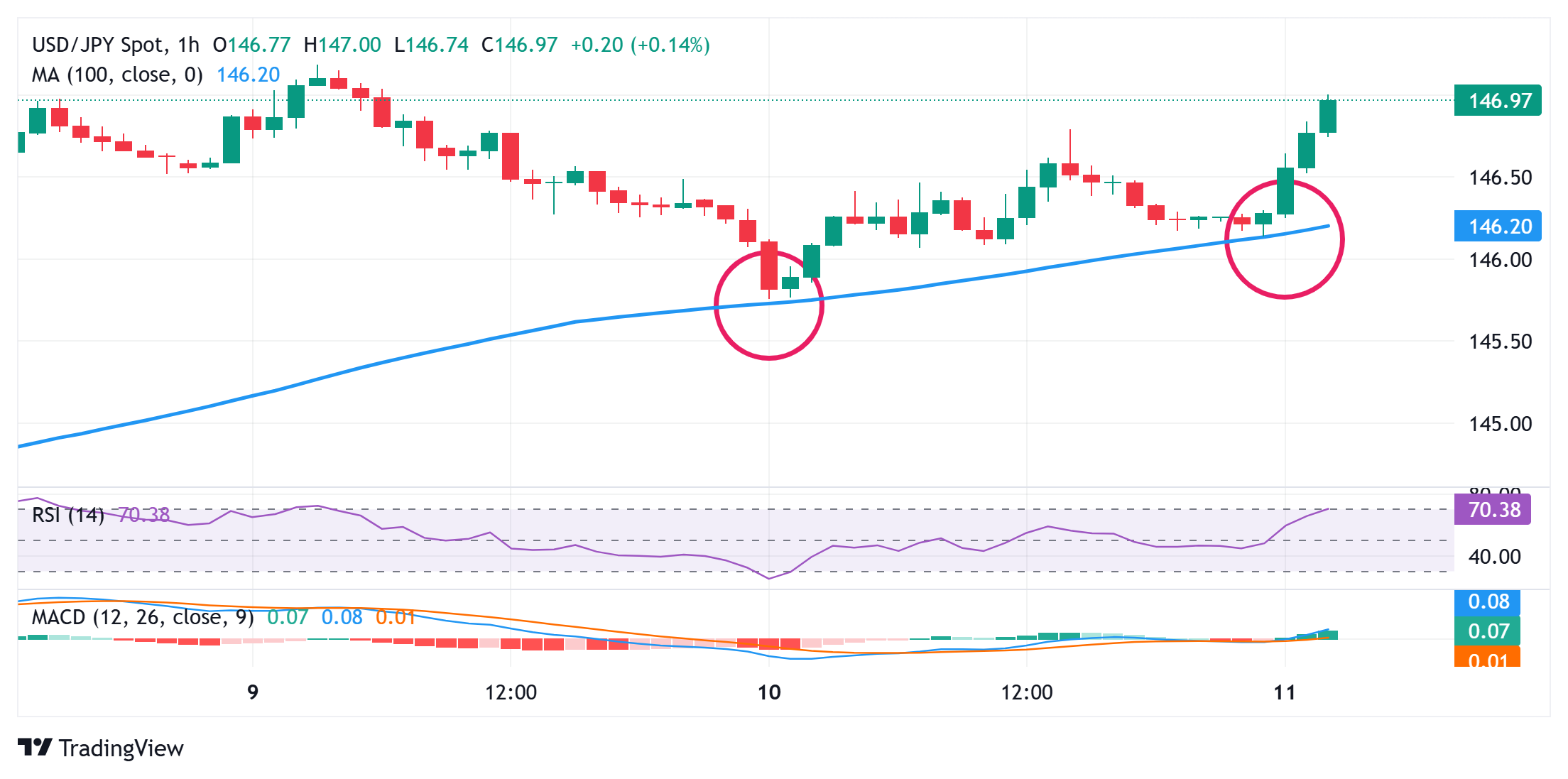
From a technical perspective, the USD/JPY pair attracts dip-buyers near the 100-hour Simple Moving Average (SMA) support for the second straight day. A subsequent strength beyond the 147.00 mark will be seen as a fresh trigger for bullish traders on the back of positive oscillators on hourly/daily charts. Spot prices might then climb towards an intermediate hurdle near the 147.60-147.65 region and eventually aim to retest the June swing high, around the 148.00 round figure.
On the flip side, any corrective pullback might continue to find decent support near the 100-hour SMA, currently pegged near the 146.20 zone. Some follow-through selling, leading to a subsequent break through the 146.00 mark, might shift the bias in favor of the USD/JPY bears. The downward trajectory might then extend towards the 145.50-145.45 area en route to the 145.00 psychological mark.
US Dollar PRICE This week
The table below shows the percentage change of US Dollar (USD) against listed major currencies this week. US Dollar was the strongest against the Japanese Yen.
| USD | EUR | GBP | JPY | CAD | AUD | NZD | CHF | |
|---|---|---|---|---|---|---|---|---|
| USD | 0.88% | 0.82% | 1.83% | 0.72% | -0.40% | 0.71% | 0.48% | |
| EUR | -0.88% | -0.04% | 0.72% | -0.18% | -1.21% | -0.18% | -0.41% | |
| GBP | -0.82% | 0.04% | 0.74% | -0.11% | -1.15% | -0.12% | -0.49% | |
| JPY | -1.83% | -0.72% | -0.74% | -0.88% | -1.99% | -0.89% | -1.28% | |
| CAD | -0.72% | 0.18% | 0.11% | 0.88% | -1.09% | 0.00% | -0.38% | |
| AUD | 0.40% | 1.21% | 1.15% | 1.99% | 1.09% | 1.15% | 0.68% | |
| NZD | -0.71% | 0.18% | 0.12% | 0.89% | -0.00% | -1.15% | -0.37% | |
| CHF | -0.48% | 0.41% | 0.49% | 1.28% | 0.38% | -0.68% | 0.37% |
The heat map shows percentage changes of major currencies against each other. The base currency is picked from the left column, while the quote currency is picked from the top row. For example, if you pick the US Dollar from the left column and move along the horizontal line to the Japanese Yen, the percentage change displayed in the box will represent USD (base)/JPY (quote).
Author

Haresh Menghani
FXStreet
Haresh Menghani is a detail-oriented professional with 10+ years of extensive experience in analysing the global financial markets.

















