Japanese Yen remains weaker due to dovish BoJ
- The Japanese Yen continues to lose ground following the dovish remarks from BoJ Deputy Governor Shinichi Uchida.
- BoJ’s Uchida emphasized that the central bank must maintain its current level of monetary easing for the time being.
- CME FedWatch tool suggests 67.5% odds of a 50-basis point Fed rate cut in September, up from 13.2% last week.

The Japanese Yen (JPY) extends its losses against the US Dollar (USD) for the second successive day. This downside could be attributed to the comments from Bank of Japan (BoJ) Deputy Governor Shinichi Uchida on Wednesday, “We won’t raise rates when markets are unstable,” according to Reuters.
Deputy Governor Uchida also noted that the BoJ's interest rate strategy will adapt if market volatility alters economic forecasts, risk assessments, or projections. Given recent market volatility, he emphasized the need for careful monitoring of the economic and price impacts of their policies, stating, “We must maintain the current degree of monetary easing for the time being.”
The upside potential for the USD/JPY pair may be limited as the US Dollar faces challenges, with markets anticipating a more substantial rate cut beginning in September. According to the CME FedWatch tool, there is now a 67.5% probability of a 50-basis point (bps) interest rate cut by the US Federal Reserve (Fed) in September, up from 13.2% a week earlier.
Daily Digest Market Movers: Japanese Yen weakens following remarks from BoJ’s Uchida
- Japan’s Chief Cabinet Secretary Yoshimasa Hayashi stated on Tuesday that “wage increases are expected to extend to part-timers and small businesses by autumn, supported by strong Shunto results and minimum wage hikes.” Hayashi did not provide comments on foreign exchange levels.
- Japan’s Labor Cash Earnings data showed a 4.5% year-on-year increase in average income for June, surpassing both the previous 2.0% and the expected 2.3% readings. This is the highest increase since January 1997, reinforcing Japan's transition toward a rising interest rate environment.
- According to Reuters, Federal Reserve Bank of San Francisco President Mary Daly expressed increased confidence on Monday that US inflation is moving towards the Fed's 2% target. Daly noted that “risks to the Fed's mandates are becoming more balanced and that there is openness to the possibility of cutting rates in upcoming meetings.”
- Chicago Fed President Austan Goolsbee stated on Monday that the US central bank is prepared to act if economic or financial conditions worsen. Goolsbee emphasized, "We're forward-looking about it, and so if the conditions collectively start coming in like that on the through line, there’s deterioration on any of those parts, we’re going to fix it.” according to Reuters.
- The minutes from the Bank of Japan's June meeting showed that some members expressed concerns about rising import prices due to the recent decline in the JPY, which could pose an upside risk to inflation. One member noted that cost-push inflation might intensify underlying inflation if it results in higher inflation expectations and wage increases.
- The Bank of Japan (BoJ) released the full version of its Quarterly Outlook Report on Thursday, noting that there is a possibility wages and inflation could exceed expectations. This could be accompanied by rising inflation expectations and a tight labor market.
Technical Analysis: USD/JPY rises to near 146.50
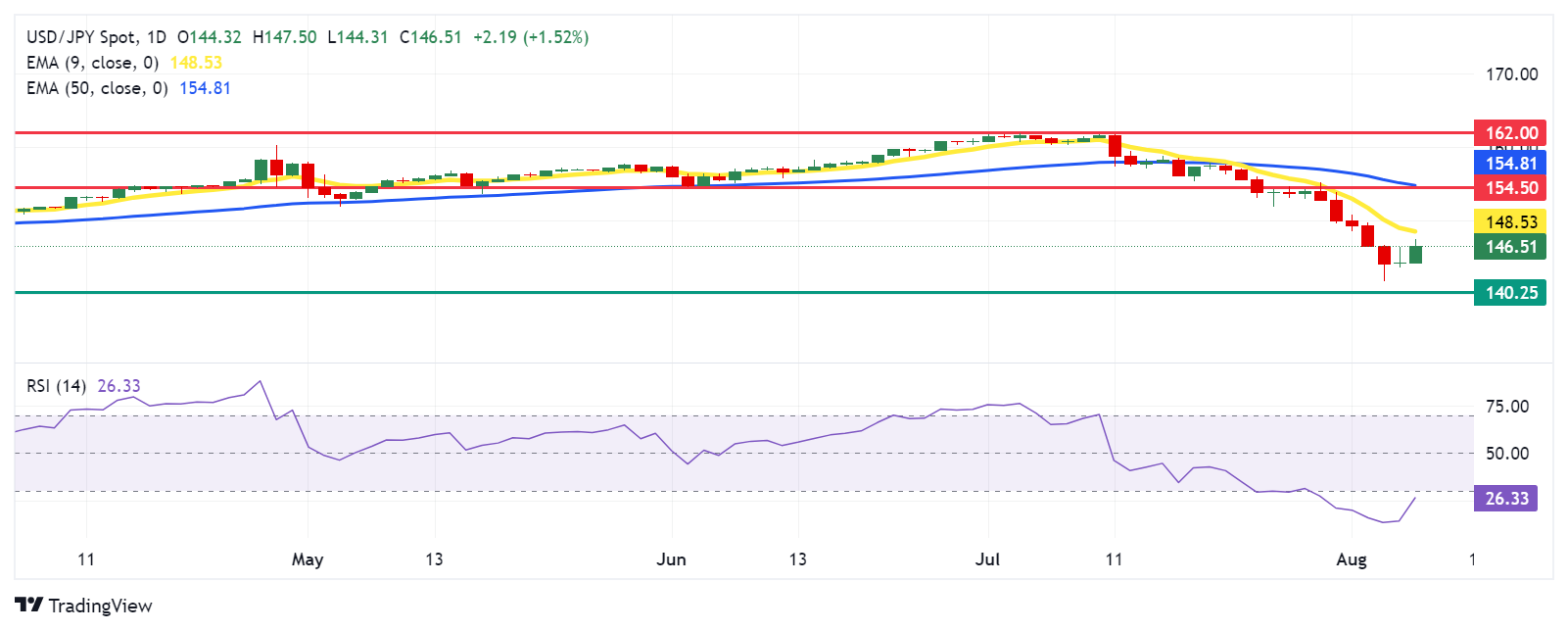
USD/JPY trades around 146.70 on Wednesday. The daily chart analysis shows that the pair continues to rise toward the nine-day Exponential Moving Average (EMA) at 148.57 level, suggesting a weakening of the bearish momentum. Additionally, the 14-day Relative Strength Index (RSI) is below 30, signaling that the currency pair is oversold and could see a short-term rebound.
Regarding support, the USD/JPY pair may test the throwback support at the 140.25 level, which was recorded in December.
In terms of resistance, the USD/JPY pair might face a barrier at the nine-day Exponential Moving Average (EMA) around 149.22. A breakout above this level could reduce bearish momentum and enable the pair to test the "throwback support turned resistance" at 154.50, followed by the 50-day EMA at 155.58.
USD/JPY: Daily Chart
Japanese Yen PRICE Today
The table below shows the percentage change of Japanese Yen (JPY) against listed major currencies today. Japanese Yen was the weakest against the New Zealand Dollar.
| USD | EUR | GBP | JPY | CAD | AUD | NZD | CHF | |
|---|---|---|---|---|---|---|---|---|
| USD | 0.17% | -0.14% | 1.63% | -0.06% | -0.32% | -1.00% | 0.67% | |
| EUR | -0.17% | -0.31% | 1.46% | -0.23% | -0.53% | -1.17% | 0.52% | |
| GBP | 0.14% | 0.31% | 1.77% | 0.08% | -0.22% | -0.81% | 0.82% | |
| JPY | -1.63% | -1.46% | -1.77% | -1.67% | -1.95% | -2.57% | -0.96% | |
| CAD | 0.06% | 0.23% | -0.08% | 1.67% | -0.28% | -0.90% | 0.75% | |
| AUD | 0.32% | 0.53% | 0.22% | 1.95% | 0.28% | -0.59% | 1.05% | |
| NZD | 1.00% | 1.17% | 0.81% | 2.57% | 0.90% | 0.59% | 1.65% | |
| CHF | -0.67% | -0.52% | -0.82% | 0.96% | -0.75% | -1.05% | -1.65% |
The heat map shows percentage changes of major currencies against each other. The base currency is picked from the left column, while the quote currency is picked from the top row. For example, if you pick the Japanese Yen from the left column and move along the horizontal line to the US Dollar, the percentage change displayed in the box will represent JPY (base)/USD (quote).
Japanese Yen FAQs
The Japanese Yen (JPY) is one of the world’s most traded currencies. Its value is broadly determined by the performance of the Japanese economy, but more specifically by the Bank of Japan’s policy, the differential between Japanese and US bond yields, or risk sentiment among traders, among other factors.
One of the Bank of Japan’s mandates is currency control, so its moves are key for the Yen. The BoJ has directly intervened in currency markets sometimes, generally to lower the value of the Yen, although it refrains from doing it often due to political concerns of its main trading partners. The current BoJ ultra-loose monetary policy, based on massive stimulus to the economy, has caused the Yen to depreciate against its main currency peers. This process has exacerbated more recently due to an increasing policy divergence between the Bank of Japan and other main central banks, which have opted to increase interest rates sharply to fight decades-high levels of inflation.
The BoJ’s stance of sticking to ultra-loose monetary policy has led to a widening policy divergence with other central banks, particularly with the US Federal Reserve. This supports a widening of the differential between the 10-year US and Japanese bonds, which favors the US Dollar against the Japanese Yen.
The Japanese Yen is often seen as a safe-haven investment. This means that in times of market stress, investors are more likely to put their money in the Japanese currency due to its supposed reliability and stability. Turbulent times are likely to strengthen the Yen’s value against other currencies seen as more risky to invest in.
Author

Akhtar Faruqui
FXStreet
Akhtar Faruqui is a Forex Analyst based in New Delhi, India. With a keen eye for market trends and a passion for dissecting complex financial dynamics, he is dedicated to delivering accurate and insightful Forex news and analysis.
















