Japanese Yen advances to over two-month high against USD on BoJ rate hike bets
- The Japanese Yen continues to strengthen amid rising bets for additional BoJ rate hikes.
- Trump’s tariff threats weigh on investors’ sentiment but also benefit the safe-haven JPY.
- The Fed's hawkish outlook fails to impress the USD bulls or lend support to USD/JPY.

The Japanese Yen (JPY) bulls retain control heading into the European session on Thursday amid the growing acceptance that the Bank of Japan (BoJ) would hike interest rates further. Meanwhile, hawkish BoJ expectations push the Japanese government bond (JGB) yields to their highest levels in more than a decade. The resultant narrowing of the rate differential between Japan and other countries provides an additional boost to the lower-yielding JPY.
Apart from this, a fresh wave of the global risk aversion trade, triggered by US President Donald Trump's tariff threats, further benefits the safe-haven JPY. This, along with the emergence of some US Dollar (USD) selling, drags the USD/JPY pair closer to the 150.00 psychological mark, or its lowest level since December 9. That said, the Federal Reserve's (Fed) hawkish outlook could act as a tailwind for the buck and lend support to the currency pair.
Japanese Yen bulls retain control as hawkish BoJ expectations continue to lift JGB yields
- Bank of Japan board member Hajime Takata said on Wednesday that Japan's real interest rates remain deeply negative and the central bank must adjust the degree of monetary support further if the economy moves in line with forecasts.
- This comes on top of Japan's upbeat Q4 Gross Domestic Product (GDP) on Monday and cements expectations that the BoJ would hike interest rates further, which continues to push the Japanese government bond (JGB) yields higher.
- According to a Reuters poll, over 65% of economists say that the BoJ could raise the key interest rate to 0.75% in the third quarter and the rate of pay increases in this year's labour talks is seen as 5.00% vs. 4.75% in January poll.
- The yield on the benchmark 10-year JGB hits its highest since November 2009, which, in turn, provides a strong boost to the Japanese Yen during the Asian session on Thursday amid a fresh wave of the global risk aversion trade.
- US President Donald Trump said on Wednesday that he will announce tariffs on a number of products next month or even sooner, fueling concerns about a global trade war and tempering investors' appetite for riskier assets.
- The Asahi newspaper reported this Thursday that Japan's Trade Minister, Yoji Muto, is planning a trip to the US in March to request that the Trump administration exempt Japan from upcoming tariffs on steel and automobiles.
- Minutes from the January FOMC meeting released on Wednesday revealed that officials noted a high degree of uncertainty that requires the central bank to take a careful approach in considering any further interest rate cuts.
- Fed Vice Chairman Philip Jefferson noted that the US economic performance has been quite strong, the US labor market is solid, inflation has eased but is still elevated, and the path back to 2% inflation could be bumpy.
- Separately, Chicago Fed President Austan Goolsbee said that inflation has decreased but it is still excessive and once inflation falls, rates can fall more. This, however, does little to provide any meaningful impetus to the US Dollar.
- Thursday's US economic docket features the release of Weekly Initial Jobless Claims and the Philly Fed Manufacturing Index. Apart from this, speeches by influential FOMC members will drive the USD and the USD/JPY pair.
USD/JPY bears now await break below the 150.00 psychological mark before placing fresh bets
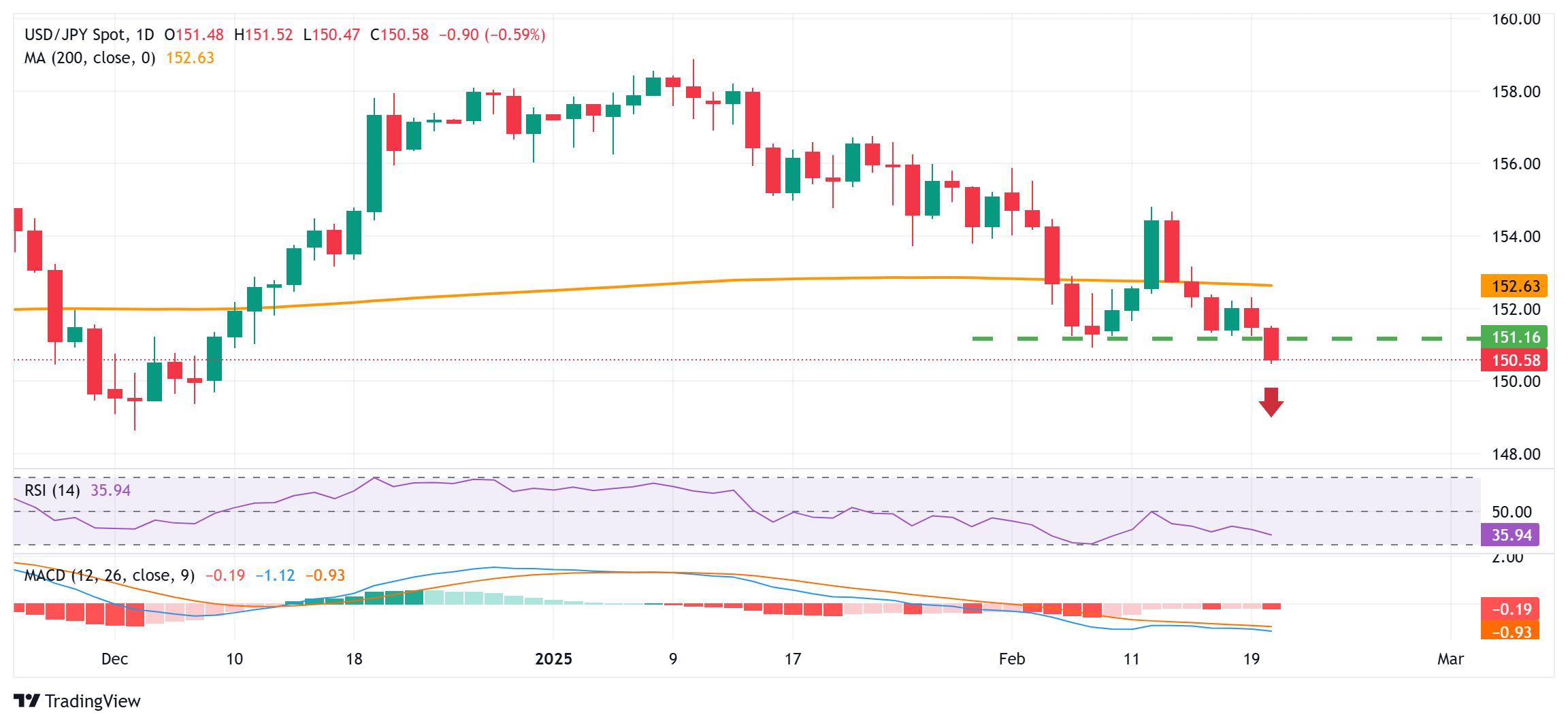
From a technical perspective, a sustained break and acceptance below the 151.00 mark could be seen as a fresh trigger for bearish traders. Moreover, oscillators on the daily chart are holding deep in negative territory and are still away from being in the oversold zone. This, in turn, suggests that the path of least resistance for the USD/JPY pair is to the downside and supports prospects for a slide toward the 150.00 psychological mark. The downward trajectory could extend further towards the 149.60-149.55 region en route to the 149.00 mark and the December 2024 low, around the 148.65 region.
On the flip side, the 150.90-151.00 horizontal support breakpoint now seems to act as an immediate hurdle, above which a bout of a short-covering could lift the USD/JPY pair to the 151.40 hurdle. Any further move up could be seen as a selling opportunity around the 152.00 round-figure mark and runs the risk of fizzling out rather quickly near the 152.65 area. The latter represents the very important 200-day Simple Moving Average (SMA) and should act as a key pivotal point for short-term traders.
Tariffs FAQs
Tariffs are customs duties levied on certain merchandise imports or a category of products. Tariffs are designed to help local producers and manufacturers be more competitive in the market by providing a price advantage over similar goods that can be imported. Tariffs are widely used as tools of protectionism, along with trade barriers and import quotas.
Although tariffs and taxes both generate government revenue to fund public goods and services, they have several distinctions. Tariffs are prepaid at the port of entry, while taxes are paid at the time of purchase. Taxes are imposed on individual taxpayers and businesses, while tariffs are paid by importers.
There are two schools of thought among economists regarding the usage of tariffs. While some argue that tariffs are necessary to protect domestic industries and address trade imbalances, others see them as a harmful tool that could potentially drive prices higher over the long term and lead to a damaging trade war by encouraging tit-for-tat tariffs.
During the run-up to the presidential election in November 2024, Donald Trump made it clear that he intends to use tariffs to support the US economy and American producers. In 2024, Mexico, China and Canada accounted for 42% of total US imports. In this period, Mexico stood out as the top exporter with $466.6 billion, according to the US Census Bureau. Hence, Trump wants to focus on these three nations when imposing tariffs. He also plans to use the revenue generated through tariffs to lower personal income taxes.
Author

Haresh Menghani
FXStreet
Haresh Menghani is a detail-oriented professional with 10+ years of extensive experience in analysing the global financial markets.