Japanese Yen sticks to strong GDP-inspired gains; USD/JPY hangs near one-week low
- The Japanese Yen attracts strong follow-through buying in reaction to the upbeat Q4 GDP print.
- Optimism over the delay of Trump’s reciprocal tariffs provides an additional boost to the JPY.
- The USD languishes near a two-month low and further contributes to the USD/JPY pair’s slide.


The Japanese Yen (JPY) sticks to its strong intraday gains in the wake of a strong domestic Gross Domestic Product (GDP) print, which reaffirmed bets that the Bank of Japan (BoJ) will hike interest rates further. Furthermore, the narrowing of the US-Japan rate differential turns out to be other factors underpinning demand for the lower-yielding JPY. Apart from this, the prevalent US Dollar (USD) selling bias keeps the USD/JPY pair depressed just above mid-151.00s, or near a one-week low touched during the Asian session earlier this Monday.
That said, concerns about US President Donald Trump's reciprocal tariffs might hold back the JPY bulls from placing aggressive bets. Moreover, the growing acceptance that the Federal Reserve (Fed) would retain its hawkish stance and keep interest rates on hold for an extended period acts as a tailwind for the USD, which, in turn, helps limit losses for the USD/JPY pair. Nevertheless, the fundamental backdrop seems tilted in favor of the JPY bulls and suggests that the path of least resistance for the currency pair remains to the downside.
Japanese Yen retains bullish bias as strong Q4 GDP print reaffirms BoJ rate hike bets
- Data released earlier this Monday showed that Japan's economy expanded by 0.7% in the October-December quarter compared to the previous quarter's upwardly revised reading of 0.4%.
- The yearly growth rate accelerated from a revised 1.7% in the third quarter to 2.8%, which supports the Bank of Japan's plan to keep hiking rates amid signs of broadening inflation in Japan.
- Japan's Economy Minister Ryosei Akazawa said that he expects the economy to continue making a modest recovery, though he noted the need to be mindful of overseas economic downside risks.
- Tokyo-based Kyodo News reported on Sunday that Japan had asked to be exempted from US President Donald Trump's 25% tariffs on steel and aluminum, and the so-called reciprocal tariffs.
- This follows Trump’s order on Thursday to formulate plans for reciprocal tariffs on every country that imposes taxes on US imports, though he stopped short of announcing immediate levies.
- This, along with the dismal US Retail Sales figures released on Friday, keeps the US Dollar depressed near its lowest level since December 17 and weighs on the USD/JPY pair.
- The US Census Bureau reported that Retail Sales declined by 0.9% in January, worse than the decrease of 0.1% expected and the 0.7% increase (revised from 0.4%) in December.
- US Secretary of State Marco Rubio signaled on Sunday that talks with Russia this week were a chance to see how serious Russian President Vladimir Putin is about peace.
- Adding to this, Trump said that he was working hard to achieve peace and that he believed he could meet Putin very soon to discuss ending the protracted war in Ukraine.
USD/JPY could accelerate the slide once the 151.45-151.40 immediate support is broken
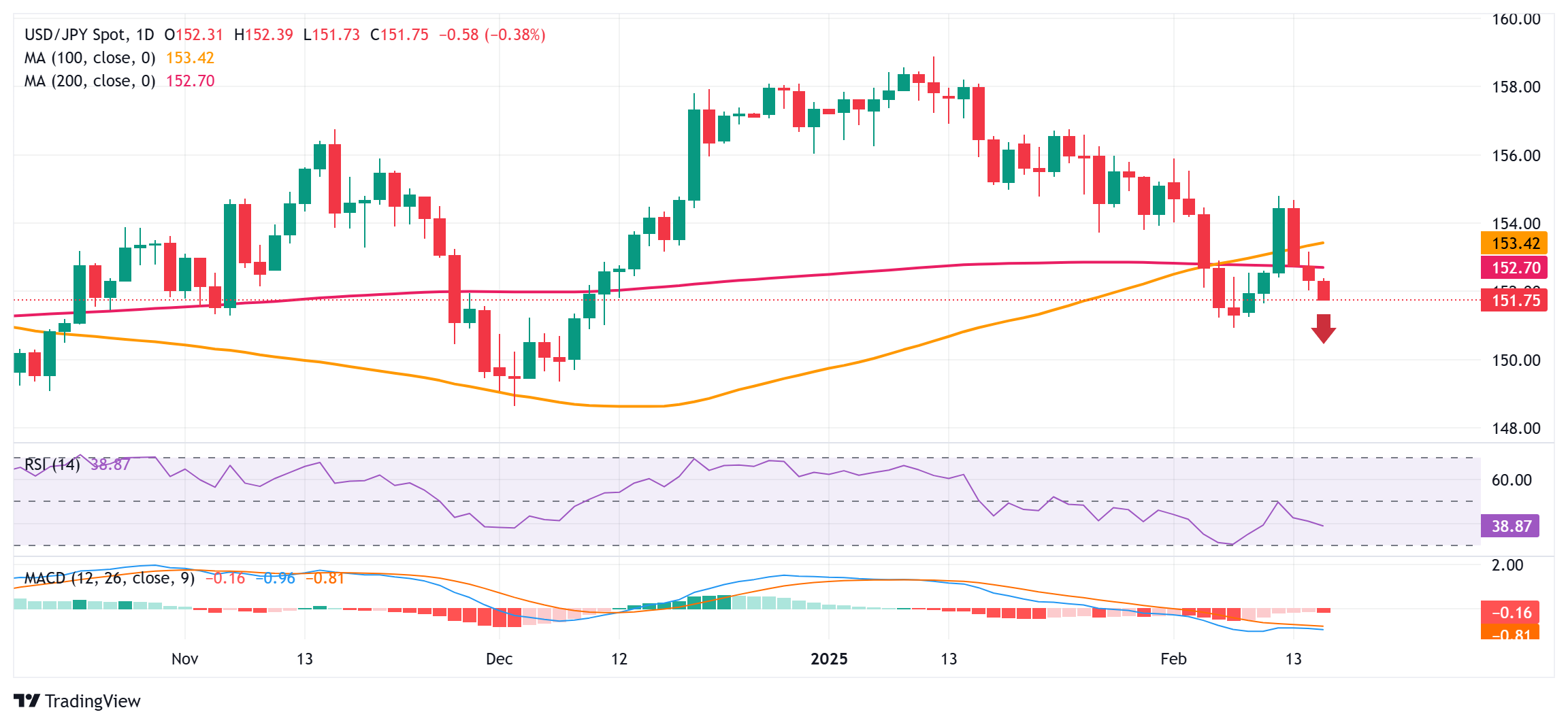
From current levels, the 151.45-151.40 area could offer immediate support ahead of the 150.95-150.90 region, or the lowest level since December 10 touched earlier this month. Given that oscillators on the daily chart are holding in negative territory, some follow-through selling would be seen as a fresh trigger for bearish traders. The USD/JPY pair might then accelerate the fall towards the 150.00 psychological mark en route to the 149.60-149.55 zone, the 149.00 round figure, and the December 2024 swing low, around the 148.65 region.
On the flip side, any meaningful recovery beyond the 152.00 mark might confront a strong hurdle near the 152.70 area, or the 200-day Simple Moving Average (SMA). This is followed by the 100-day SMA, currently pegged near the 153.15 region, which if cleared decisively could trigger a short-covering rally. The subsequent move up has the potential to lift the USD/JPY pair beyond the 154.00 round figure, towards the 154.45-154.50 supply zone en route to last week's swing high, around the 154.75-154.80 region.
Japanese Yen PRICE Today
The table below shows the percentage change of Japanese Yen (JPY) against listed major currencies today. Japanese Yen was the strongest against the Euro.
| USD | EUR | GBP | JPY | CAD | AUD | NZD | CHF | |
|---|---|---|---|---|---|---|---|---|
| USD | 0.00% | -0.07% | -0.33% | -0.03% | -0.30% | -0.34% | 0.06% | |
| EUR | -0.01% | 0.07% | -0.38% | 0.06% | -0.22% | -0.25% | 0.16% | |
| GBP | 0.07% | -0.07% | -0.34% | -0.01% | -0.24% | -0.32% | 0.09% | |
| JPY | 0.33% | 0.38% | 0.34% | 0.30% | 0.07% | 0.20% | 0.37% | |
| CAD | 0.03% | -0.06% | 0.01% | -0.30% | -0.24% | -0.31% | 0.10% | |
| AUD | 0.30% | 0.22% | 0.24% | -0.07% | 0.24% | -0.03% | 0.41% | |
| NZD | 0.34% | 0.25% | 0.32% | -0.20% | 0.31% | 0.03% | 0.41% | |
| CHF | -0.06% | -0.16% | -0.09% | -0.37% | -0.10% | -0.41% | -0.41% |
The heat map shows percentage changes of major currencies against each other. The base currency is picked from the left column, while the quote currency is picked from the top row. For example, if you pick the Japanese Yen from the left column and move along the horizontal line to the US Dollar, the percentage change displayed in the box will represent JPY (base)/USD (quote).
Tariffs FAQs
Tariffs are customs duties levied on certain merchandise imports or a category of products. Tariffs are designed to help local producers and manufacturers be more competitive in the market by providing a price advantage over similar goods that can be imported. Tariffs are widely used as tools of protectionism, along with trade barriers and import quotas.
Although tariffs and taxes both generate government revenue to fund public goods and services, they have several distinctions. Tariffs are prepaid at the port of entry, while taxes are paid at the time of purchase. Taxes are imposed on individual taxpayers and businesses, while tariffs are paid by importers.
There are two schools of thought among economists regarding the usage of tariffs. While some argue that tariffs are necessary to protect domestic industries and address trade imbalances, others see them as a harmful tool that could potentially drive prices higher over the long term and lead to a damaging trade war by encouraging tit-for-tat tariffs.
During the run-up to the presidential election in November 2024, Donald Trump made it clear that he intends to use tariffs to support the US economy and American producers. In 2024, Mexico, China and Canada accounted for 42% of total US imports. In this period, Mexico stood out as the top exporter with $466.6 billion, according to the US Census Bureau. Hence, Trump wants to focus on these three nations when imposing tariffs. He also plans to use the revenue generated through tariffs to lower personal income taxes.
Author
Haresh Menghani
FXStreet
Haresh Menghani is a detail-oriented professional with 10+ years of extensive experience in analysing the global financial markets.