Japanese Yen appreciates as US GDP, Tokyo's inflation data loom
- The Japanese Yen gained ground after comments from BoJ board member Seiji Adachi on Wednesday.
- BoJ's Adachi favored raising interest rates if a weaker JPY leads to heightened inflation.
- US Dollar holds ground ahead of releases of US GDP and Core PCE.

The Japanese Yen (JPY) snapped recent losses on Thursday, spurred by comments from Bank of Japan (BoJ) board member Seiji Adachi on Wednesday. Adachi emphasized the gradual reduction of bond purchases to ensure that long-term yields accurately reflect market signals. Additionally, he suggested that raising interest rates could be appropriate if a weaker JPY leads to increased inflation, per Reuters
Traders have increased bets on the Bank of Japan (BoJ) implementing another interest rate hike. Investors are now turning their attention to Tokyo's inflation data scheduled for release on Friday, which is seen as a key indicator of nationwide price trends.
Hawkish remarks from Minneapolis Fed President Neel Kashkari further fueled concerns about potential rate hikes, sustaining the significant yield gap between the US and Japan. This environment continues to foster JPY carry trades, where investors leverage low-interest Japanese Yen to invest in higher-yielding US Dollar assets.
The US Dollar (USD) strengthened on account of elevated US Treasury yields, partly driven by increased risk aversion ahead of the release of US Gross Domestic Product Annualized (Q1) data on Thursday. Additionally, market participants will likely observe the Core Personal Consumption Expenditures (PCE) Price Index data scheduled for Friday, which are anticipated to offer insights into the Federal Reserve's potential stance on interest rate adjustments.
Daily Digest Market Movers: Japanese Yen gains ground due to hawkish remarks from BoJ's Adachi
- According to Bloomberg, Federal Reserve Bank of Atlanta President Raphael Bostic stated on Thursday that the path of inflation is expected to be uneven, and a decrease in inflation breadth would bolster confidence in the necessity of a rate cut.
- On Wednesday, the Fed Beige Book report covering the period from April to mid-May showed that national economic activity experienced slight growth, with mixed conditions across industries and districts. The report also indicated that employment rose slightly, wage growth was moderate, and prices increased modestly as consumers resisted further price hikes.
- Reuters reported that Neel Kashkari, President of the Federal Reserve Bank of Minneapolis, hinted at the possibility of a rate hike. Kashkari remarked, “I don’t believe anyone has completely ruled out the option of increasing rates,” expressing doubts about the disinflationary trend and projecting only two rate cuts.
- On Tuesday, the US Housing Price Index (MoM) for March was underperforming, with March's number coming in at 0.1% against 1.2% for February, where 0.5% was expected.
- Japan's Weighted Median Inflation Index, a significant gauge of the country’s trend inflation, increased by 1.1% in April. This growth rate represents a slowdown from the 1.3% increase recorded in March.
- Japan’s Corporate Service Price Index (CSPI). The index posted a year-over-year reading of 2.8% in April, surpassing expectations of 2.3% and marking its fastest rate of increase since March 2015.
- Japan Finance Minister Shun'ichi Suzuki on Tuesday, emphasized the importance of currencies moving in a stable manner that reflects fundamentals, stating that he is closely monitoring foreign exchange (FX) movements. However, Suzuki refrained from commenting on whether Japan has conducted currency intervention.
Technical Analysis: USD/JPY drops to near 157.00
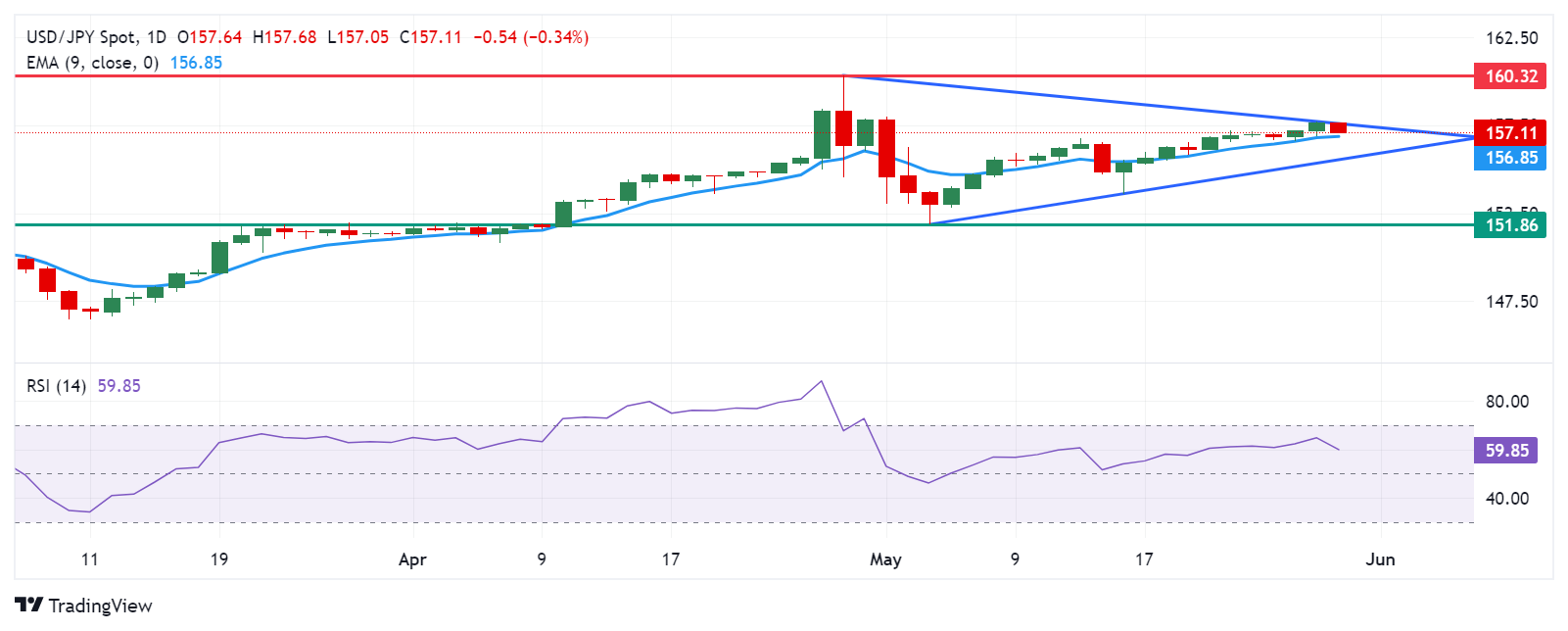
The USD/JPY pair trades around 157.10 on Thursday. The daily chart shows a symmetrical triangle, indicating a pause in the prevailing bullish trend. However, the 14-day Relative Strength Index (RSI) remains above 50, confirming a bullish bias.
The USD/JPY pair could test the upper boundary of the symmetrical triangle, followed by the psychological level of 158.00. If this level is breached, the next target could be 160.32, marking its highest point in over thirty years.
On the downside, the immediate support appears at the psychological level of 157.00, followed by the nine-day Exponential Moving Average (EMA) at 156.86. Further decline in the USD/JPY pair could apply downward pressure, potentially testing the lower boundary of the symmetrical triangle.
USD/JPY: Daily Chart
Japanese Yen price today
The table below shows the percentage change of the Japanese Yen (JPY) against listed major currencies today. Japanese Yen was the strongest against the New Zealand Dollar.
| USD | EUR | GBP | CAD | AUD | JPY | NZD | CHF | |
| USD | -0.08% | -0.10% | 0.00% | 0.08% | -0.37% | 0.18% | -0.33% | |
| EUR | 0.08% | 0.00% | 0.09% | 0.15% | -0.28% | 0.26% | -0.26% | |
| GBP | 0.09% | 0.01% | 0.10% | 0.15% | -0.28% | 0.28% | -0.26% | |
| CAD | -0.01% | -0.09% | -0.11% | 0.06% | -0.37% | 0.18% | -0.35% | |
| AUD | -0.06% | -0.14% | -0.14% | -0.05% | -0.41% | 0.12% | -0.40% | |
| JPY | 0.35% | 0.28% | 0.24% | 0.35% | 0.44% | 0.53% | 0.01% | |
| NZD | -0.19% | -0.27% | -0.30% | -0.19% | -0.13% | -0.54% | -0.54% | |
| CHF | 0.35% | 0.26% | 0.24% | 0.35% | 0.42% | -0.02% | 0.52% |
The heat map shows percentage changes of major currencies against each other. The base currency is picked from the left column, while the quote currency is picked from the top row. For example, if you pick the Euro from the left column and move along the horizontal line to the Japanese Yen, the percentage change displayed in the box will represent EUR (base)/JPY (quote).
Japanese Yen FAQs
The Japanese Yen (JPY) is one of the world’s most traded currencies. Its value is broadly determined by the performance of the Japanese economy, but more specifically by the Bank of Japan’s policy, the differential between Japanese and US bond yields, or risk sentiment among traders, among other factors.
One of the Bank of Japan’s mandates is currency control, so its moves are key for the Yen. The BoJ has directly intervened in currency markets sometimes, generally to lower the value of the Yen, although it refrains from doing it often due to political concerns of its main trading partners. The current BoJ ultra-loose monetary policy, based on massive stimulus to the economy, has caused the Yen to depreciate against its main currency peers. This process has exacerbated more recently due to an increasing policy divergence between the Bank of Japan and other main central banks, which have opted to increase interest rates sharply to fight decades-high levels of inflation.
The BoJ’s stance of sticking to ultra-loose monetary policy has led to a widening policy divergence with other central banks, particularly with the US Federal Reserve. This supports a widening of the differential between the 10-year US and Japanese bonds, which favors the US Dollar against the Japanese Yen.
The Japanese Yen is often seen as a safe-haven investment. This means that in times of market stress, investors are more likely to put their money in the Japanese currency due to its supposed reliability and stability. Turbulent times are likely to strengthen the Yen’s value against other currencies seen as more risky to invest in.
Author

Akhtar Faruqui
FXStreet
Akhtar Faruqui is a Forex Analyst based in New Delhi, India. With a keen eye for market trends and a passion for dissecting complex financial dynamics, he is dedicated to delivering accurate and insightful Forex news and analysis.

















