Japanese Yen adds to intraday gains; USD/JPY slides further below 144.00 amid notable USD weakness
- The Japanese Yen attracts safe-haven flows amid trade uncertainties and rising geopolitical tensions.
- The divergent BoJ-Fed policy expectations undermine the USD/JPY pair amid a broadly weaker USD.
- Traders now look forward to the release of the US PPI for short-term impetus later this Thursday.

The Japanese Yen (JPY) clings to strong intraday gains through the early European session on Thursday and hits a fresh weekly high against a broadly weaker US Dollar (USD). US President Donald Trump's fresh tariffs threat, along with rising geopolitical tensions in the Middle East, contributes to the safe-haven JPY's relative outperformance against its American counterpart for the second straight day.
Meanwhile, the growing acceptance that the Bank of Japan (BoJ) will continue raising interest rates further underpins the JPY. Meanwhile, hawkish BoJ expectations mark a significant divergence in comparison to bets that the Federal Reserve (Fed) will lower borrowing costs further in 2025. This further benefits the JPY and keeps the USD/JPY pair depressed below the 144.00 mark amid sustained USD selling bias.
Japanese Yen bulls have the upper hand amid risk-off impulse and hawkish BoJ expectations
- US President Donald Trump told reporters on Wednesday that he will set unilateral tariffs and send letters to trading partners in the next week or two, saying “this is the deal you can take it or leave it”. Earlier, US Treasury Secretary Scott Bessent told Congress that it is highly likely that the tariff pause would be extended to countries that are negotiating in good faith.
- The comments add a layer of uncertainty amid Trump's rapidly shifting stance on trade policies, overshadowing the optimism over the US-China agreement on a plan to ease export controls and trade tensions. Meanwhile, the Wall Street Journal reported that China is imposing a six-month limit on rare-earth export licenses for US automakers and manufacturers.
- In return, US negotiators have agreed to ease some export restrictions on items such as jet engines, related components, and ethane — used in plastics manufacturing. The temporary arrangement reflects a fragile truce between the world's two largest economies as both sides keep options open to escalate if tensions flare again and leverage it in future talks.
- A Reuters poll indicated that a slight majority of economists expect that the Bank of Japan will forego another interest rate hike this year. Investors, however, seem convinced that the BoJ would proceed with monetary tightening, marking a significant divergence from rising market bets that the Federal Reserve (Fed) will resume its rate-cutting cycle later this year.
- The US Bureau of Labor Statistics (BLS) reported on Wednesday that the headline Consumer Price Index (CPI) rose from 2.3% in the previous month to the 2.4% annualized pace in May, missing consensus estimates of 2.5%. Meanwhile, the core gauge, which excludes volatile food and energy prices, climbed 2.8% during the reported month, matching April's increase.
- Traders were quick to react and are now pricing in a nearly 70% chance that the Federal Reserve will cut its interest rate by 25 basis points (bps) in September, up from 57% before the data. This leads to a further decline in US Treasury bond yields and drags the US Dollar back to the monthly swing low, which, in turn, exerts pressure on the USD/JPY pair.
- On the geopolitical front, Israel reportedly may soon launch a strike on Iran's nuclear sites. To prepare for the possibility, the US State Department authorized some staff to leave Iraq, while the Pentagon is allowing military families to depart US bases across the region voluntarily. This comes as Trump expressed doubt about reaching a nuclear deal with Iran.
- The USD/JPY pair dropped to a fresh weekly low during the Asian session on Thursday, though it managed to rebound a few pips in the last hour and currently trades around the 144.00 mark, still down over 0.35% for the day. Traders now look forward to the release of the US Producer Price Index (PPI), which could produce short-term opportunities.
USD/JPY seems vulnerable to extend the intraday downfall to the 143.00 mark
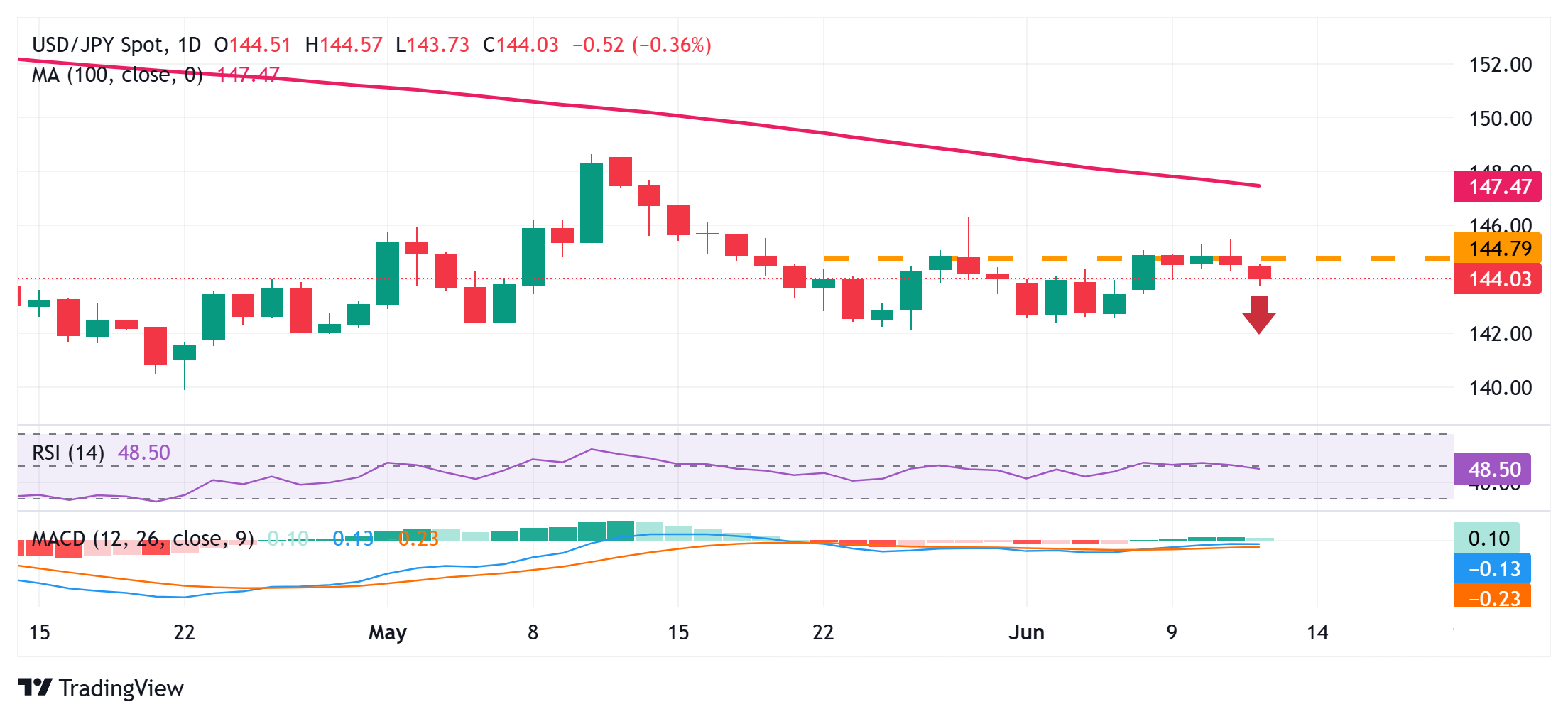
From a technical perspective, the overnight subsequent pullback from a two-week high and the subsequent slide fall below the 144.55-144.50 horizontal support favors the USD/JPY bears. Moreover, slightly negative oscillators on hourly/daily charts suggest that the path of least resistance for spot prices is to the downside. Some follow-through selling below the Asian session low, around the 143.70 area, will reaffirm the bearish outlook and pave the way for a fall towards the 143.00 round figure en route to the 142.62-142.60 horizontal support.
On the flip side, the 144.55 area, or the Asian session peak, now seems to act as an immediate hurdle, above which a fresh bout of short-covering could allow the USD/JPY pair to make a fresh attempt towards conquering the 145.00 psychological mark. Bulls, however, might wait for a subsequent strength beyond the 145.45 region, or a two-week high touched on Wednesday, before positioning for additional gains. Spot prices might then accelerate the positive momentum towards the 146.00 round figure.
US Dollar PRICE Today
The table below shows the percentage change of US Dollar (USD) against listed major currencies today. US Dollar was the strongest against the Australian Dollar.
| USD | EUR | GBP | JPY | CAD | AUD | NZD | CHF | |
|---|---|---|---|---|---|---|---|---|
| USD | -0.21% | -0.09% | -0.52% | -0.15% | 0.05% | -0.07% | -0.40% | |
| EUR | 0.21% | 0.11% | -0.35% | 0.05% | 0.23% | 0.13% | -0.17% | |
| GBP | 0.09% | -0.11% | -0.45% | -0.07% | 0.11% | 0.00% | -0.31% | |
| JPY | 0.52% | 0.35% | 0.45% | 0.36% | 0.55% | 0.39% | 0.13% | |
| CAD | 0.15% | -0.05% | 0.07% | -0.36% | 0.21% | 0.06% | -0.24% | |
| AUD | -0.05% | -0.23% | -0.11% | -0.55% | -0.21% | -0.10% | -0.44% | |
| NZD | 0.07% | -0.13% | -0.00% | -0.39% | -0.06% | 0.10% | -0.31% | |
| CHF | 0.40% | 0.17% | 0.31% | -0.13% | 0.24% | 0.44% | 0.31% |
The heat map shows percentage changes of major currencies against each other. The base currency is picked from the left column, while the quote currency is picked from the top row. For example, if you pick the US Dollar from the left column and move along the horizontal line to the Japanese Yen, the percentage change displayed in the box will represent USD (base)/JPY (quote).
Author

Haresh Menghani
FXStreet
Haresh Menghani is a detail-oriented professional with 10+ years of extensive experience in analysing the global financial markets.