|

Japan moves forward with $1tn in new coronavirus relief

  • Japan has begun finalizing a coronavirus relief package of more than $928 billion.
  • The package is equivalent to 20% of national GDP.
  • Nikkei will likely be buoyed by such a plan. 

The Nikkei has reported that the Japanese government has "begun finalizing a coronavirus relief package of more than 100 trillion yen ($928 billion), aiming to strengthen the corporate safety net and follow up on last month's 117 trillion yen stimulus."

This stimulus package, equivalent to 20% of national GDP, is meant to help families and businesses suffering from the pandemic.

Japan appeared to have the novel coronavirus epidemic well-contained but by March 24, when the 2020 Olympics in Tokyo were called off, the virus was spreading fast, forcing the country to call a state of national emergency.

 On Saturday, Tokyo reported two cases, the lowest single-day tally since Japan declared a state of emergency last month. However, Tokyo reported fourteen new coronavirus infections on Sunday, just a day after the capital reported single-digit daily figures for two days in a row, according to public broadcaster NHK. These numbers came a day ahead of a widely expected announcement by the government that it would lift restrictions on the capital and four other prefectures.

Market implications

Governments and central banks around the world have released unprecedented monetary and fiscal support for economies knocked down by the pandemic. This, in turn, has enabled global equity markets to continue to recover, rebounding from the crash. Nikkei, Japan's benchmark stock index, will likely be buoyed by such a plan. 
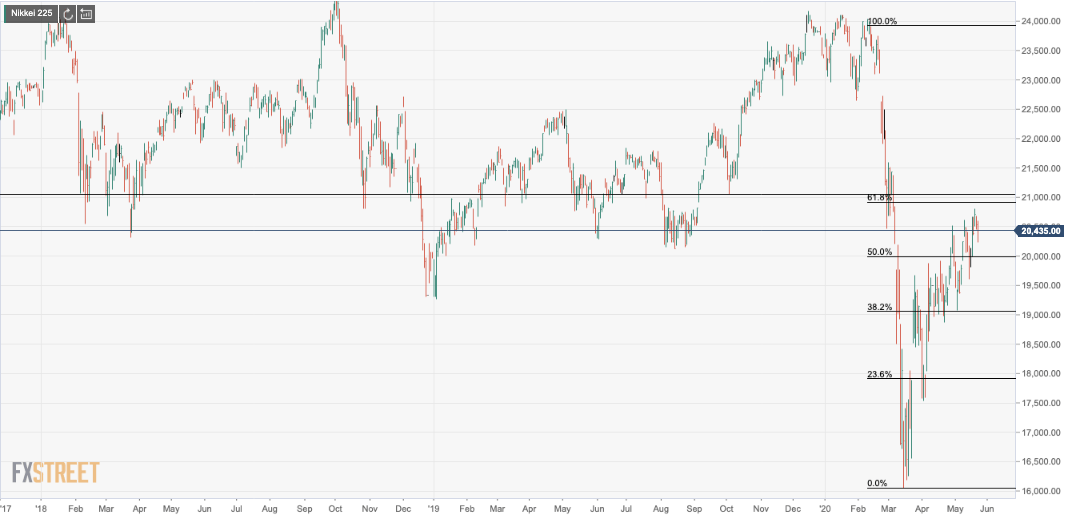
Nikkei daily chart shows that there has been a reversal of the crash which is yet to complete a full 61.8% Fibonacci retracement. 

Author

Ross J Burland

Ross J Burland, born in England, UK, is a sportsman at heart. He played Rugby and Judo for his county, Kent and the South East of England Rugby team.


More from Ross J Burland
Share:

Editor's Picks

AUD/USD advances modestly, hovers around 0.7050

AUD/USD reverses part of Friday’s sharp decline and gyrates around the 0.7050 region ahead of the opening bell in Asia. The pair’s modest recovery comes amid humble losses in the Greenback, always amid the steady uncertainty on the geopolitical front. Moving forward, Westpac’s Consumer Confidence measure will be the salient release on Tuesday.

USD/JPY holds higher ground toward 160.50 despite 'Yentervention' fears

USD/JPY holds higher ground toward 160.50 in Monday's Asian trading, despite intervention fears. Japan’s revised GDP print, which confirmed that the economy lost momentum in the first quarter, weighs on the Japanese Yen. Meanwhile, Friday's upbeat US NFP report and fresh Israel-Iran attacks favor the US Dollar bulls, underpinning the currency pair.

Gold faces initial resistance near  $4,350

Gold manages to reclaim the $4,300 mark per troy ounce and above on Monday. The yellow metal’s small uptick comes on the back of modest losses in the US Dollar, while traders continue to follow geopolitical events in the Middle East and the likelihood of a tighter-for-longer Fed.

Why institutions prefer Solana over newer rivals for stablecoin adoption – Solstice CEO
The cryptocurrency industry has entered a new era spearheaded by stablecoins, real-world asset (RWA) tokenization, decentralized finance (DeFi), and Artificial Intelligence (AI) applications.
$1.75 trillion: Is SpaceX the most popular IPO in history, or the most engineered?

On June 12, the largest initial public offering (IPO) in history is set to hit the tape, and almost nobody is asking whether the price is right, because almost everybody already wants in.

The US economy defies the rules: 100 days into the Oil shock and the recession signal is still missing

More than three months after the start of the Iran war and the resulting disruption to global energy markets, the US economy continues to display remarkable resilience. The conflict has triggered a sharp rise in Oil prices, reignited inflationary pressures and fueled widespread concerns about a potential economic slowdown.














