Is the Evergrande crisis over?

The looming collapse of China Evergrande Group (HKG:3333), the world’s most indebted property developer, has roiled financial markets for months, threatening a contagion with far-reaching implications on China and the wider economy.
In the early months since Evergrande’s financial crisis came to light, Beijing stayed mum on the issue, although the People’s Bank of China pumped billions of yuan in liquidity in what was seen as an attempt to quell liquidity concerns.
Over this time, Evergrande’s stock price slipped 95%, from ~25HKD to ~1.5HKD, where it has stagnated for all of 2022.
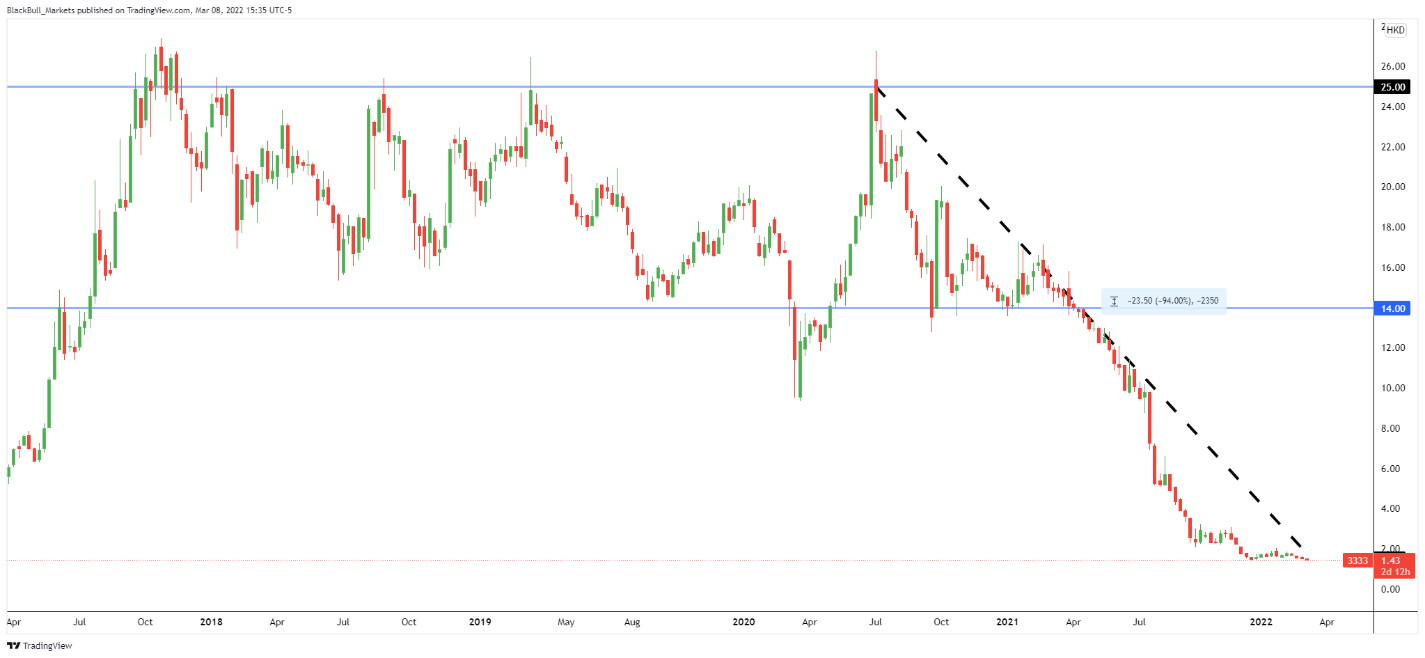
Evergrande’s massive debt pileup
Evergrande, once China’s second-largest real estate developer, is drowning in more than $300 billion in debts to suppliers, contractors, creditors and investors. The company’s crisis partly stemmed from the introduction of Beijing’s "three red lines" rule in 2020 that made it harder for developers to seek bank financing to fund their projects.
Another Lehman Brothers moment
The large exposure of Chinese banks like Minsheng Bank, Ping An Bank and Everbright Bank to Evergrande prompted many financial watchers to predict that Evergrande's debt crisis could extend beyond China’s property and financial markets, warning that it could spill over to the global markets similar to the Lehman Brothers collapse that resulted in the 2008 global financial crisis.
These fears intensified as Evergrande missed payments on a number of onshore bonds. The world’s three major credit rating agencies have already declared the developer to be in default after missing on its bond interest payments late last year.
However, some analysts have played down concerns of Evergrande being the next “Lehman moment,” as they expect Beijing’s policymakers to prevent the crisis from being a systemic risk.
Beijing steps in to limit fallout
To minimize the potential impact of Evergrande’s looming collapse, Beijing has stepped up its efforts, but without a state-led bailout in sight. Back in October, the Chinese central bank said the risk of Evergrande’s liabilities spilling over to the country’s financial sector is "controllable,” while confirming reports that relevant government agencies and local governments have been carrying out risk disposal and resolution work to mitigate a potential contagion.
In recent weeks, a number of news outlets reported that some banks in China have lowered mortgage rates, offered subsidies and allowed developers to access their funds on escrow in an attempt to revive the housing market.
Beijing also started urging state-owned developers to acquire some projects of troubled builders to help ease the sector’s liquidity crunch. Fitch Ratings recently said Chinese developers are poised to see more small-scale mergers and acquisitions and the impact on buyers’ leverage are predicted to be small "as they select projects with promising returns."
Light at the end of the tunnel
It may take months or years for the property sector to recover as developers continue to struggle with a cash crunch that prevents them from meeting their debt obligations.
However, with Beijing’s subtle approach in reviving the property market, Evergrande’s recovery may be drawing near. In February, new home prices in 100 cities in China rose for the first time in two months, further recovering from the slump in November when prices contracted for the first time since 2015.
Policy reforms could encourage home-buying this year as the government included the healthy development of the real estate sector in its government work report unveiled by Premier Li Keqiang over the weekend. Li said authorities will seek to promote the commercial housing market and stabilize house prices this year.
Foreign investors that purchase bonds and other securities from Chinese builders should closely monitor developments surrounding Beijing’s policies for the sector.
Author

Mark O’Donnell
Blackbull Markets Limited
Mark O’Donnell is a Research Analyst with BlackBull Markets in Auckland, New Zealand.

















