IRA vs 401(k): Which is the best retirement plan for you?

As Americans take a more proactive role in their retirement planning, it's essential to understand the key differences between Individual Retirement Accounts (IRAs) and 401(k) plans.
With Social Security facing long-term funding problems and pensions becoming increasingly scarce, it's more important than ever to build your own retirement nest egg through tax-advantaged accounts.
So, when it comes to choosing between an IRA and a 401(k), which is right for you? The answer depends on your employment status, income level, savings goals and the control you wish to exercise over your investments.
IRA and 401(k): Understanding the basics
A 401(k) is an employer-sponsored retirement plan that allows employees to save a portion of their salary, usually on a pre-tax basis.
Contributions reduce taxable income now, and the money grows tax-free until retirement. Many employers offer matching contributions, providing free money to encourage saving.
An Individual Retirement Account (IRA) is opened independently by a bank or brokerage firm. Anyone with income can contribute, whether or not their employer offers a plan.
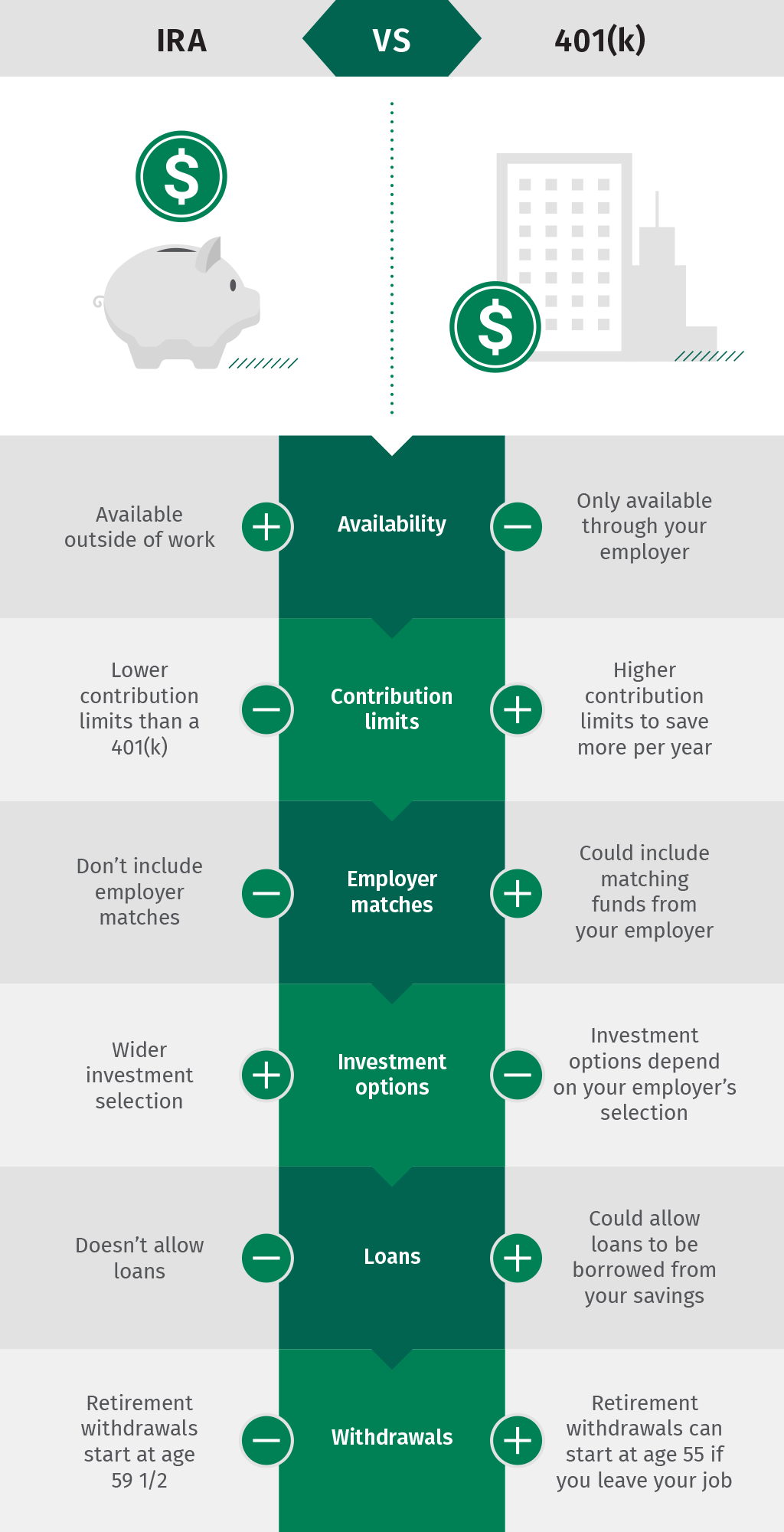
Like 401(k)s, IRAs come in two main forms: Traditional and Roth. IRAs offer greater flexibility in investment choices, but lower contribution limits.
Traditional or Roth?
- Traditional 401(k) and IRA: Contributions are tax-deductible (based on income in the case of IRAs), but withdrawals are taxed as retirement income.
- Roth 401(k) and Roth IRA: Contributions are made with after-tax money, but qualified withdrawals at retirement are tax-free.
The choice between Roth and Traditional depends on the tax bracket you expect to be in during retirement.
IRA or 401(k): Which should you choose first?
If your employer offers a match, consider maximizing the 401(k) first
Employer matching is the most obvious gain in retirement planning. Not taking advantage of it is like leaving money on the table.
Want to control investments? Consider an IRA
IRAs generally offer broader investment options than most 401(k) plans. If you're comfortable choosing your own funds or working with an advisor, this can lead to better long-term returns, especially if your 401(k) plan has high fees.
Making a lot of money? Beware of IRA limits
If your income exceeds certain thresholds (for example, $165,000 for Roth IRAs in 2025), your ability to contribute or deduct IRA contributions may be limited. 401(k)s do not have these income restrictions.
Want early access? 401(k)s offer more flexibility
Some 401(k) plans allow penalty-free loans or withdrawals starting at age 55 if you leave your job (rule of 55). IRAs generally don't offer loans, and early withdrawals may be more limited.
Source: Citizens
Can you use both IRA and 401(k)?
Absolutely. Many savers contribute to both an IRA and a 401(k), using the 401(k) to benefit from employer matches and higher limits, while using an IRA for investment flexibility or Roth diversification.
Just bear in mind the annual limits and potential income-based restrictions.
Don't rely on Social Security alone
Social Security was never designed to fully replace your earned income. For most Americans, it only replaces about 40% of pre-retirement income, according to the Social Security Administration.
IRA and 401(k) plans help bridge this gap by offering the power of compound interest and tax advantages over decades of savings.
It's not IRA vs 401(k), it's IRA and 401(k)
There's no single answer, but for many, the best strategy combines the strengths of both accounts. Start by capturing all employer 401(k) matches, then consider maximizing an IRA.
If you're self-employed or changing jobs, transfers to an IRA can help you consolidate and manage your retirement savings.
Smart retirement planning isn't about choosing the "best" account, it's about using the tools available to build the retirement you want.
IRAs FAQs
An IRA (Individual Retirement Account) allows you to make tax-deferred investments to save money and provide financial security when you retire. There are different types of IRAs, the most common being a traditional one – in which contributions may be tax-deductible – and a Roth IRA, a personal savings plan where contributions are not tax deductible but earnings and withdrawals may be tax-free. When you add money to your IRA, this can be invested in a wide range of financial products, usually a portfolio based on bonds, stocks and mutual funds.
Yes. For conventional IRAs, one can get exposure to Gold by investing in Gold-focused securities, such as ETFs. In the case of a self-directed IRA (SDIRA), which offers the possibility of investing in alternative assets, Gold and precious metals are available. In such cases, the investment is based on holding physical Gold (or any other precious metals like Silver, Platinum or Palladium). When investing in a Gold IRA, you don’t keep the physical metal, but a custodian entity does.
They are different products, both designed to help individuals save for retirement. The 401(k) is sponsored by employers and is built by deducting contributions directly from the paycheck, which are usually matched by the employer. Decisions on investment are very limited. An IRA, meanwhile, is a plan that an individual opens with a financial institution and offers more investment options. Both systems are quite similar in terms of taxation as contributions are either made pre-tax or are tax-deductible. You don’t have to choose one or the other: even if you have a 401(k) plan, you may be able to put extra money aside in an IRA
The US Internal Revenue Service (IRS) doesn’t specifically give any requirements regarding minimum contributions to start and deposit in an IRA (it does, however, for conversions and withdrawals). Still, some brokers may require a minimum amount depending on the funds you would like to invest in. On the other hand, the IRS establishes a maximum amount that an individual can contribute to their IRA each year.
Investment volatility is an inherent risk to any portfolio, including an IRA. The more traditional IRAs – based on a portfolio made of stocks, bonds, or mutual funds – is subject to market fluctuations and can lead to potential losses over time. Having said that, IRAs are long-term investments (even over decades), and markets tend to rise beyond short-term corrections. Still, every investor should consider their risk tolerance and choose a portfolio that suits it. Stocks tend to be more volatile than bonds, and assets available in certain self-directed IRAs, such as precious metals or cryptocurrencies, can face extremely high volatility. Diversifying your IRA investments across asset classes, sectors and geographic regions is one way to protect it against market fluctuations that could threaten its health.
Author

Ghiles Guezout
FXStreet
Ghiles Guezout is a Market Analyst with a strong background in stock market investments, trading, and cryptocurrencies. He combines fundamental and technical analysis skills to identify market opportunities.