New Zealand Dollar has one CPI release left before the RBNZ
- NZD/USD rises for a fourth session to its highest since September 23.
- Swaps price about an 80% chance of an RBNZ hike to 3.00% on October 28.
- New Zealand's third-quarter CPI is due Wednesday, the last before the RBNZ.

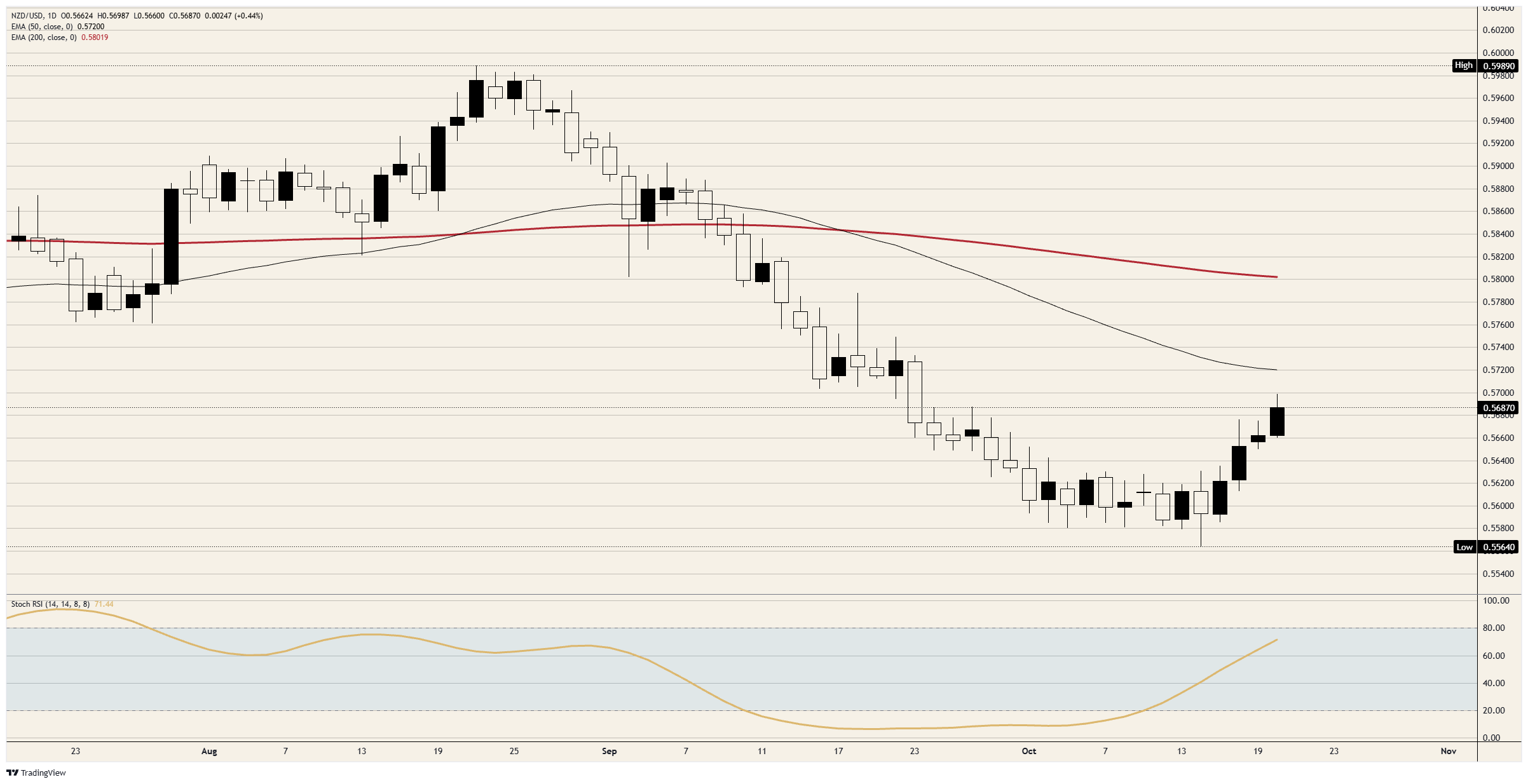
A fourth straight daily gain took NZD/USD to its highest since September 23 on Tuesday. It rose from just above 0.5650 to just under 0.5700 and ended near that level, about 135 pips above the October 14 low that was its lowest since April 2025.
Swaps price about an 80% chance that the Reserve Bank of New Zealand (RBNZ) raises its 2.75% Official Cash Rate (OCR) to 3.00% on October 28. Fed futures price a hold the same day at about 83%. Wednesday's Consumer Price Index (CPI) is the last before that decision, and its 0.8% quarterly forecast is the RBNZ's own projection to the decimal.
Crude Oil fell on Tuesday, and New Zealand has bought all its refined fuel abroad since its only refinery shut in 2022. The annual trade deficit widened to NZD $6.18 billion in September from $5.61 billion, so cheaper fuel trims the bill New Zealand has to pay for in foreign currency.
On the calendar
Stats NZ releases third-quarter CPI at 21:45 GMT on Wednesday, with annual inflation forecast at 3.8% after 4.1%, a tenth under the RBNZ's 3.9% projection. A figure under that projection bears on whether the October 28 hike still goes ahead.
The US weekly jobless claims count, due Thursday at 12:30 GMT, is forecast to rise to 200K from 199K. Friday's S&P Global and University of Michigan surveys, at 13:45 GMT and 14:00 GMT, close out the US week before the Fed's own October 28 decision.
On the charts
The 50-day Exponential Moving Average (EMA) is about 20 pips above Tuesday's high, with the 200-day EMA near 0.5800. The climb off its October 14 low has recovered almost a third of the drop from just under 0.6000 in August.
NZD/USD daily chart
New Zealand Dollar FAQs
The New Zealand Dollar (NZD), also known as the Kiwi, is a well-known traded currency among investors. Its value is broadly determined by the health of the New Zealand economy and the country’s central bank policy. Still, there are some unique particularities that also can make NZD move. The performance of the Chinese economy tends to move the Kiwi because China is New Zealand’s biggest trading partner. Bad news for the Chinese economy likely means less New Zealand exports to the country, hitting the economy and thus its currency. Another factor moving NZD is dairy prices as the dairy industry is New Zealand’s main export. High dairy prices boost export income, contributing positively to the economy and thus to the NZD.
The Reserve Bank of New Zealand (RBNZ) aims to achieve and maintain an inflation rate between 1% and 3% over the medium term, with a focus to keep it near the 2% mid-point. To this end, the bank sets an appropriate level of interest rates. When inflation is too high, the RBNZ will increase interest rates to cool the economy, but the move will also make bond yields higher, increasing investors’ appeal to invest in the country and thus boosting NZD. On the contrary, lower interest rates tend to weaken NZD. The so-called rate differential, or how rates in New Zealand are or are expected to be compared to the ones set by the US Federal Reserve, can also play a key role in moving the NZD/USD pair.
Macroeconomic data releases in New Zealand are key to assess the state of the economy and can impact the New Zealand Dollar’s (NZD) valuation. A strong economy, based on high economic growth, low unemployment and high confidence is good for NZD. High economic growth attracts foreign investment and may encourage the Reserve Bank of New Zealand to increase interest rates, if this economic strength comes together with elevated inflation. Conversely, if economic data is weak, NZD is likely to depreciate.
The New Zealand Dollar (NZD) tends to strengthen during risk-on periods, or when investors perceive that broader market risks are low and are optimistic about growth. This tends to lead to a more favorable outlook for commodities and so-called ‘commodity currencies’ such as the Kiwi. Conversely, NZD tends to weaken at times of market turbulence or economic uncertainty as investors tend to sell higher-risk assets and flee to the more-stable safe havens.
Author

Joshua Gibson
FXStreet
Joshua joins the FXStreet team as an Economics and Finance double major from Vancouver Island University with twelve years' experience as an independent trader focusing on technical analysis.