SpaceX's earnings don't matter. What they unlock does

The Elon Musk-founded SpaceX (SPCX) reports third-quarter results after Tuesday's session. The figure that decides the next month for the stock isn't in them. On Thursday, the second full trading day after the release, up to 1.3 billion shares held by employees and early investors become eligible for sale.
That is the largest single release under the lockup, the agreement that has stopped insiders selling since the June 12 listing. The stock has gone from the $135 offer price to above $225, down to near $105 and back to the mid-$140s in four months.
Six earlier releases, up to 2.27 billion shares in all, happened on the way without breaking it. Thursday's is bigger than all six combined, and the largest buyer on the other side is a group of index funds that were obliged to add the stock in July.
A lockup that opens on earnings dates, not calendar dates
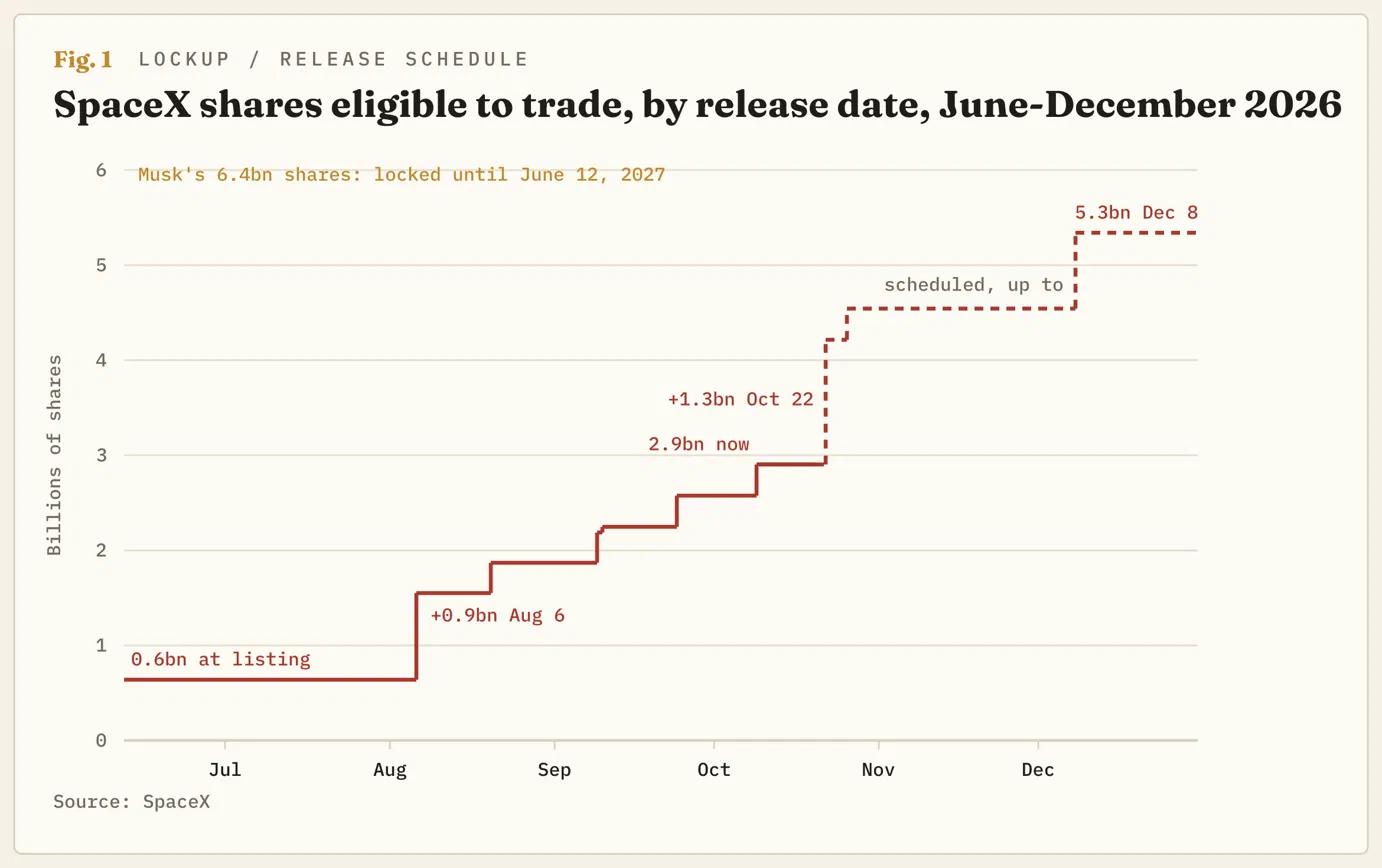
Most lockups end on one day. SpaceX's runs 180 days to December 8 and opens in stages keyed to the company's own results, which is why a quarterly report moves the share count. Up to 20% of the locked shares, 912 million, came free two trading days after the first report in August. Another 10% that required the stock to be 30% above the offer price never came free. Slices of 7%, between 319 million and 328 million shares each, followed on August 20, September 9, September 24 and October 9.
Thursday's release is 28% of the pool, 1.3 billion, and it carries no price condition. A final 7% can trade from October 26. Whatever is still restricted, about 798 million shares, comes free on December 8. Musk's own holding, up to 6.4 billion shares, is locked until June 12, 2027, with no early release, which is why his promise on Monday to give a share to every child in America is dated next year. On the prospectus figures, roughly 22% of the company's 13.2 billion shares can trade now, about 32% after Thursday, 34% after October 26 and 40% after December 8.
Six releases, one seller on file
The six release days so far produced moves of +6.1%, -4.0%, -3.9%, +0.4%, -0.2% and +1.2%. Over the period, the stock rose roughly a third from its August low. The first and largest release, on August 6, saw a 13.6% fall on the first report, followed by a 15.8% rise the next day. The October 9 release was followed by a 10% slide over five sessions, during the week the Nasdaq Composite posted its worst weekly loss since June.
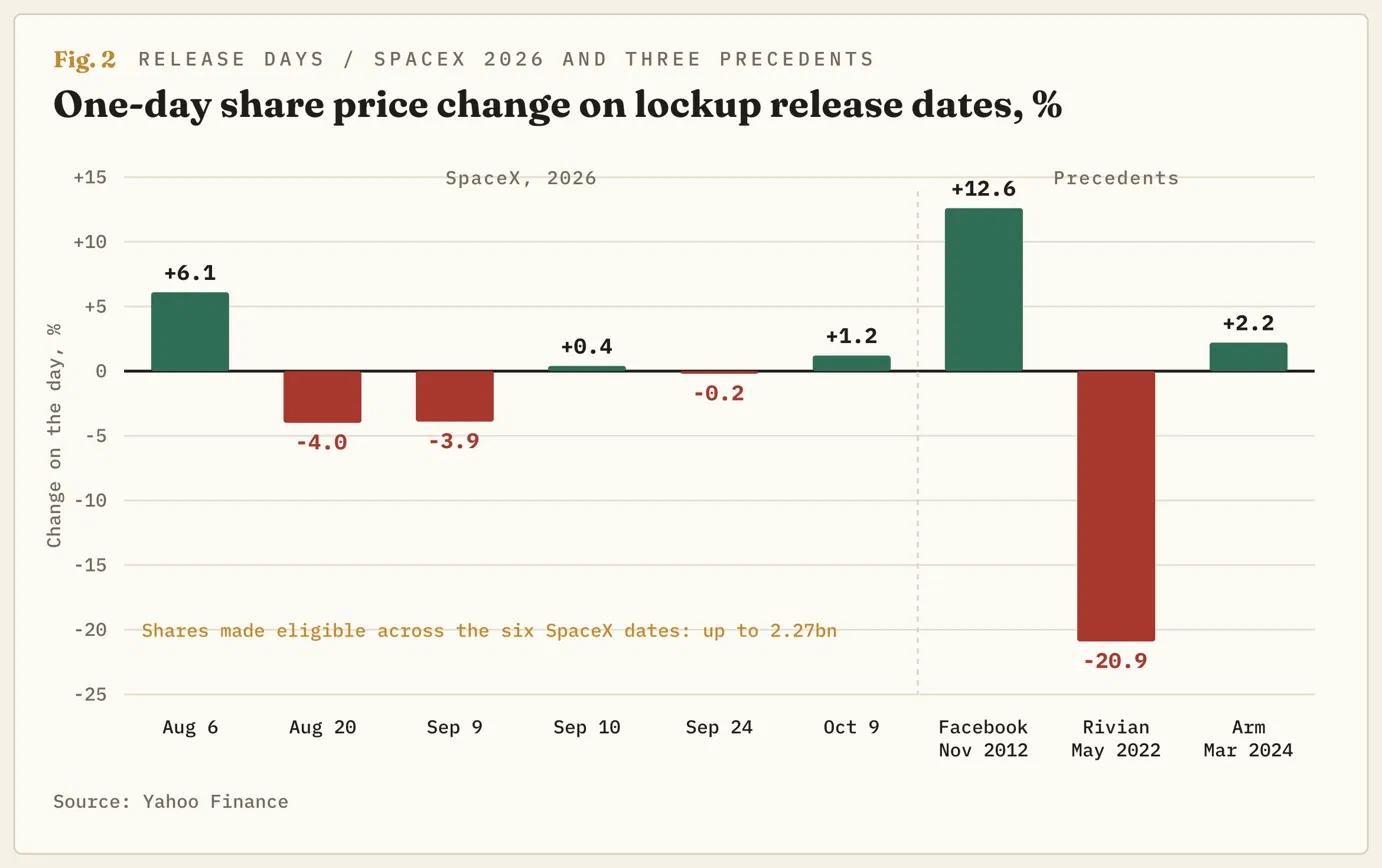
Eligibility is not selling. Up to 2.27 billion shares have been made eligible since August, and the insider filings show one sale: President Gwynne Shotwell's 342K shares in September under a pre-arranged plan. The precedents say the day is decided by whether a large holder actually sells, not by how many could. Facebook, now Meta Platforms (META), rose 12.6% on its November 2012 release of about 800 million shares. Rivian (RIVN) fell 21% in May 2022 because Ford (F) sold 8 million shares into the expiry. Arm (ARM) rose 2.2% in March 2024 because SoftBank, which owned about 90% of it, didn't.
Index funds buy what the insiders sell, two months later
SpaceX entered the NASDAQ-100 on July 7 under the index's fast-entry rule at a weight near 1%, far below its size. The index counts only shares available to trade (the float) and caps a company's count at three times that float. The September 21 rebalance, the quarterly reset of those counts, lifted the weight to 2.8% on Nasdaq's own projection. JPMorgan put the resulting purchases by index funds at about $15.5 billion. The shares freed on Thursday and on October 26 are counted at the November 30 reference date and bought for the December 21 rebalance.
On the index's formula, the cap stops binding once the float passes about 2.7 billion shares. The count then becomes the full 8.1 billion listed Class A shares, the publicly traded class, up from about 5.6 billion in September. That is roughly 44% more shares for the funds to hold and a weight near 4% at current prices. Nasdaq hasn't published a figure, but the direction isn't in doubt. Every share an insider sells this quarter adds to what the index funds are required to buy at the end of it.
The numbers that can change the story are the spending ones
Second-quarter revenue was $7.8 billion, up 92% on the year. Capital spending was $18.4 billion, $15.8 billion of it on artificial-intelligence data centres, so the company spent 2.4 times what it took in. Cash and securities were $100 billion after the $86 billion raised in the listing. The forecast for the third quarter is revenue near $12.9 billion and spending near $19.6 billion.
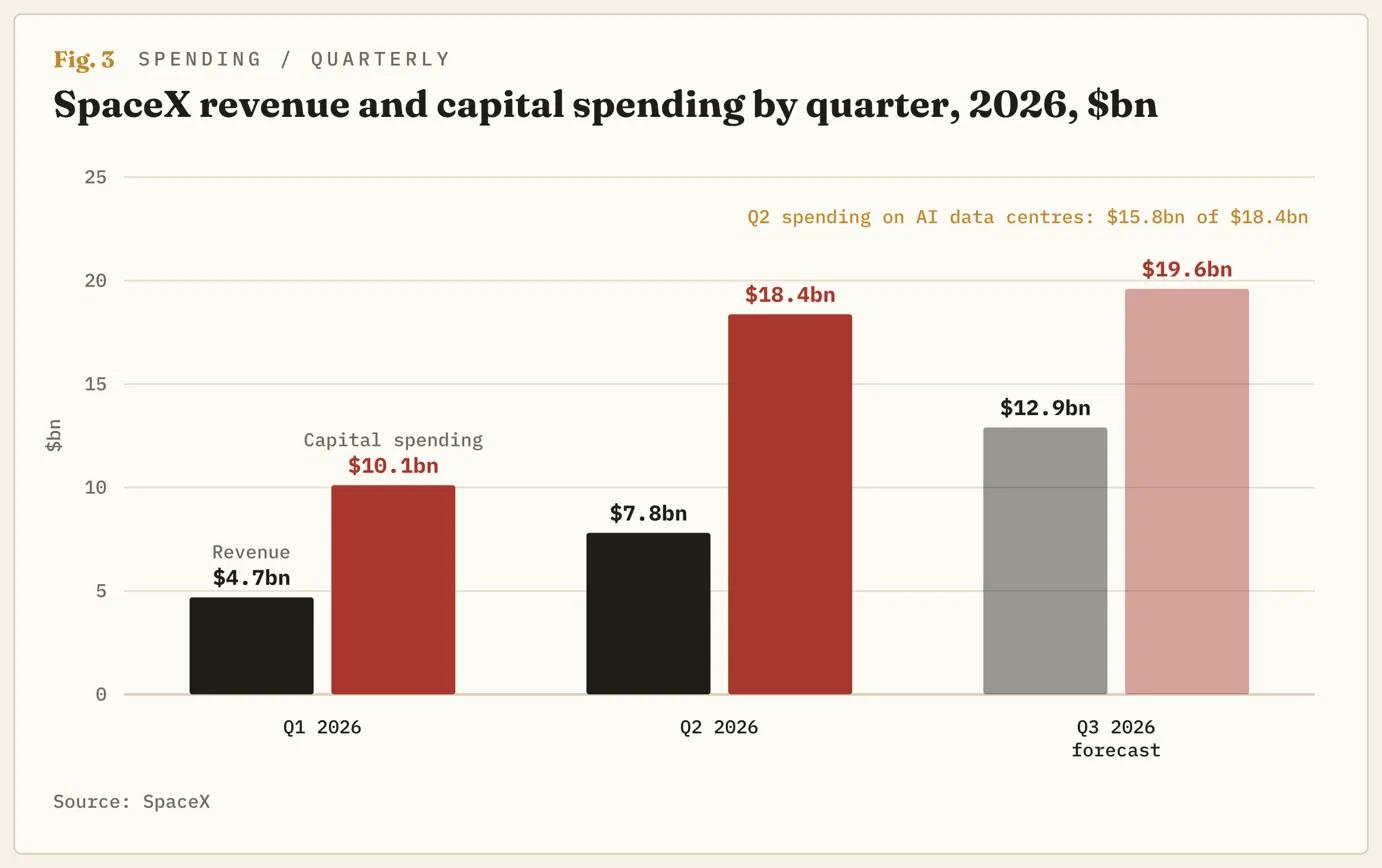
The August report beat on revenue, and the stock fell 13.6% the next day because the spending was about 40% above the forecast. Chief Financial Officer Bret Johnsen said on that call that spending in the next two quarters would look much like the second quarter's. That puts the listing proceeds at about four and a half quarters of it. So the report decides how long the cash lasts and whether 12 million Starlink subscribers can fund the data centres. It doesn't decide the share count, and the share count is what changes on Thursday.
Where the unlock gets priced
The stock has given back its early-October rise to the $170s and trades in the mid-$140s, below the $150 area it traded around through September. The daily Stochastic Relative Strength Index (Stoch RSI), a momentum gauge, is in the mid-40s and has drifted lower since early September, so the stock is stretched in neither direction ahead of the report. Since June, the pattern is a lower high below the June peak and a higher low above the August trough. The level that matters inside it is $135, the offer price.
The lean is that Thursday's release gets absorbed, because the buying scheduled for December is larger than the selling proven so far. Stay with the stock while it holds $135 on a closing basis after Thursday. A daily close below $135 in the week after the release says the insiders selling outnumber the funds that will buy, and the case is wrong. A close back above $150 undoes the October round trip and moves the question to December 8, the final release, and December 21, when the index funds buy.
Author

Joshua Gibson
FXStreet
Joshua joins the FXStreet team as an Economics and Finance double major from Vancouver Island University with twelve years' experience as an independent trader focusing on technical analysis.