Intel Stock Earnings and Forecast: INTC advances 4% on Tower Semi news
- Intel lost less money than expected in Q1
- INTC stock rose 4% on news.
- CEO Pat Gelsinger says Tower Semi talks 'positive'.
- Q2 revenue guidance slightly above consensus.
Intel (INTC) stock has moved up 4.3% in Friday's premarket after the legacy chipmaker lost less money that Wall Street expected in the first quarter. INTC shares initially sold off on Thursday's post-market release, but news that CEO Pat Gelsinger received positive vibes from Chinese regulators on the company's hopeful Tower Semi (TSEM) acquisition pushed the stock up.
Shares are consolidating around $31.15 at the time of writing, even while NASDAQ 100, Dow and S&P 500 futures are drifting lower before the opening bell. The market is somewhat reticent about the Personal Consumption Expenditures data for March that comes out one hour before New York's opening bell.
Intel stock earnings news: Q2 adjusted EPS guidance flat
Intel reported an adjusted loss of $-0.04 per share in the first quarter, which was better than Wall Street's prediction of a $-0.15 loss. Intel saw revenue tank a miserable 36% YoY to $11.7 billion, but even this figure was nearly $600 million ahead of Wall Street's somber estimate.
“We hit key execution milestones in our data center roadmap and demonstrated the health of the process technology underpinning it," said CEO Pat Gelsinger. "While we remain cautious on the macroeconomic outlook, we are focused on what we can control as we deliver on IDM 2.0: driving consistent execution across process and product roadmaps and advancing our foundry business to best position us to capitalize on the $1 trillion market opportunity ahead.”
Management guided for a slight rebound in Q2 revenue between $11.5 and $12.5 billion, but guidance for flat adjusted EPS fell below consenus of a 2-cent profit. Gross margin is expected to fall further from Q1's 38.4% to 37.5% in Q2, which would amount to a 7.3% decline YoY.
In the first quarter, $458 million of Intel revenue came from Mobileye (MBLY), since Intel still retains a majority share in the autonomous vehicle technology company based in Israel.
First quarter revenue can be dissected with $5.8 billion from the Client Computing segment, $3.7 billion from the AI/data center segment and $1.5 billion from the Network & Edge segment. Intel's reinvigorated foundry business saw revenues tumble by a quarter YoY to $118 million. Overall, Client Computing sales dropped 38%, AI/data center saw a 39% dive, and Network & Edge had sales that declined 30% YoY. The stock may be up on the fact that it was better than expected, but make no mistake – it was a truly rotten quarter for Intel. Shares are only rising because the apocalypse did not arrive and so shorts are closing their positions.
"As part of my recent trip to China, we continue to work hard to complete the Tower acquisition and will update you appropriately," Gelsinger said during the earnings call. Chinese regulators are expected to release their decision on Intel's $5.4 billion buyout offer in the next few weeks.
Intel stock forecast
Intel stock has leapt above the $31 resistance level that has roots back to last November and several sessions in between. The next challenge will be $33, where early April's surge met its demise. The R1 on the daily chart is currently at $35.39, while the pivot is placed at $30.18. This break above the pivot certainly places INTC stock on a bullish footing. Moreover, both the downtrending 9-day/21-day moving average dichotomy and the bearish Moving Average Convergence Divergence (MACD) indicator will be upended with this price action.
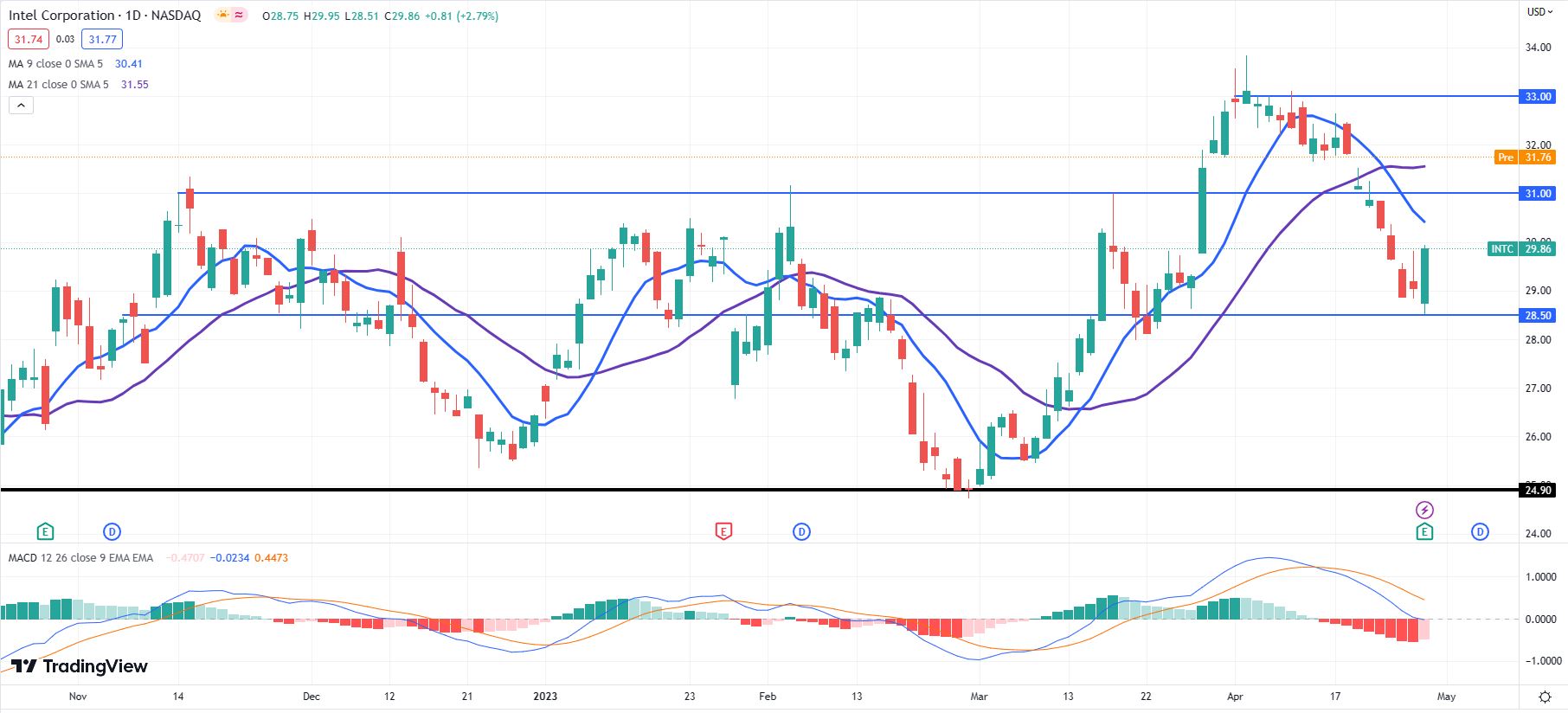
INTC daily chart
Author

Clay Webster
FXStreet
Clay Webster grew up in the US outside Buffalo, New York and Lancaster, Pennsylvania. He began investing after college following the 2008 financial crisis.
















