|

IIFL Finance Elliott Wave analysis: Wave (2) correction nears completion, bullish rally ahead

IIFL Finance (NSE: IIFL) shows a corrective Elliott Wave pattern (2) with key support at ₹370.10. A potential bullish wave (3) rally may follow soon.

IIFL Finance Ltd (NSE: IIFL) continues to follow a well-defined Elliott Wave structure, suggesting the stock is undergoing a corrective phase before resuming its larger bullish trend. After completing wave (1) at the recent high, the stock is currently in wave (2), which is unfolding as a double three corrective pattern (W)-(X)-(Y).

The initial leg lower, wave W, has already completed, followed by a smaller recovery in wave X. The ongoing decline appears to be part of wave Y, which could ideally extend toward the 1.0 Fibonacci extension level around ₹370.10, marking equal legs before a potential reversal.
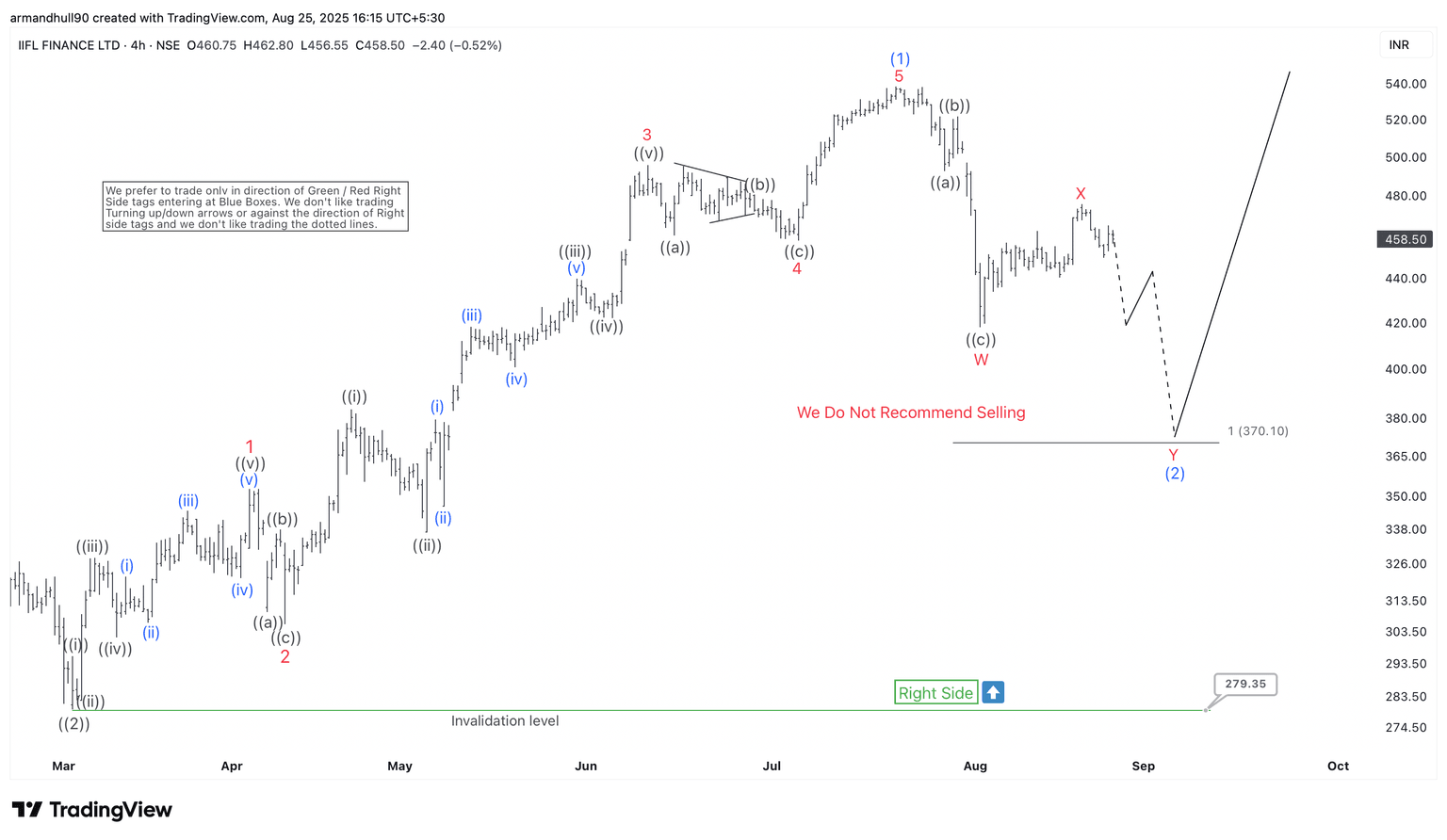
Despite this correction, the bigger picture stays bullish. The right-side tag shows a higher probability for upward movement. We do not recommend selling during this pullback. Instead, traders should wait for wave (2) to complete and prepare for a potential wave (3) rally. This next bullish wave can lead to new highs if the structure holds.

The invalidation level for this outlook is ₹279.35. If the price stays above this point, the current decline remains corrective. Pullbacks can then create buying opportunities once signs of a reversal appear.

Summary:

In summary, IIFL Finance is likely in the final stages of its wave (2) correction within a broader bullish cycle. Traders and investors should stay patient, avoid shorting, and prepare for a possible continuation higher once the corrective structure completes.

Author

Elliott Wave Forecast Team

Elliott Wave Forecast Team

ElliottWave-Forecast.com

More from Elliott Wave Forecast Team
Share:

Markets move fast. We move first.

Orange Juice Newsletter brings you expert driven insights - not headlines. Every day on your inbox.

By subscribing you agree to our Terms and conditions.

Editor's Picks

EUR/USD eases toward 1.1700 as USD finds fresh demand

EUR/USD eases toward the 1.1700 mark in Europe trading on Friday. The pair faces headwinds from a renewed uptick in the US Dollar as investors look past softer US inflation data. However, the EUR/USD downside appears capped by expectations of the Fed-ECB monetary policy divergence. 

GBP/USD steadies below 1.3400 as traders digest BoE policy update and US inflation data

The GBP/USD pair stalls the previous day's pullback from the vicinity of mid-1.3400s and a nearly two-month high, though it struggles to attract meaningful buyers during the Asian session on Friday. Spot prices currently trade around the 1.3380-1.3385 region, up only 0.05% for the day, amid mixed cues.

Gold stays weak below $4,350 as USD bulls shrug off softer US CPI

Gold holds the previous day's late pullback from the vicinity of the record high and stays in the red below $4,350 in the European session on Friday. The US CPI report released on Thursday pointed to cooling inflationary pressures, but the US Dollar seems resilient amid a fresh bout of short-covering.

Bitcoin, Ethereum and Ripple correction slide as BoJ rate decision weighs on sentiment

Bitcoin, Ethereum, and Ripple are extending their correction phases after losing nearly 3%, 8%, and 10%, respectively, through Friday. The pullback phase is further strengthened as the upcoming Bank of Japan’s rate decision on Friday weighs on risk sentiment, with BTC breaking key support, ETH deepening weekly losses, and XRP sliding to multi-month lows.

How much can one month of soft inflation change the Fed’s mind?

One month of softer inflation data is rarely enough to shift Federal Reserve policy on its own, but in a market highly sensitive to every data point, even a single reading can reshape expectations. November’s inflation report offered a welcome sign of cooling price pressures. 

Ethereum Price Forecast: EF outlines ways to solve growing state issues

Ethereum price today: $2,920. The EF noted that Ethereum's growing state could lead to centralization and weaken censorship resistance. The Stateless Consensus team outlined state expiry, state archive and partial statelessness as potential solutions to the growing state load.