How will China GDP affect the price of AUD/USD?

The main event of the session is due at the top of the hour with the Chinese data dump that will include Gross Domestic Product readings for the third quarter. With the nation's property sector and energy crisis, the economy is under scrutiny for fears of global contagion. This makes the reading an important one for forex today, specifically, the Australian dollar which has enjoyed a surge in Aussie yields at the start of the week following the New Zealand Consumer Price Index upside surprise.
GDP is expected to only edge 0.4% higher, seeing the annual rate drop sharply from 7.9% in Q2 to around 5.0%. Analysts at Westpac explained that the underlying this result will be the proactive approach taken by authorities to stop delta’s spread within China, which hit consumption hard, and weaker momentum in construction and investment.
Meanwhile, in a note on Friday, analysts at TD Securities stressed that the ''supply constraints, extreme weather, regulatory measures, and environmental policies likely led to a further slowing in manufacturing activity in Sep.''
Also out today is September data for Retail Sales (f/c 3.5%yr), Industrial Production (f/c 3.8%yr) and fixed asset investment. ''Retail spending is likely to fare better given the rebound in the services PMI, as activity restrictions were lifted in many provinces and domestic tourism picked up. However, a high base last year will limit gains,'' analysts at TD Securities argued.
How might the data affect AUD/USD?
AUD is a trade-off between external factors for the near-term directly impacting the economic landscape for the now and medium-term and risk-sentiment on the flipside. Risk sentiment, when elevated, such as what we saw on Friday, owing to US Retail Sales and strong earnings results, is supportive of the Aussie.
With that being said, Australia stands to lose a great deal in the face of a Chinese economic collapse as its main source of export income. Data today will reflect the state of the Chinese economy vs projections that have been dialled back in recent weeks owing to the Evergrande Gray Rhino event that has sent shivers down the spine of the financial markets.
In technical analysis, we are seeing hidden bearish divergence again from a daily perspective as follows:
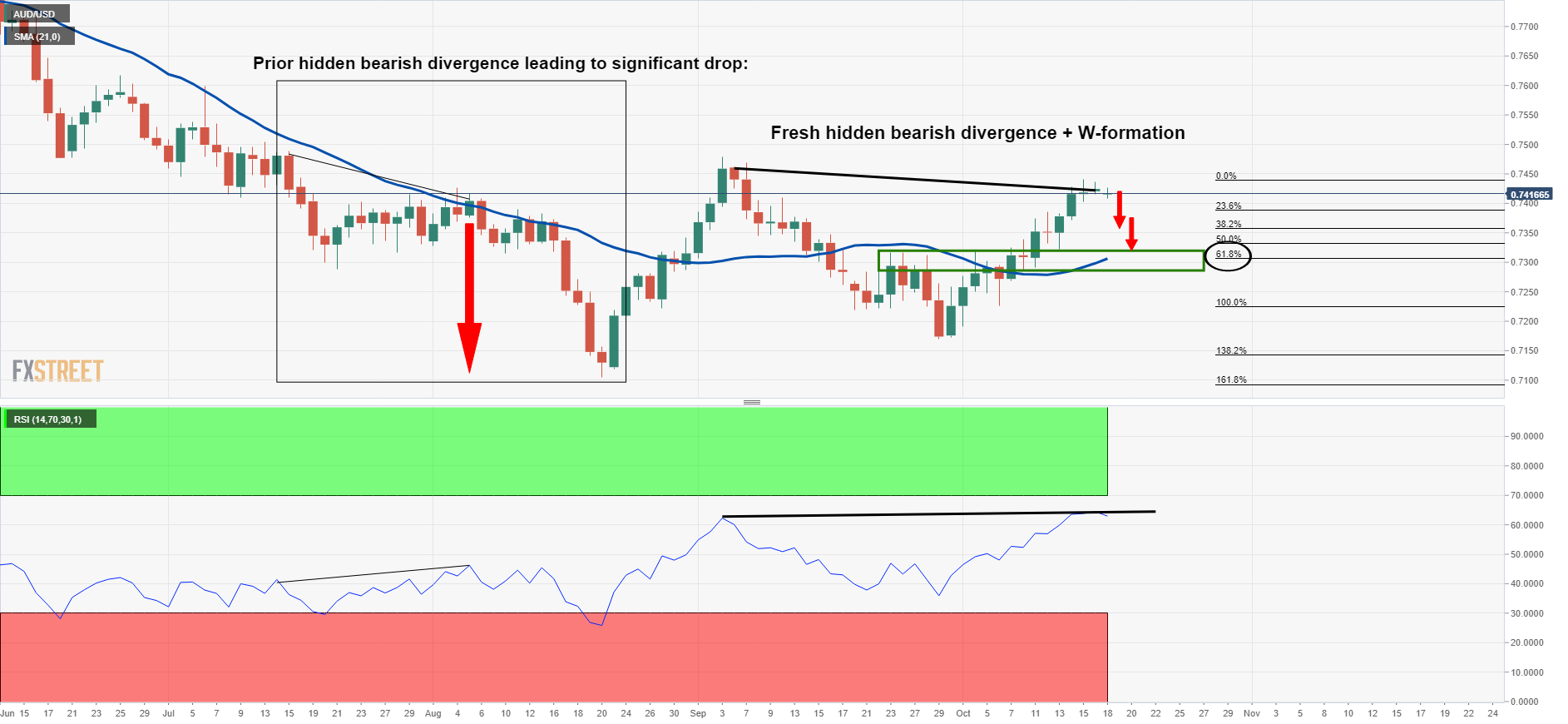
Should the Chinese data really disappoint, there is a probability that it will be the catalyst to send the Aussie lower on its way towards a test of the W-formation's neckline for the days ahead. There is a confluence of the W-formation, as a reversion pattern and bearish, the 61.8% golden ratio target that meets the 21-day moving average at the neckline near 0.73 the figure.
For the very near term, 0.7390 will be eyed on a poor outcome from an hourly basis:
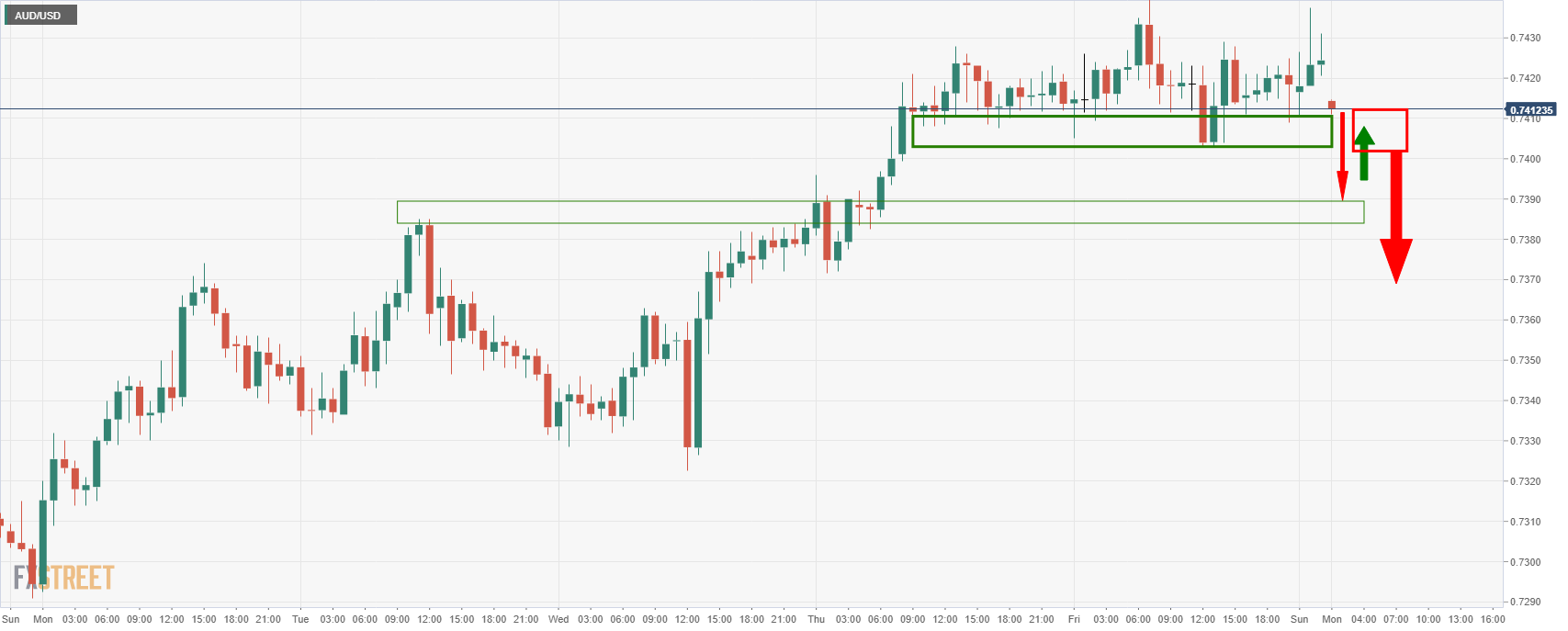
If the data surprises on the upside, then the recent spike in Aussie yields should help to elevate the currency higher towards 0.7480 and the daily highs of August.
About GDP
The Gross Domestic Product (GDP) released by the National Bureau of Statistics of China studies the gross value of all goods and services produced by China. The indicator presents the pace at which the Chinese economy is growing or decreasing.
As the Chinese economy has an influence on the global economy, this economic event would have an impact on the Forex market. Generally speaking, a high reading is seen as positive (or bullish) for the CNY, while a low reading is seen as negative (or Bearish).
Author

Ross J Burland
FXStreet
Ross J Burland, born in England, UK, is a sportsman at heart. He played Rugby and Judo for his county, Kent and the South East of England Rugby team.